Posts

2025 Study Architecture Student Showcase - Part XI

Architecture has the power to transform a space. In Part XI of the 2025 Study Architecture Student Showcase, we put a spotlight on revitalized spaces. These projects take their pre-existing sites and create new spaces that promote sustainability, community connection, accessibility, and resiliency. The transformed sites include naval bases, power plants, industrial sites, local landmarks, abandoned city centers, underserved neighborhoods, and more. Each project incorporates design, construction, policy, and infrastructure to reimagine new spaces that serve their communities. 

Take a closer look below!

The Greenest Building, The One That is Already Built by Audrey Barnhart, M.Arch ’25
Roger Williams University | Advisor: Rubén Alcolea

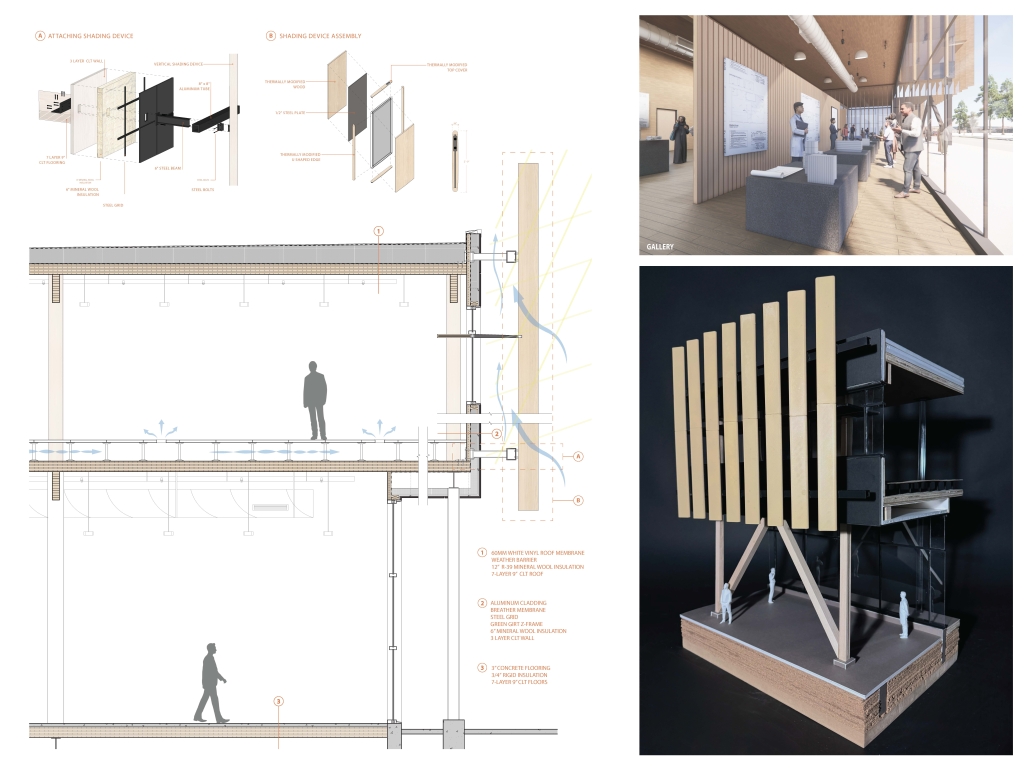
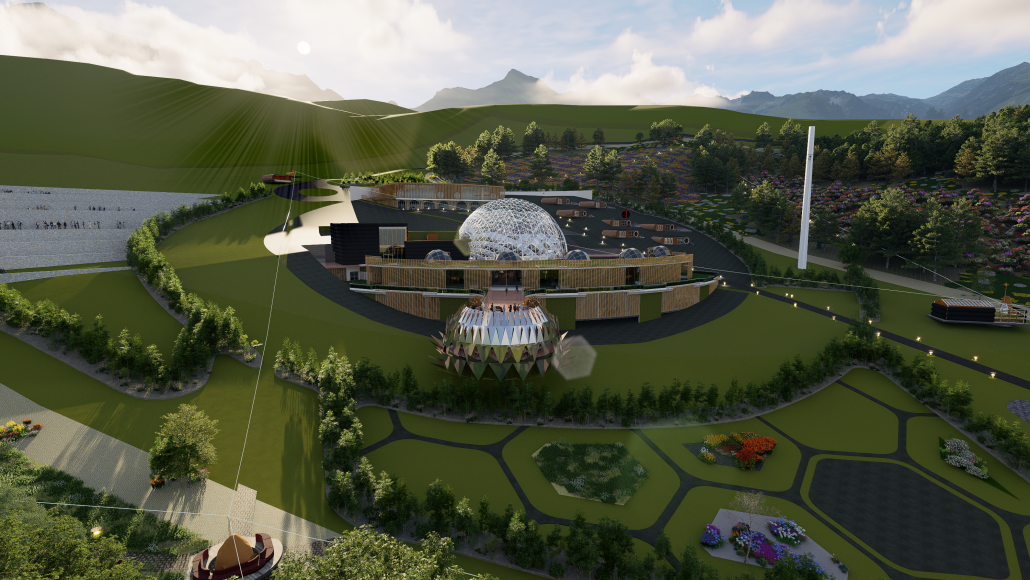
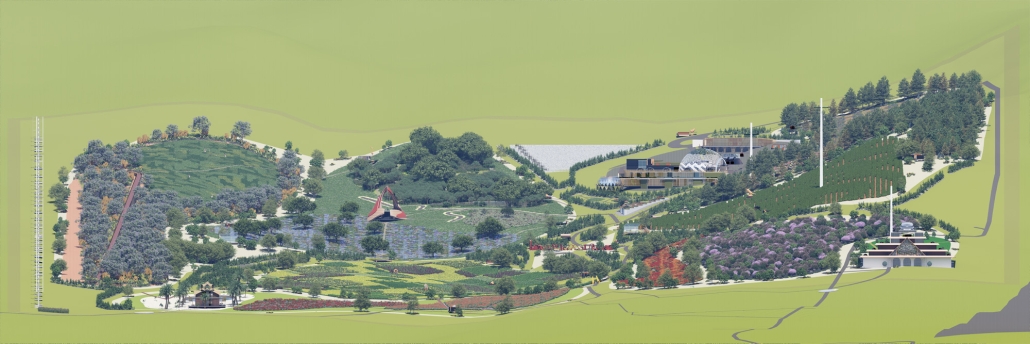
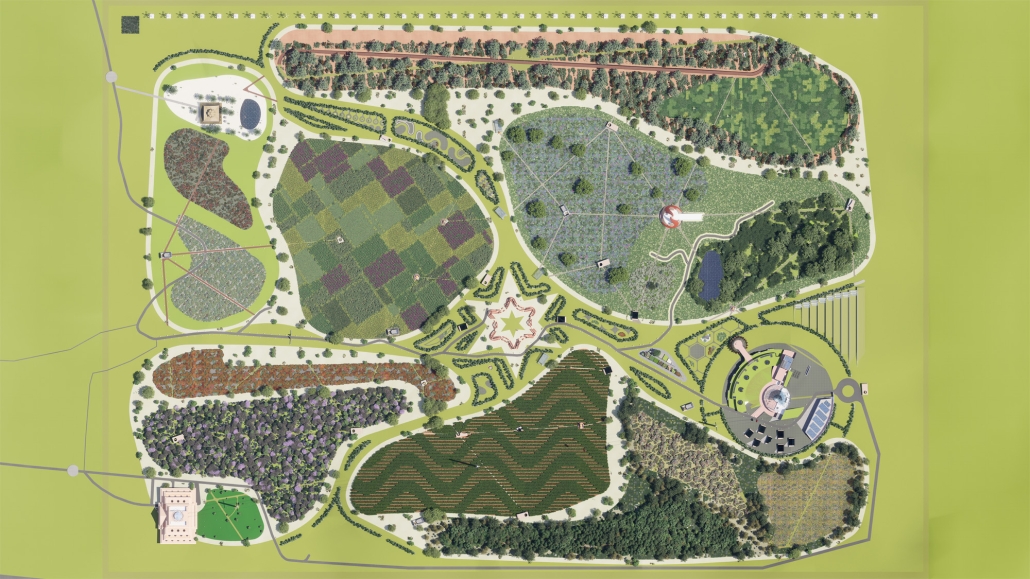
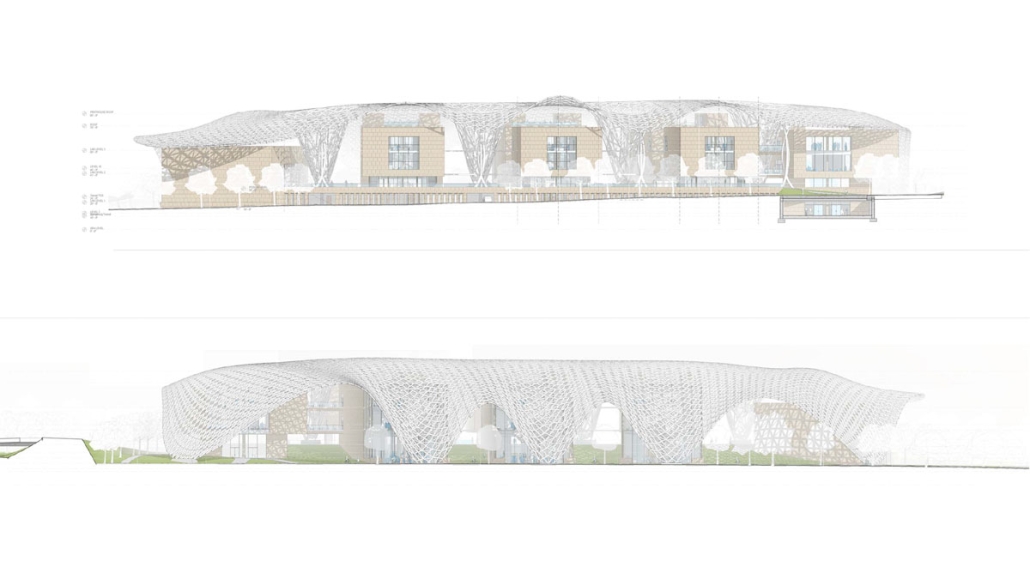
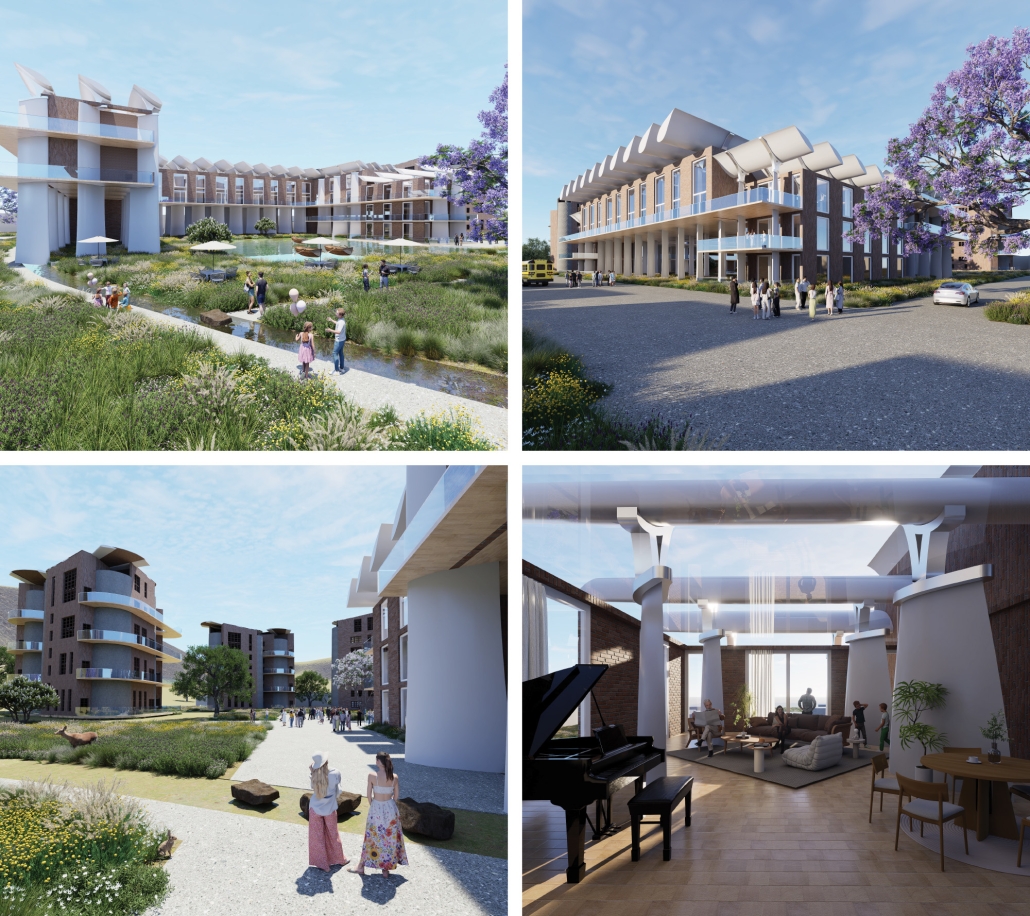
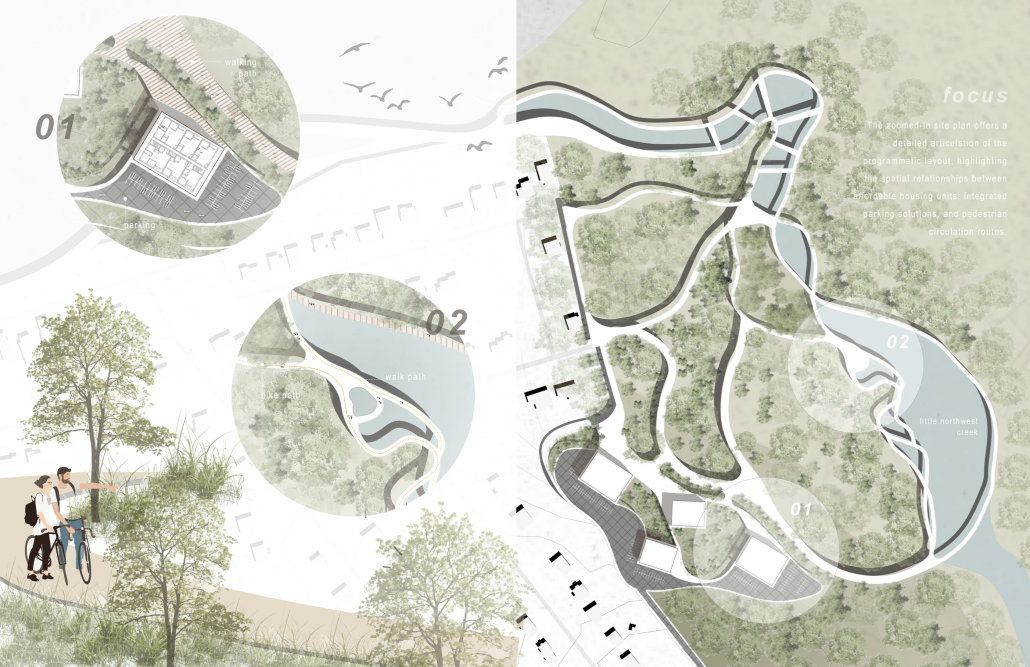
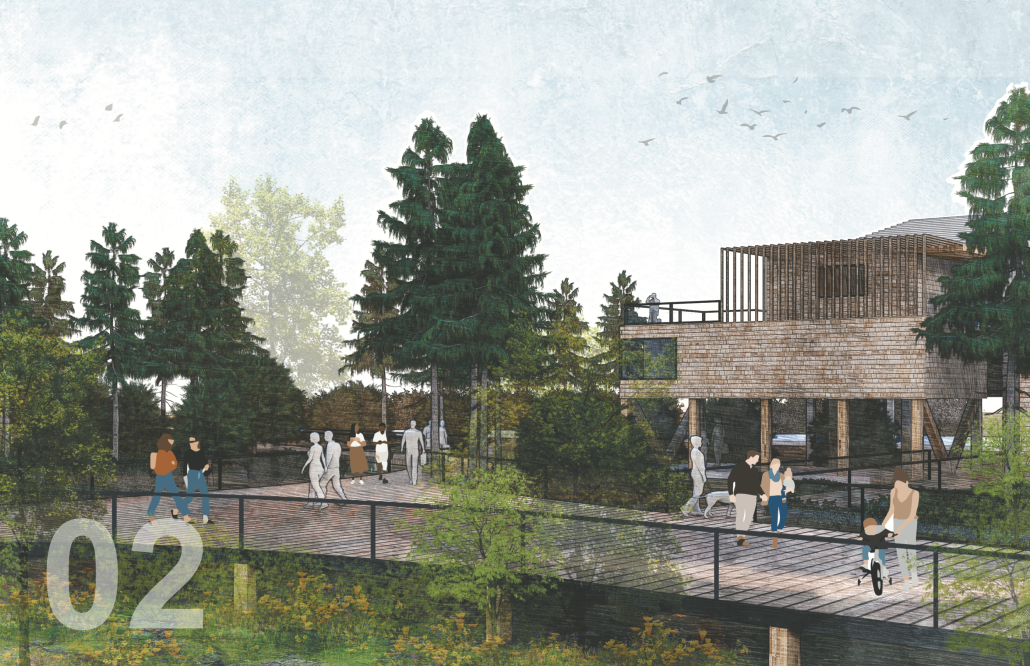
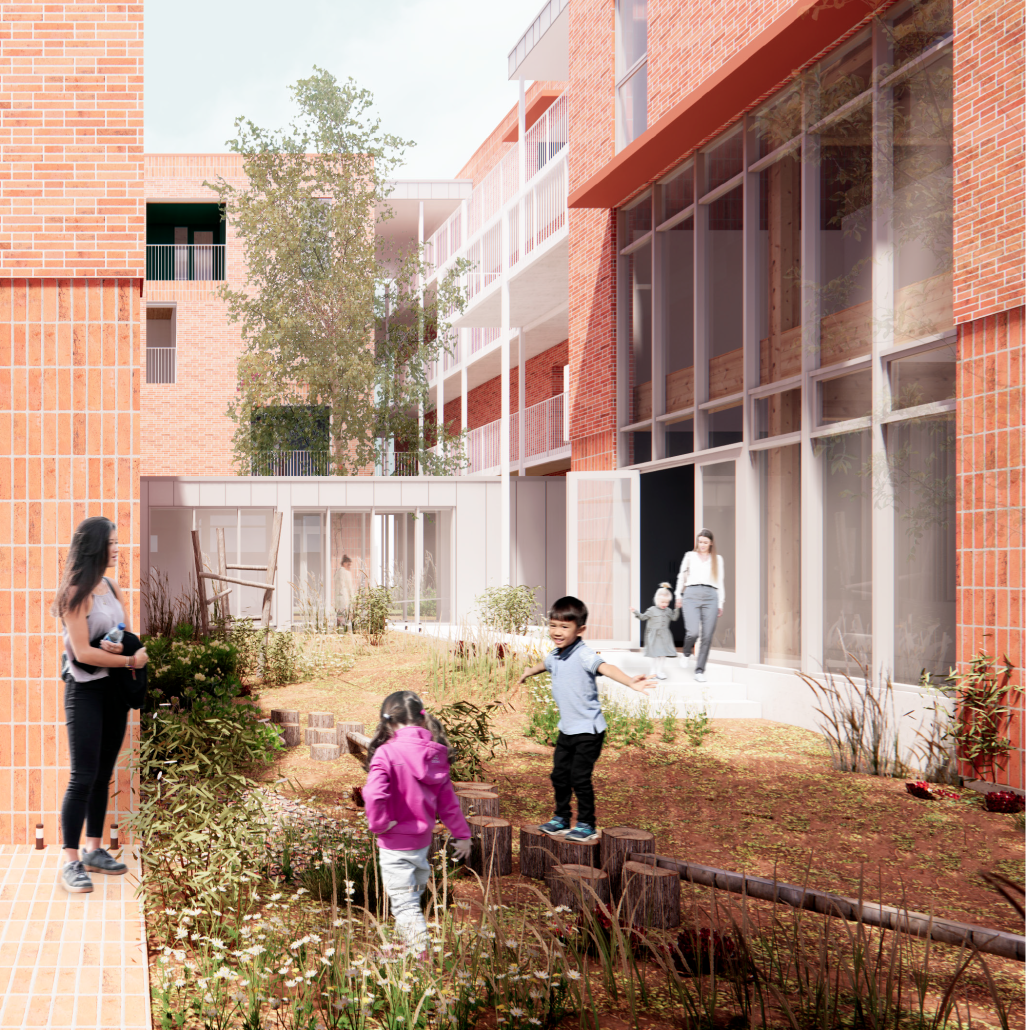
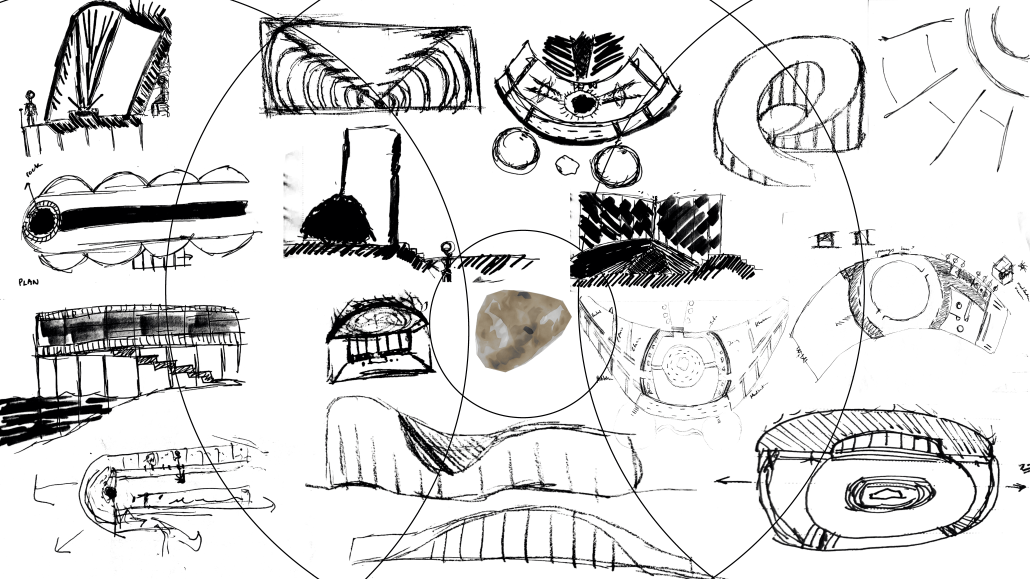
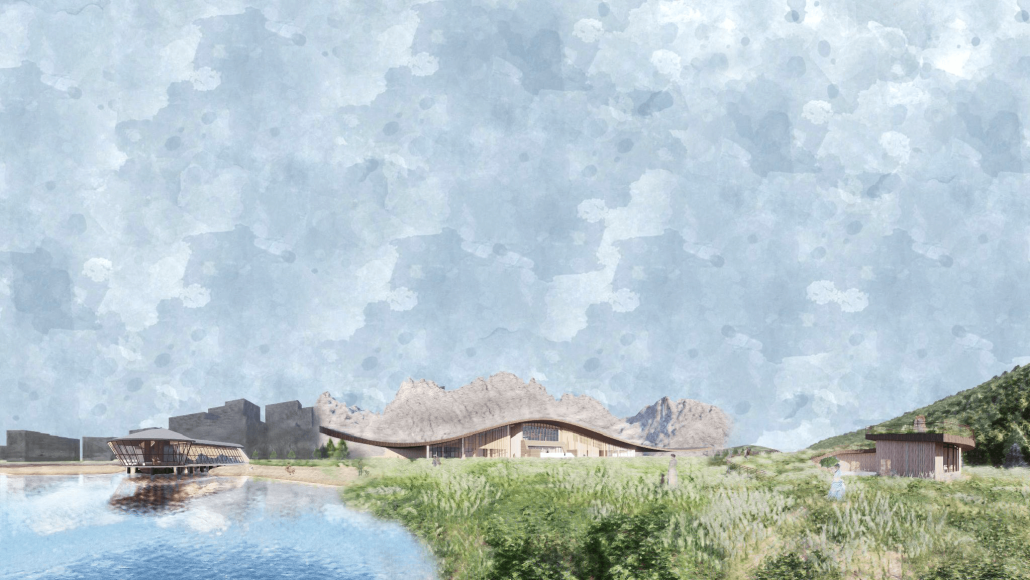
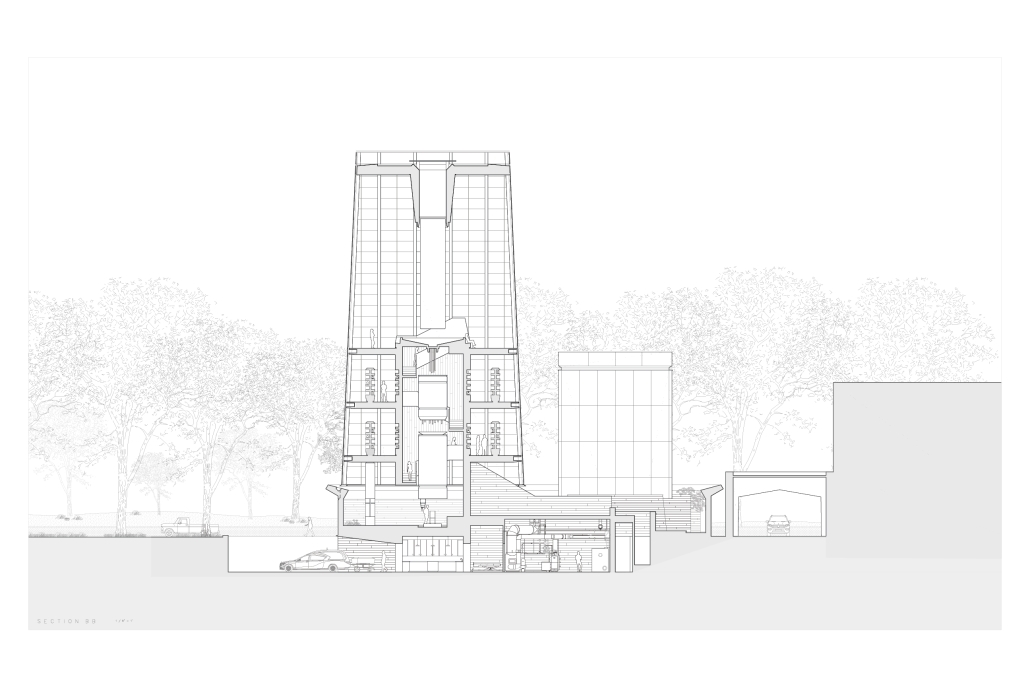
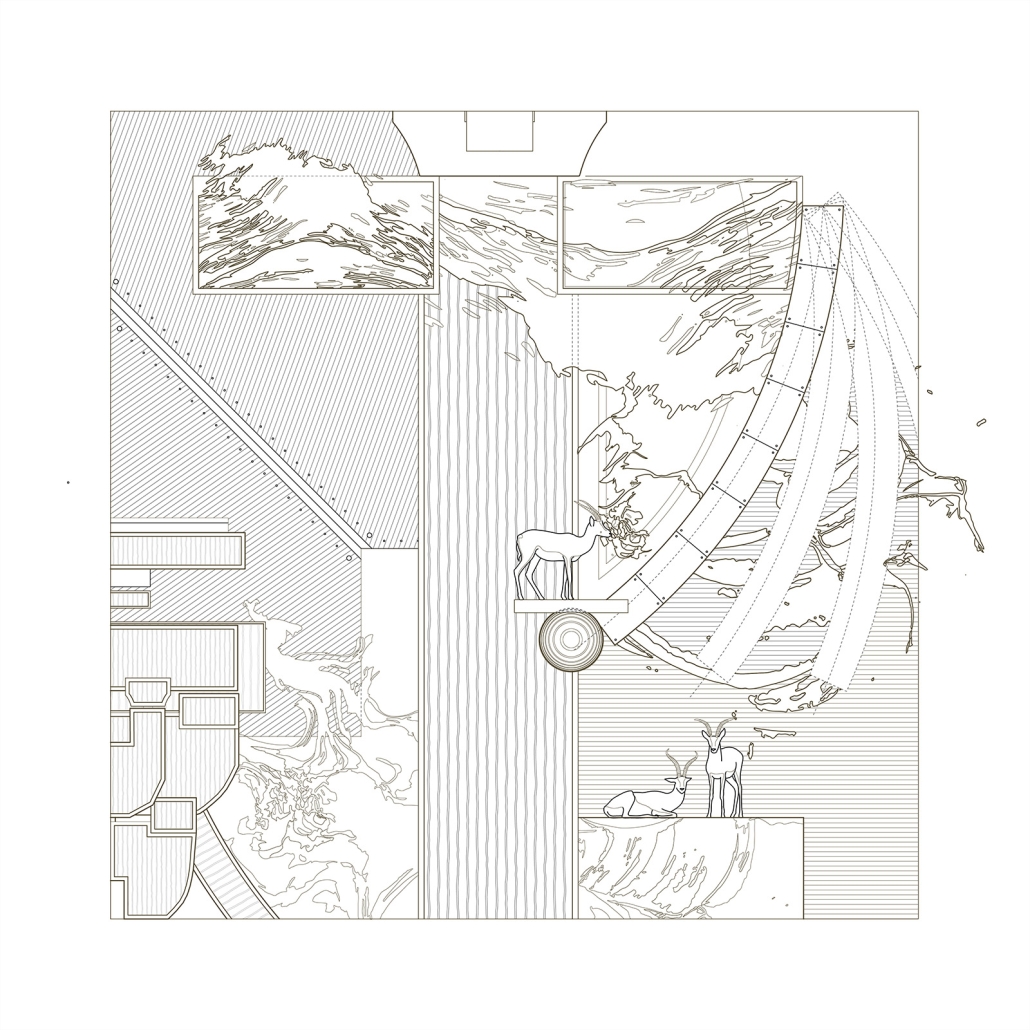
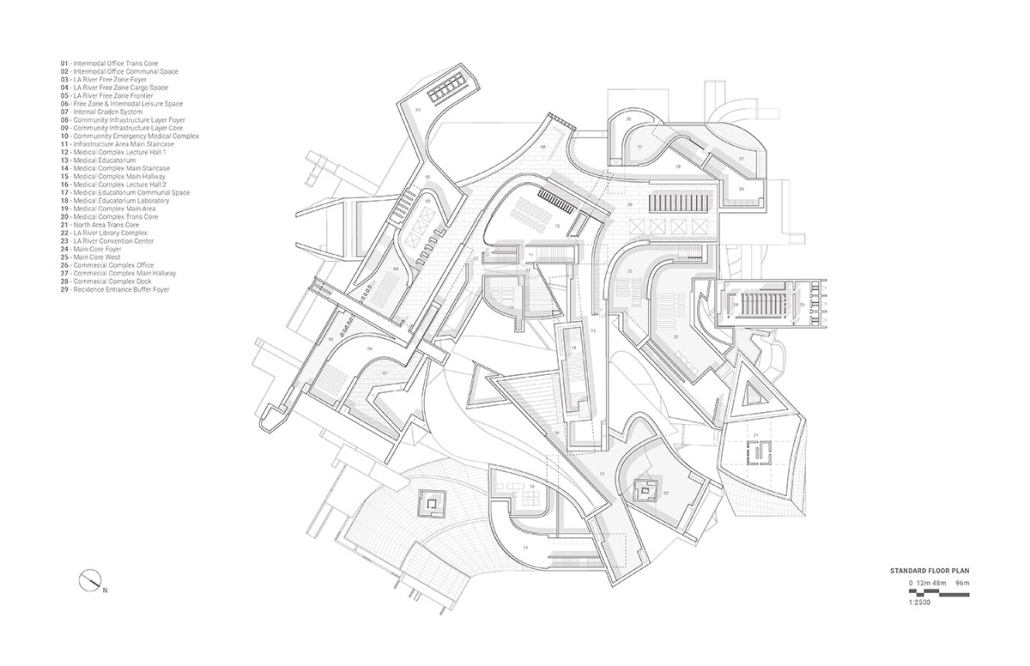
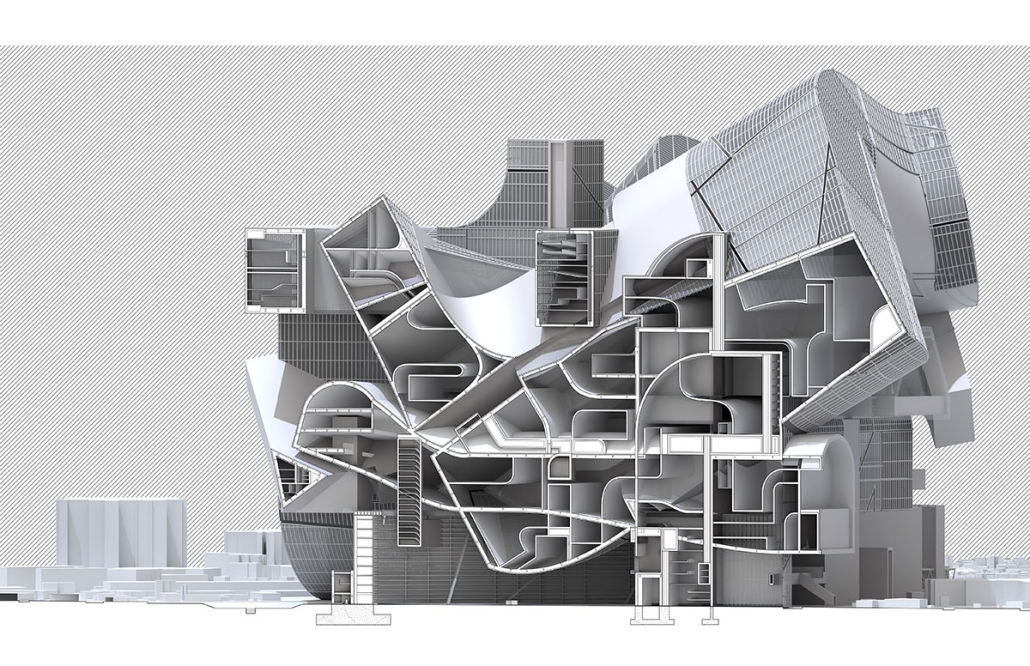
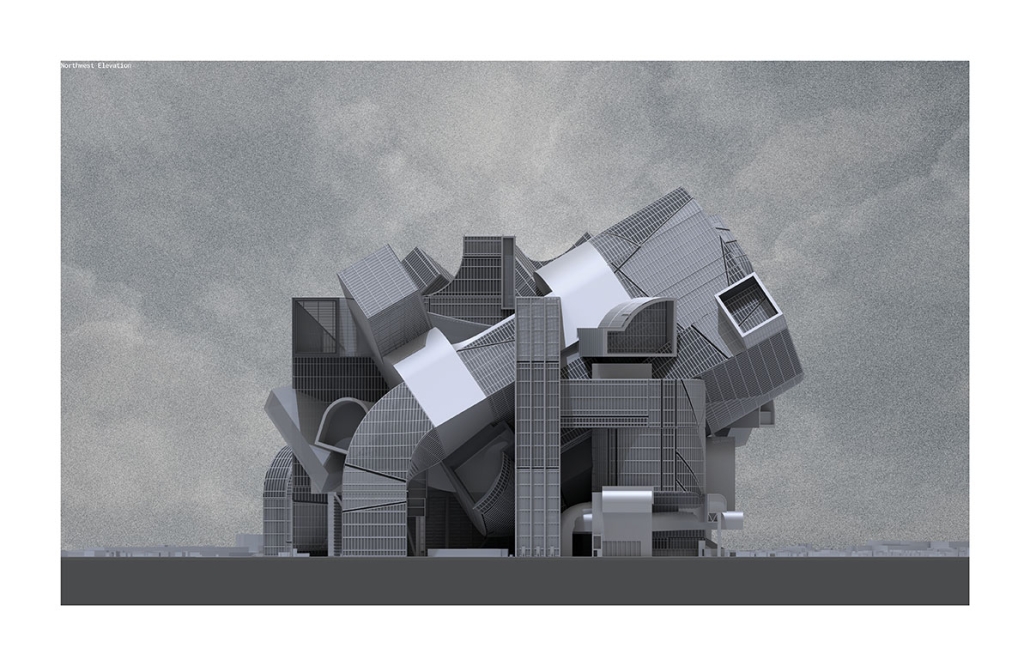
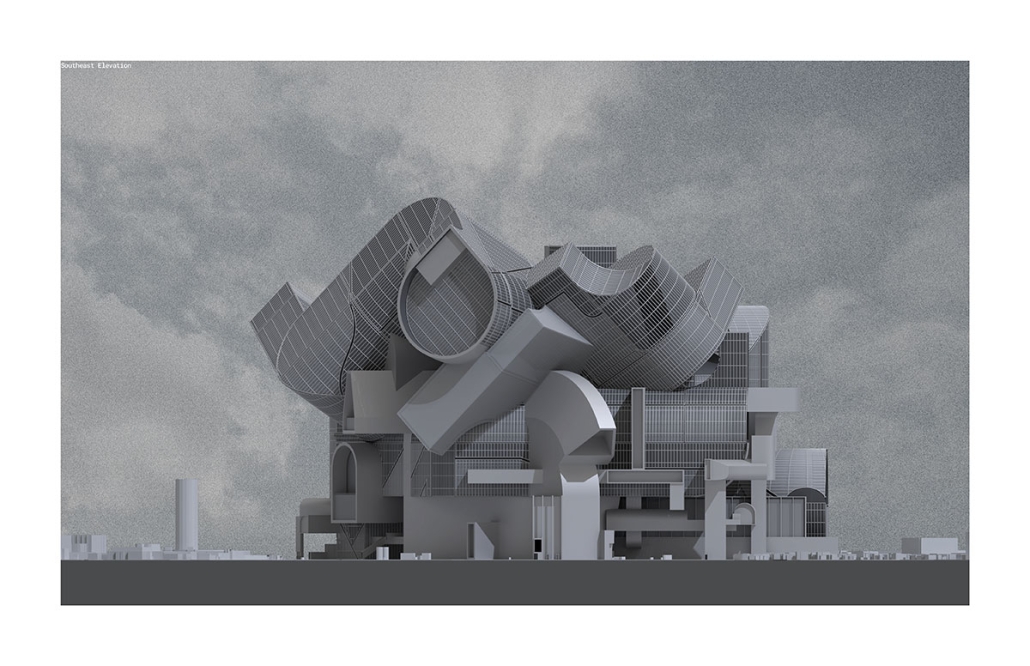
This thesis explores adaptive reuse and sustainability by transforming a retired coal-fired power plant into a conservation center. With over 300 decommissioned coal plants across the U.S., the project asks: Should these monumental industrial relics be demolished, or reimagined to serve communities once again? The selected site is located on Mare Island, California, a former naval base now undergoing revitalization. Positioned near polluted waters and existing conservation efforts, the site becomes a strategic place for ecological restoration.

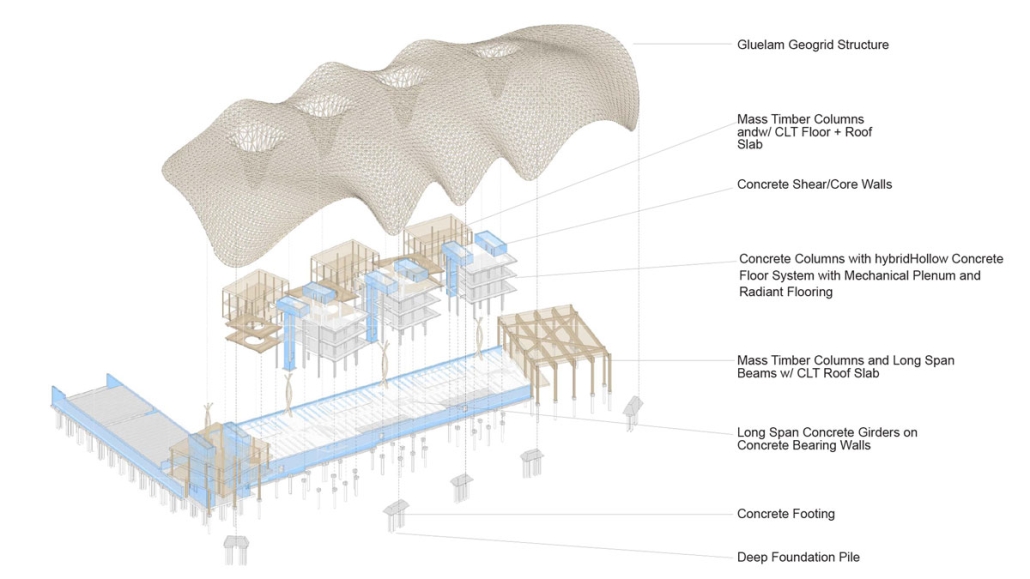
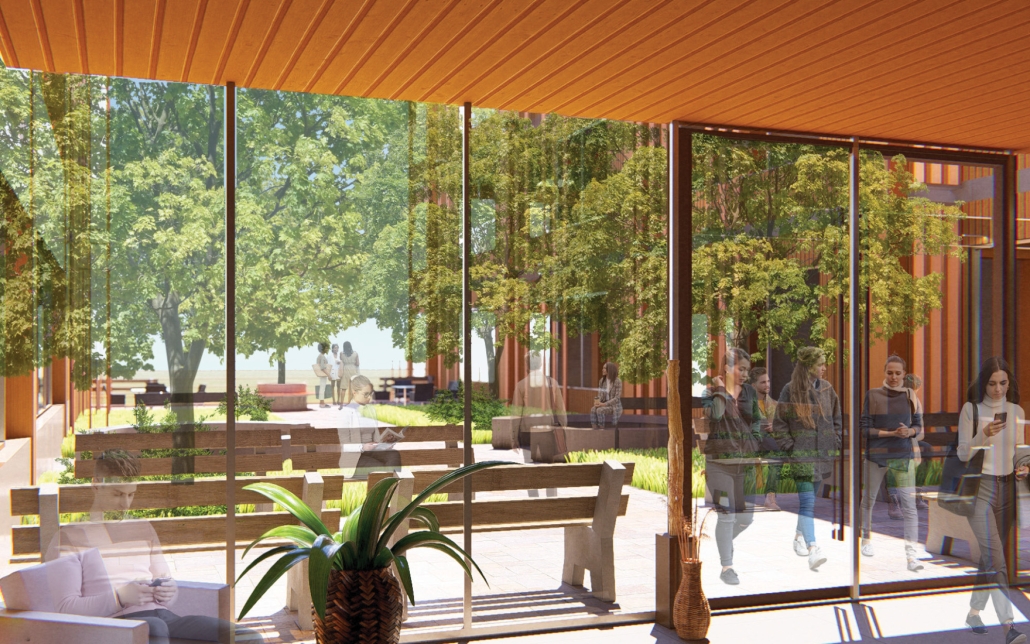
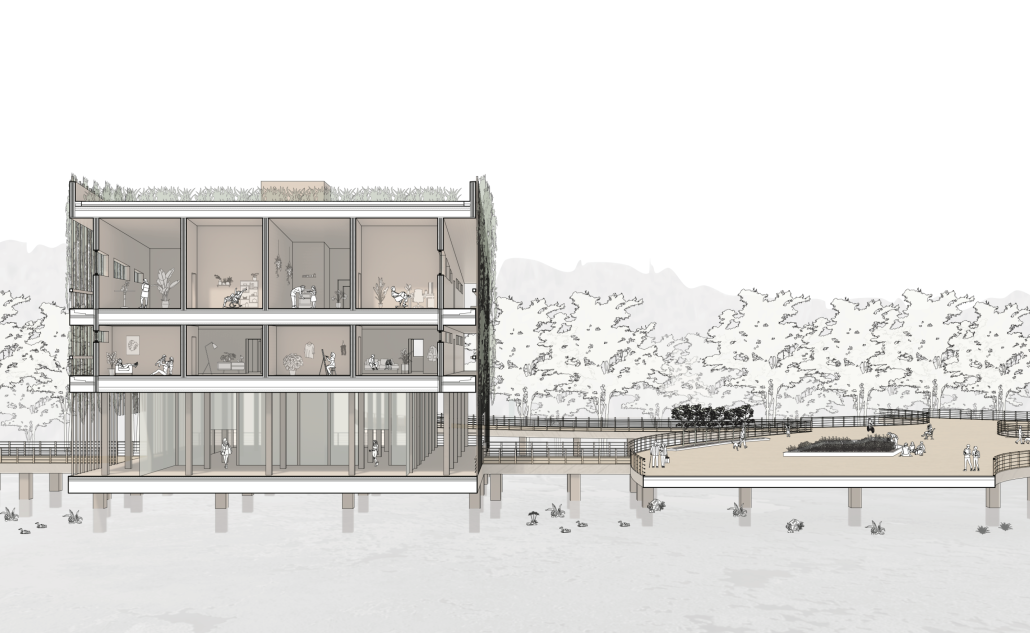
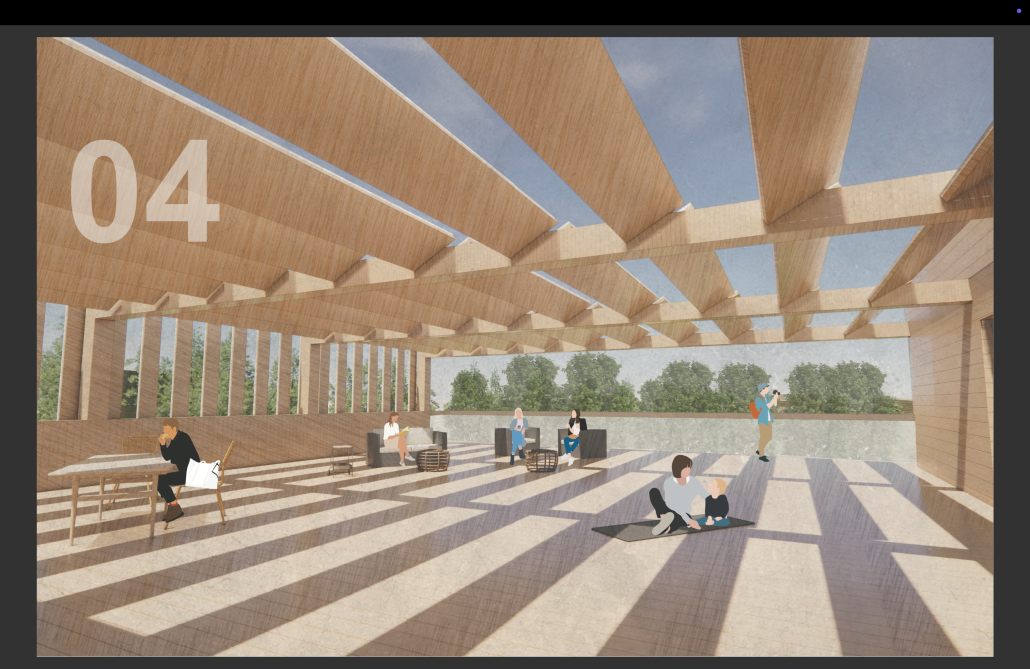
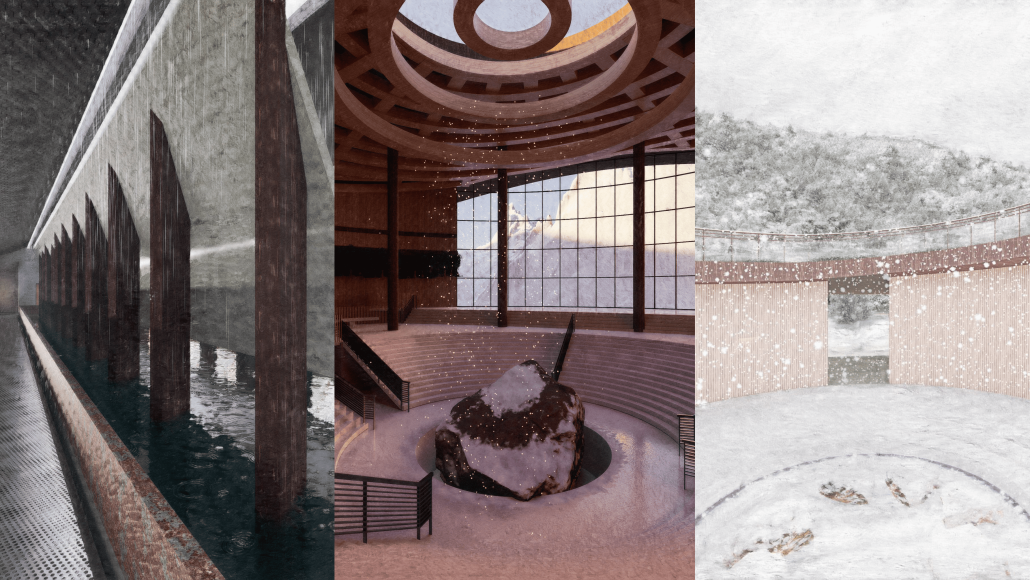
The design preserves the historic brick and concrete shell of the power plant, inserting a self-supporting mass timber structure within. This new framework uses sustainably sourced CLT panels and glulam beams, forming a light-filled, naturally ventilated interior that supports vegetation between the old and new structures. Only at vertical circulation points do the two structures physically meet, symbolizing a transition between past and future.

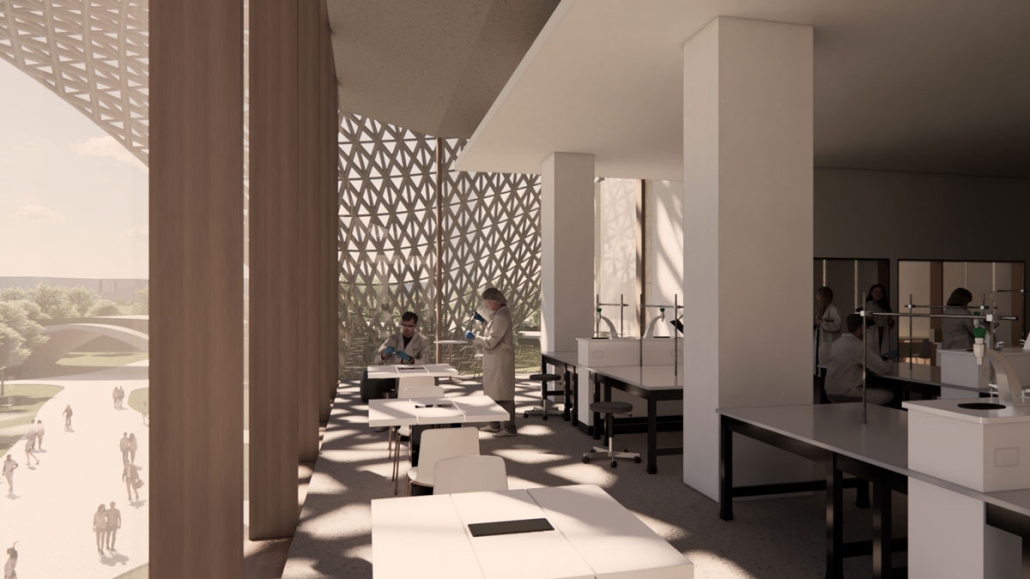
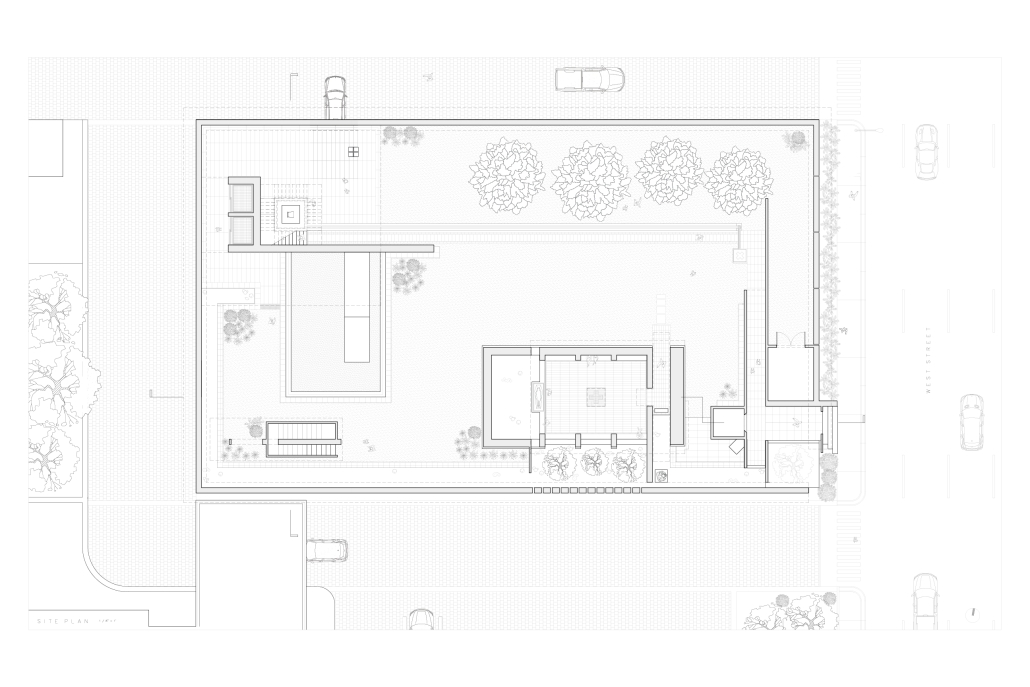
Programmatically, the conservation center includes public education spaces, research labs, and residential units. A rewilded landscape replaces paved surfaces, reducing the urban heat island effect and encouraging biodiversity. A narrow water channel brings Bay water into the site for ecological engagement, while a nearby storage hangar is converted into a ferry terminal to enhance sustainable transportation.

Passive design strategies guide the intervention, with large open-air windows providing daylight and ventilation. Prefabricated timber elements reduce site impact. Overall, the project demonstrates how industrial heritage can support ecological recovery, creating a dialogue between decay and renewal, nature and structure, and the old and the new.

This project won the Thesis Honor Award.

Instagram: @rwu_cummingsarch, @alcoleatarrago

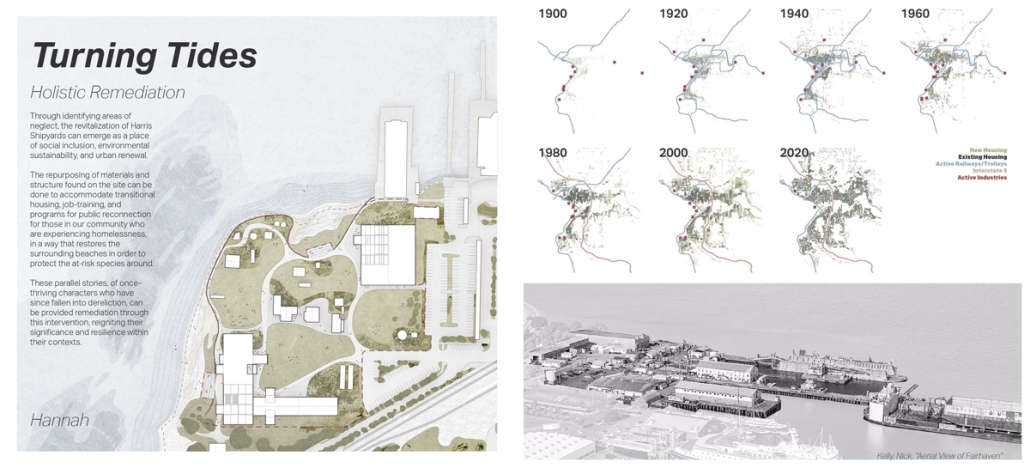
Turning Tides: Holistic Remediation by Hannah Moore, B.Arch ‘25
Academy of Art University | Advisors: Simon McKenzie, Philip Ra & Ricardo Solar

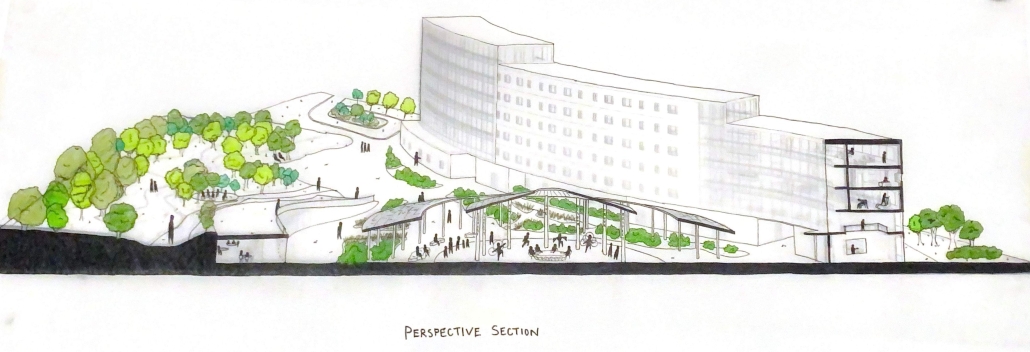
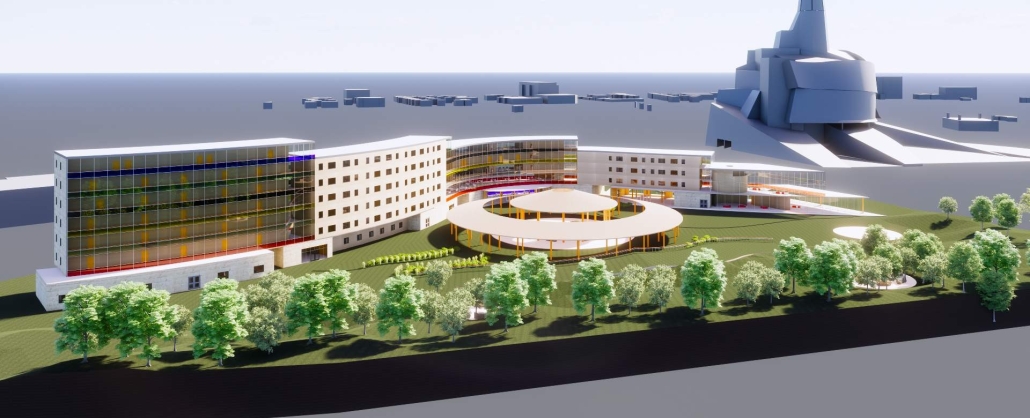
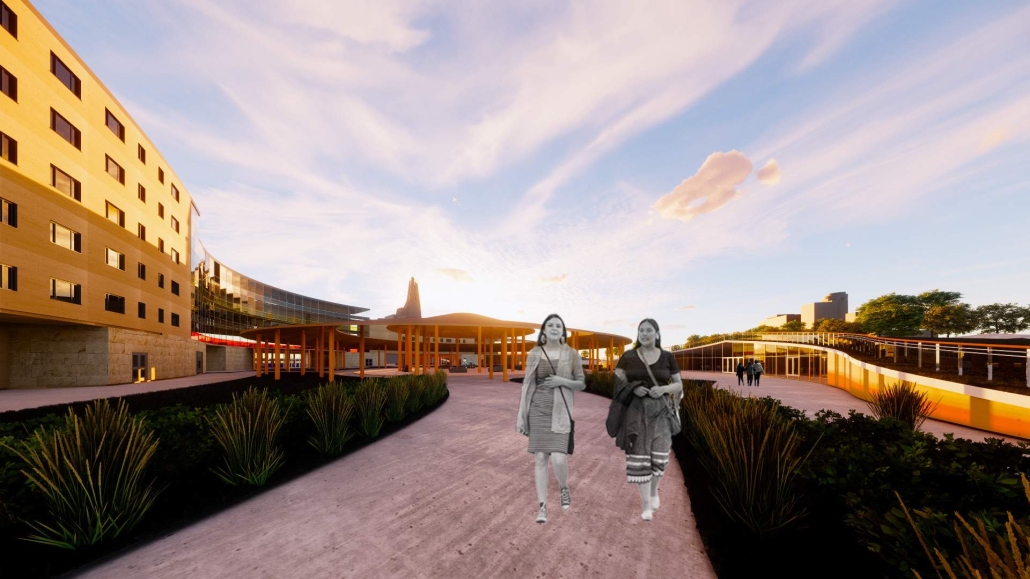
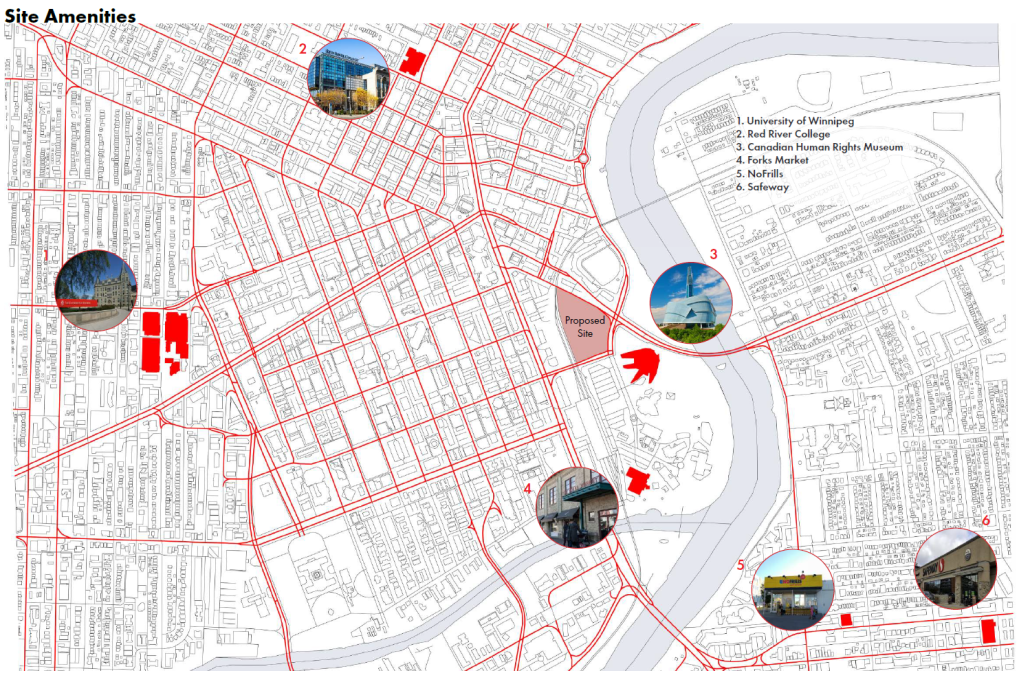
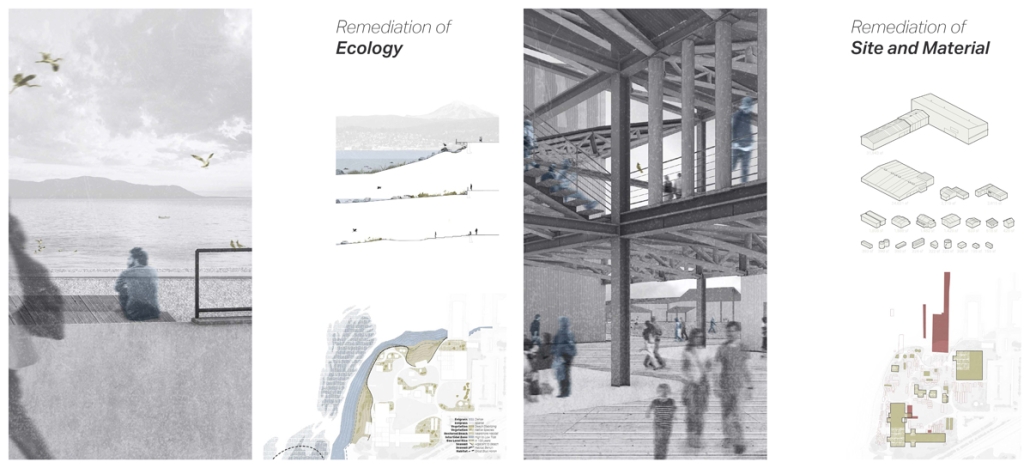
Through identifying areas of neglect, the revitalization of Harris Shipyards can emerge as a place of social inclusion, environmental sustainability, and urban renewal.

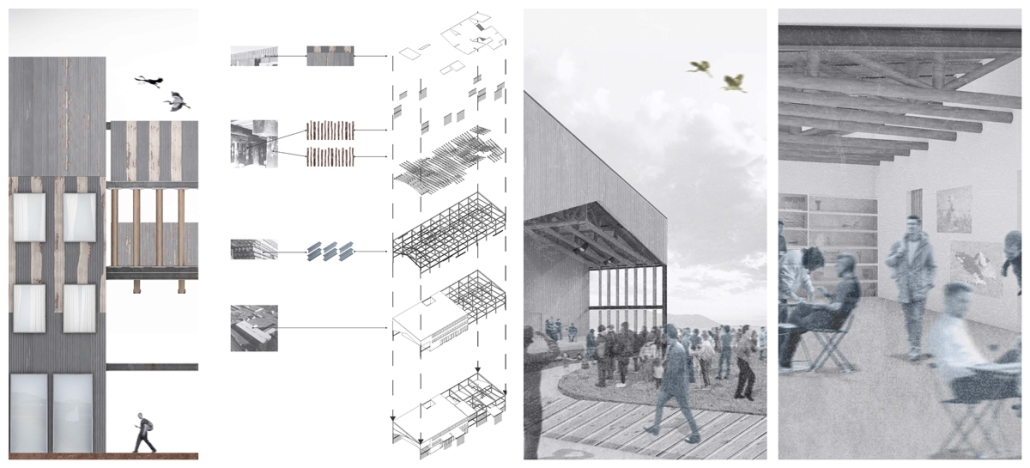
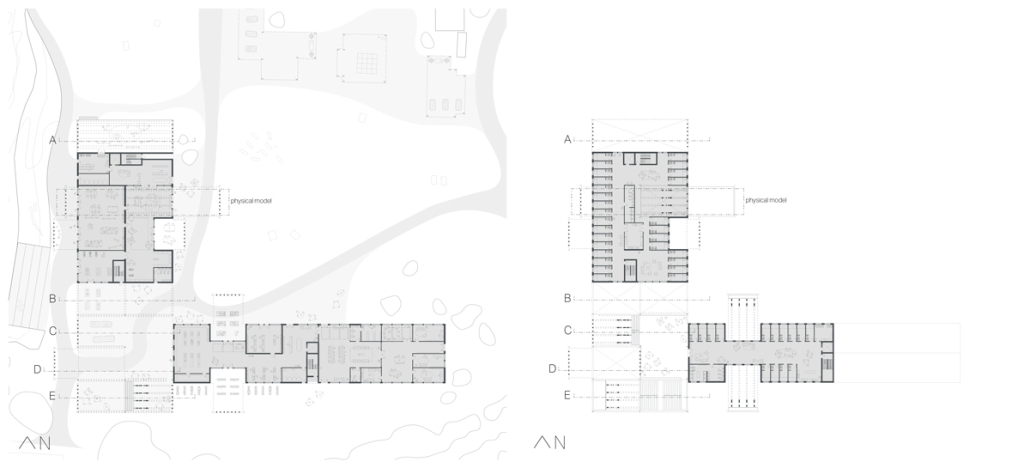
The repurposing of materials and structure found on the site accommodates transitional housing, job-training, and programs for public reconnection for those in our community who are experiencing homelessness. In addition, the project restores the surrounding beaches in order to protect at-risk species.

These parallel stories, of once-thriving characters who have since fallen into dereliction, can be provided remediation through this intervention, reigniting their significance and resilience within their contexts.

This project won the B.Arch Thesis Award. 

Click here to learn more.

Instagram: @hannah.3, @smckenzie23, @ricardo_solar_architecture

Rebuild From Decay: An Industrial Solution for A Post-Industrial Age by Kyle Sylvester, M.Arch ’25
Wentworth Institute of Technology | Advisors: Lauren McQuistion & Tom Chung

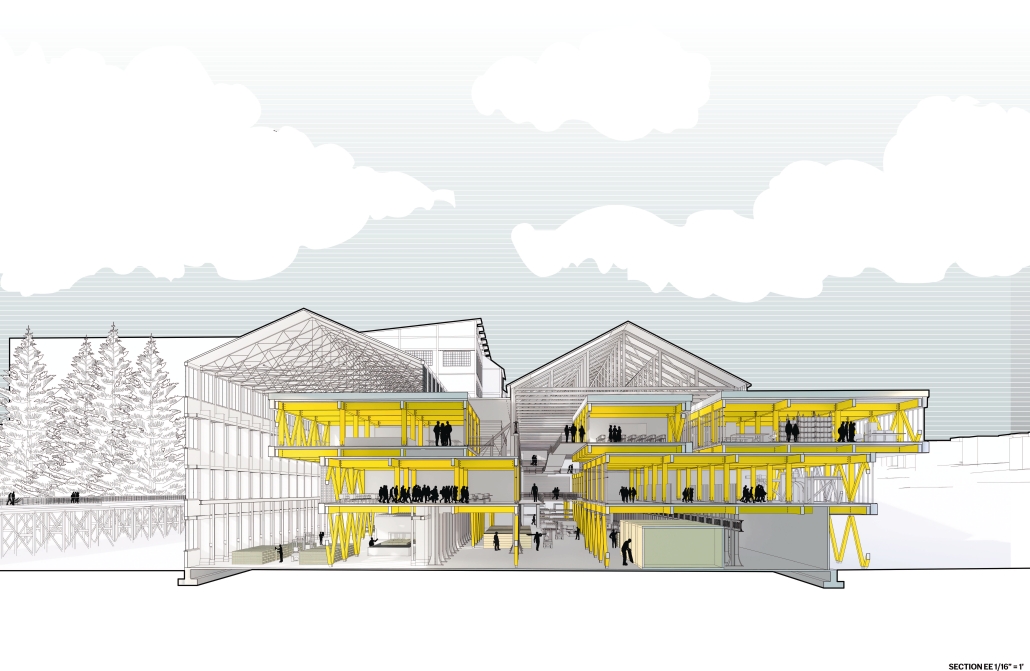
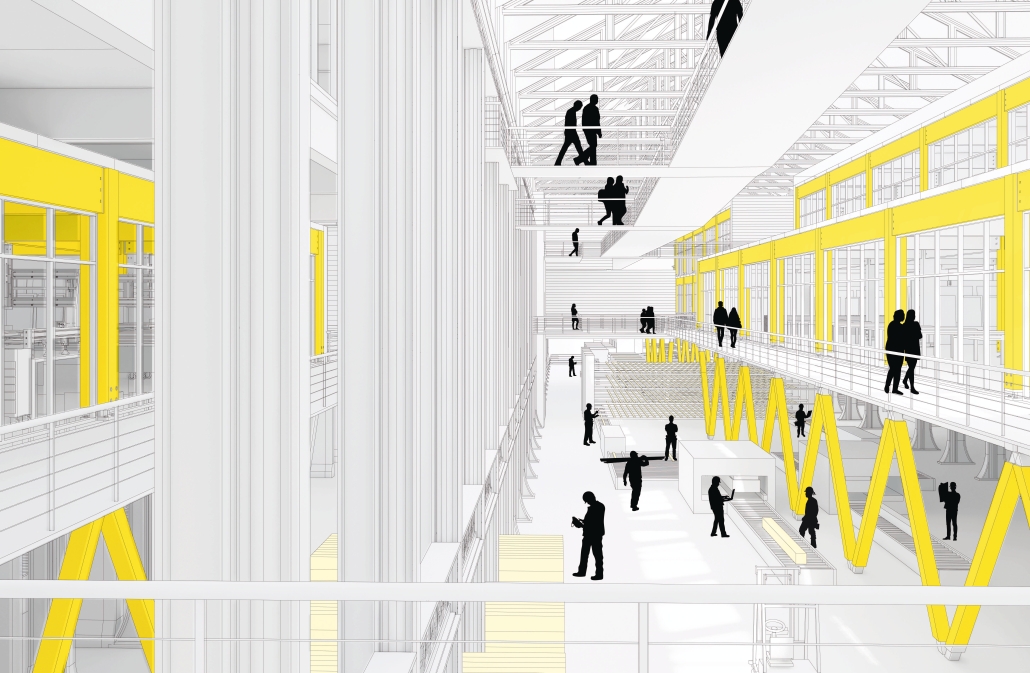
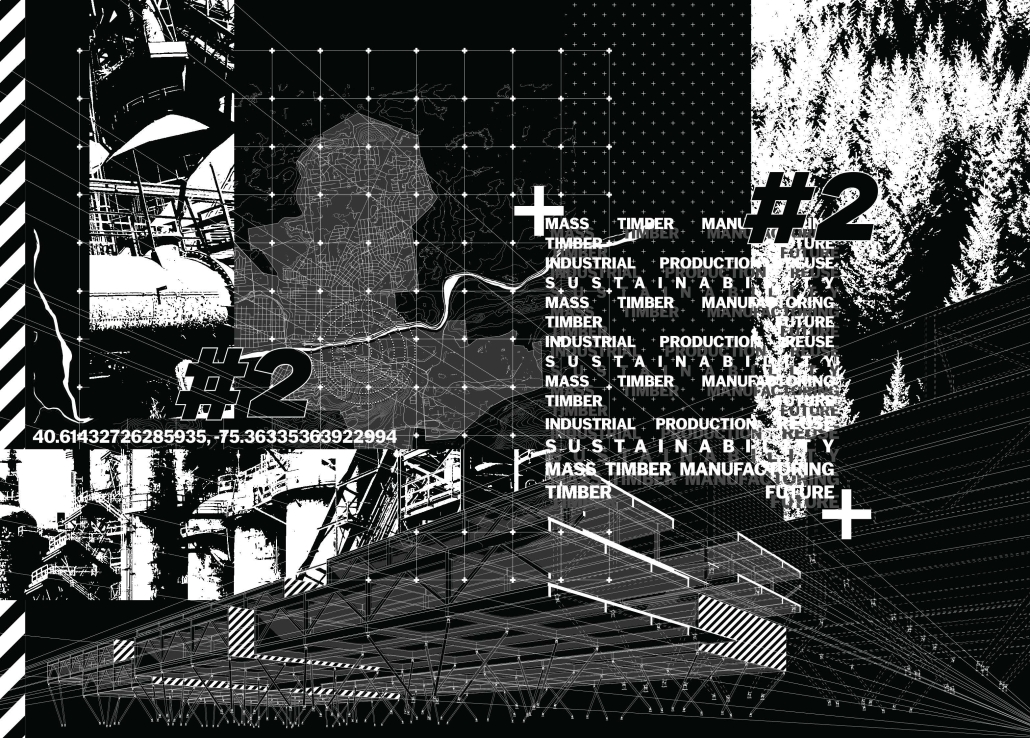
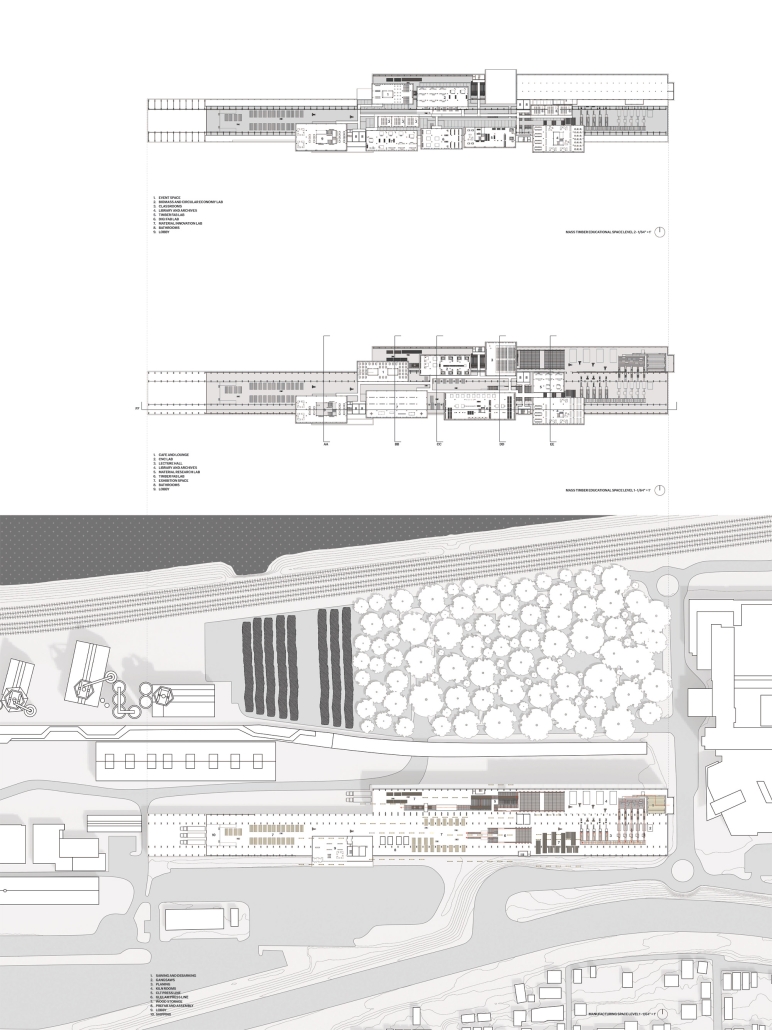
Mass timber presents an opportunity to redefine the future of abandoned industrial sites through the introduction of a new industry. While many of these sites have been repurposed as cultural and landscape parks, this approach often reduces their industrial identity to just a facade for new programs, disconnecting them from their manufacturing past. By integrating mass timber manufacturing and education within the fabric of an industrial wasteland, this model preserves the site’s historical significance while also creating a hub for sustainable industry, ensuring its continued use in the 21st century. 

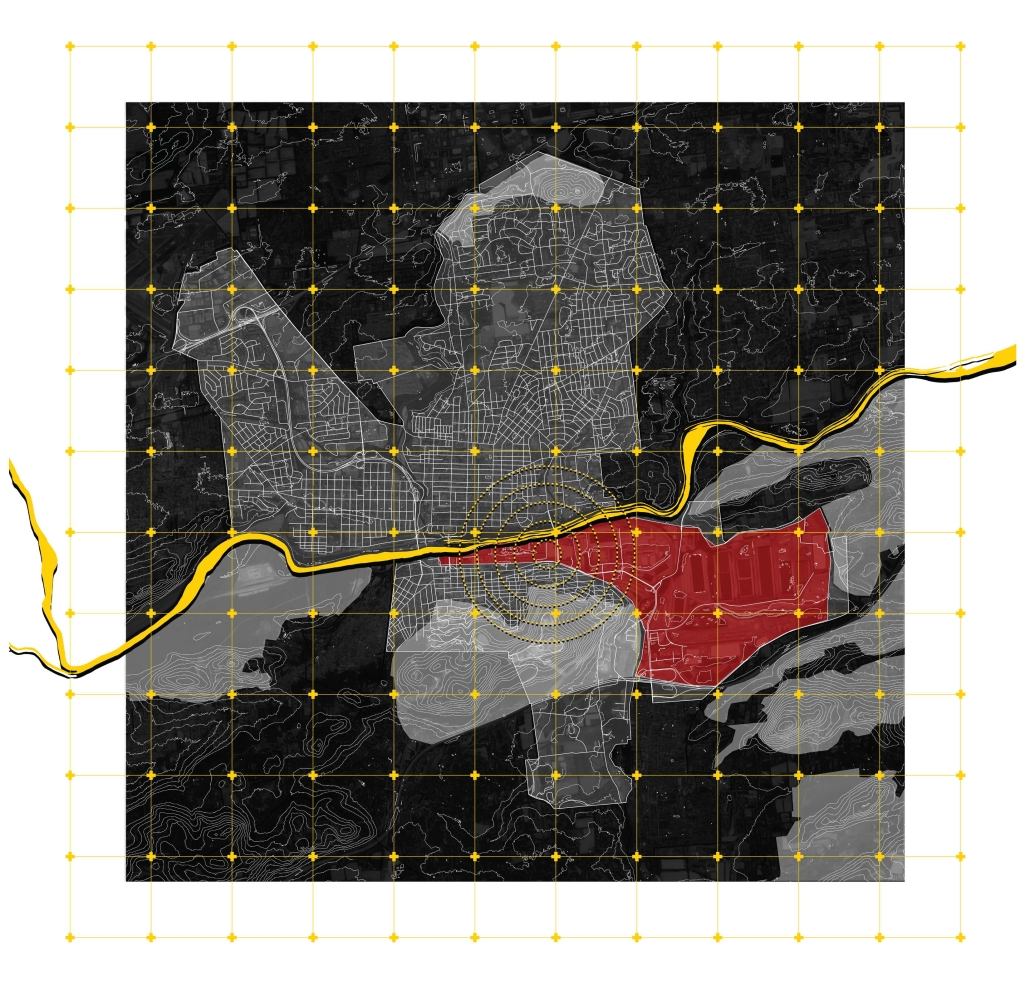
This thesis revitalizes Machine Shop No. 2 at Bethlehem Steel Mill by maintaining and reinterpreting its industrial legacy. Typically, industrial wastelands are repurposed as landscape parks or cultural centers, stripping away the site’s industrial memory and using its infrastructure as a facade. By integrating sustainable mass timber construction, this proposal offers a forward-thinking approach to revitalizing post-industrial spaces through the use of mass timber construction. The existing machine shop has been transformed into a mass timber manufacturing facility and educational center for renewable materials, blending production and education through layered programming. This approach preserves the site’s identity while addressing the need for sustainable construction practices.

This project won the Wentworth School of Architecture and Design: Design Excellence Award. 

Instagram: @ksly5, @mc.quistion

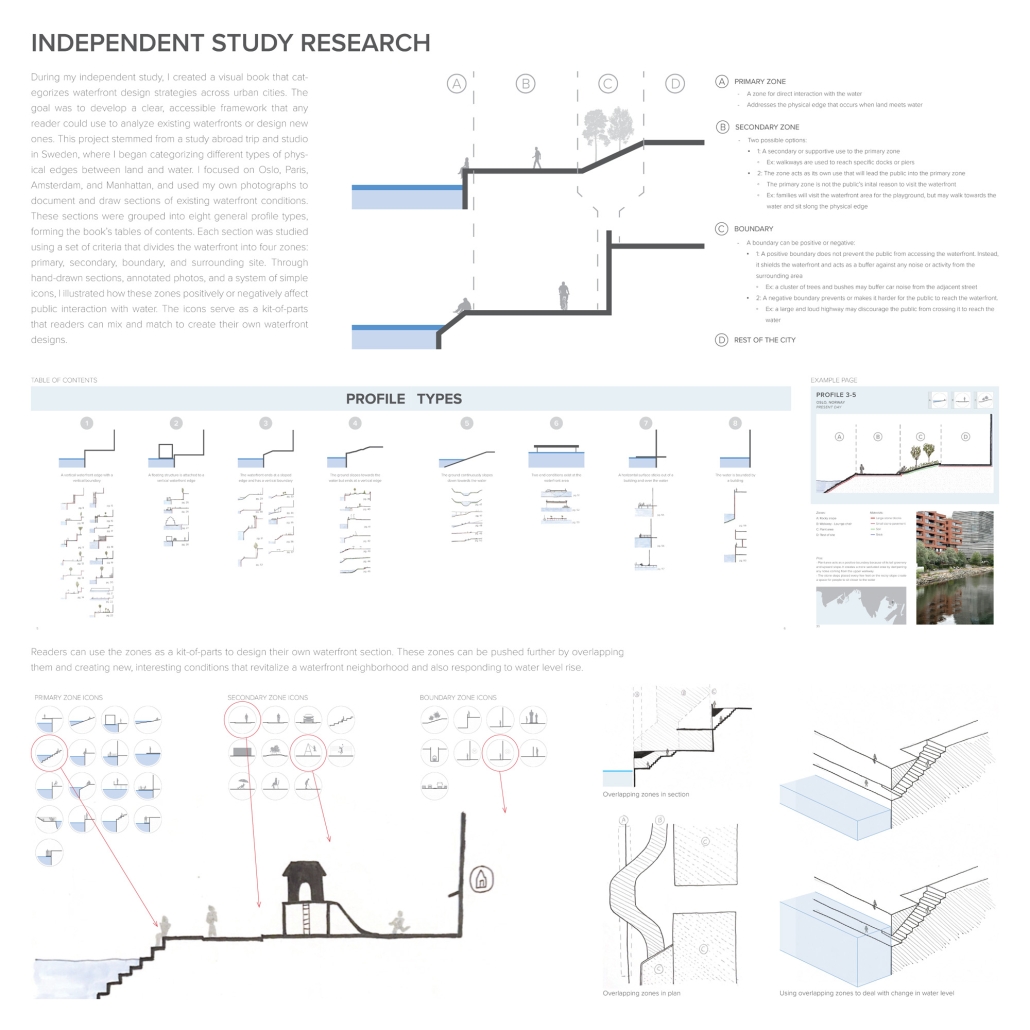
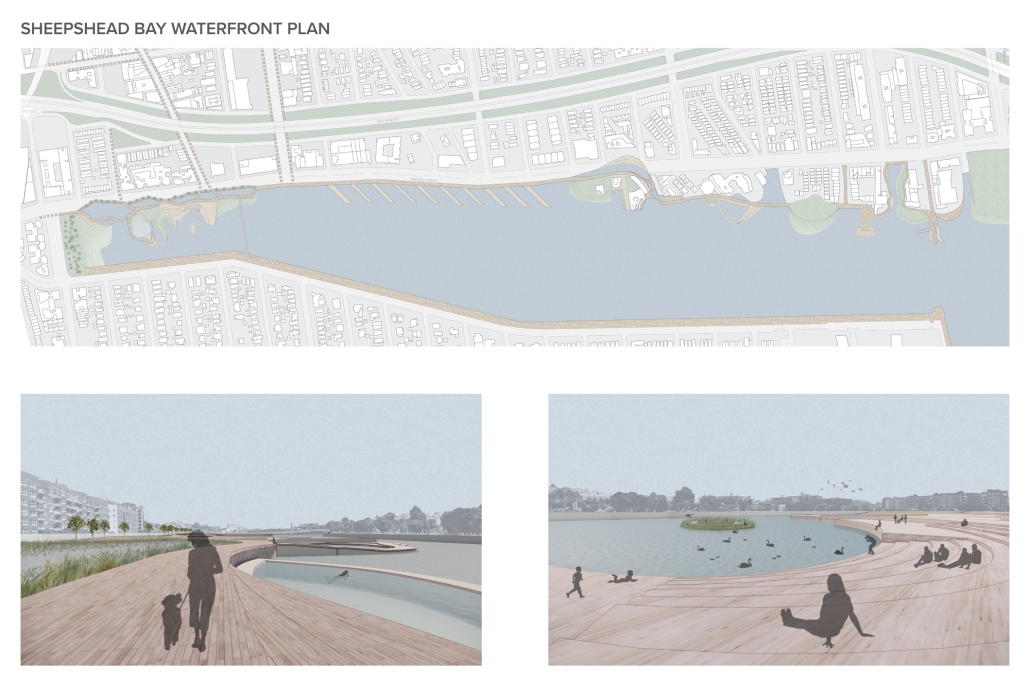
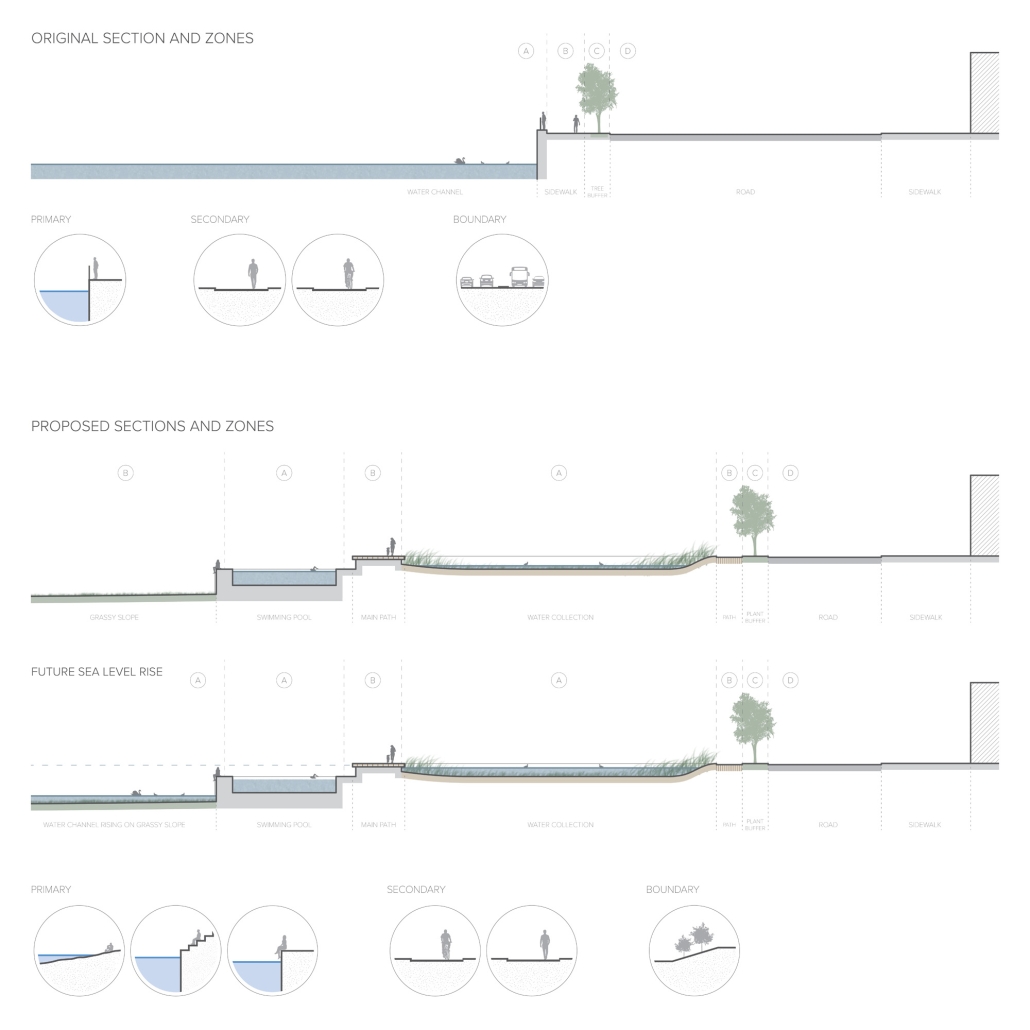
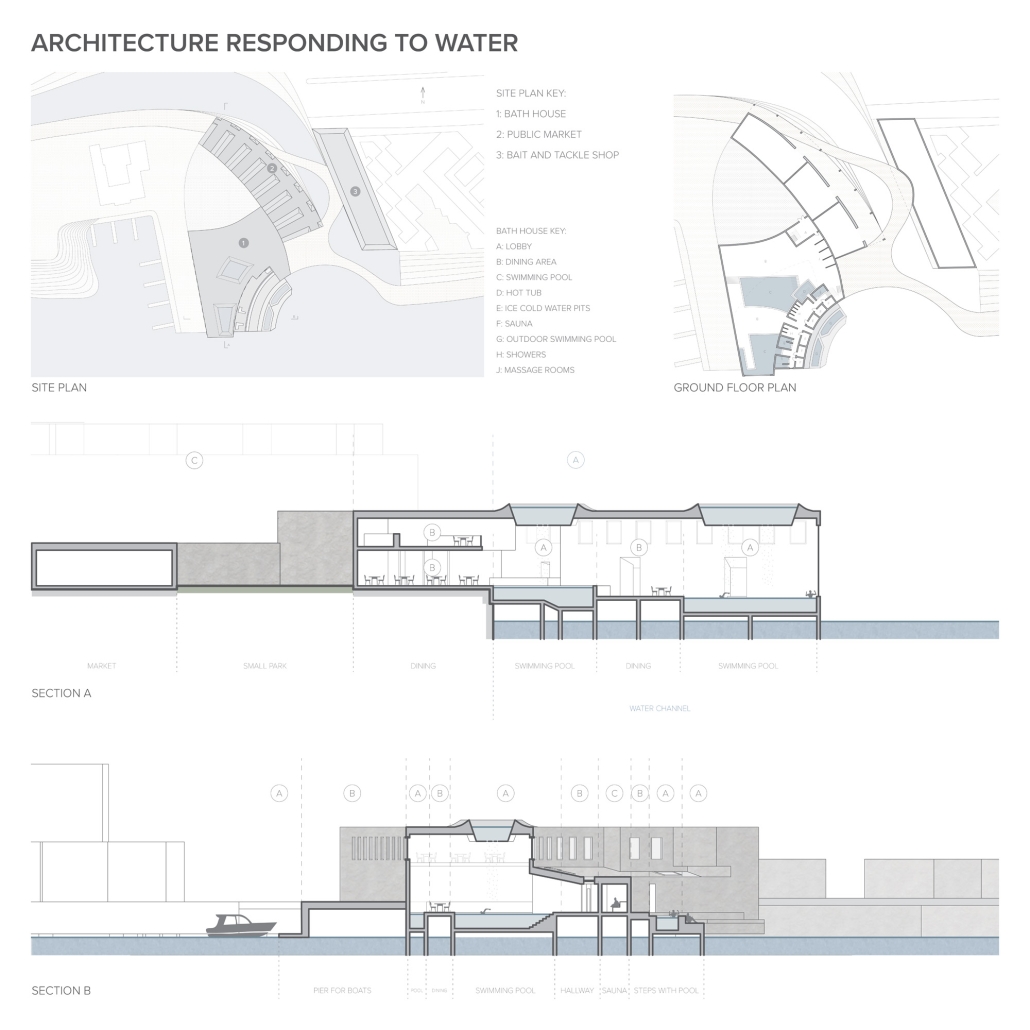
From Wrecks to Wonders: Reclaiming Shorelines, Enriching Communities by Karunia Ayu, Hongxiang Wang & Tianqi Zhao (Enoch), MSAUD (Master of Science in Architecture and Urban Design) ’25
Columbia University | Advisors: Kate Orff, Geeta Mehta, Emanuel Admassu, Sebastian Delpino, Gabriel Vergara, Lucas Coelho Netto & Shrey Patel

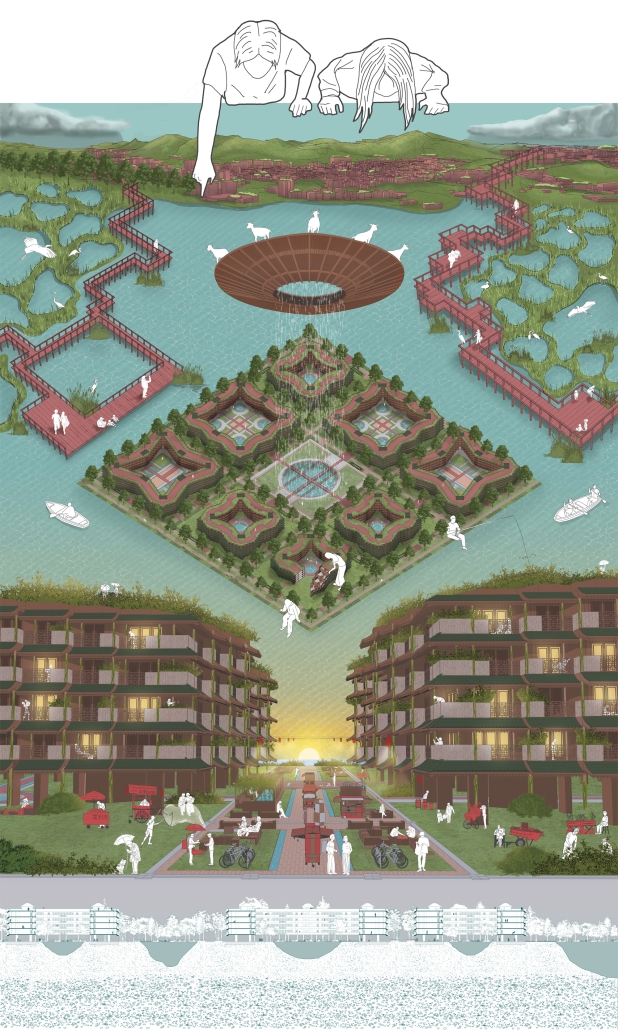
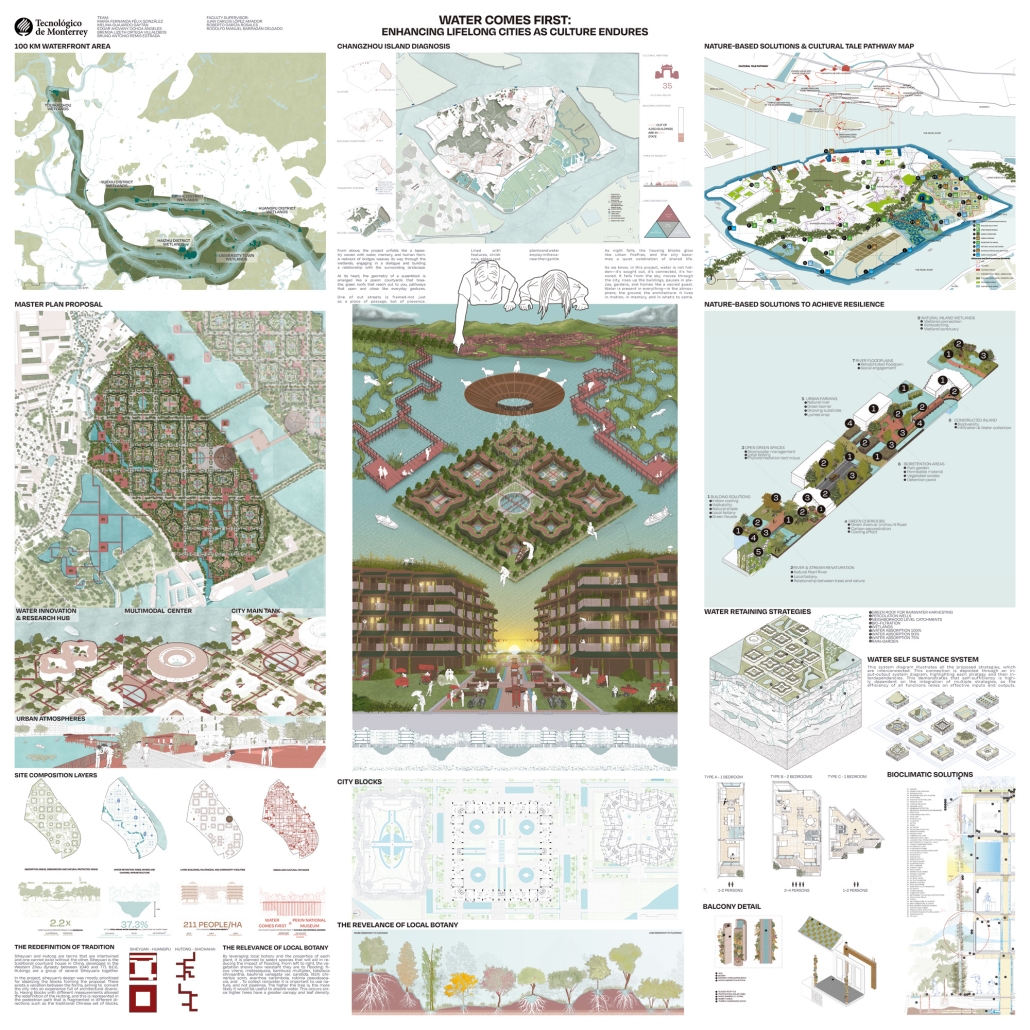
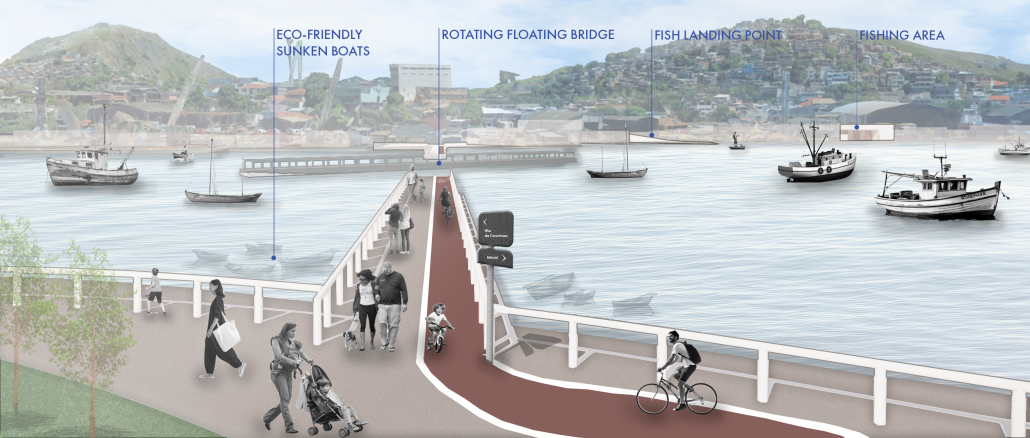
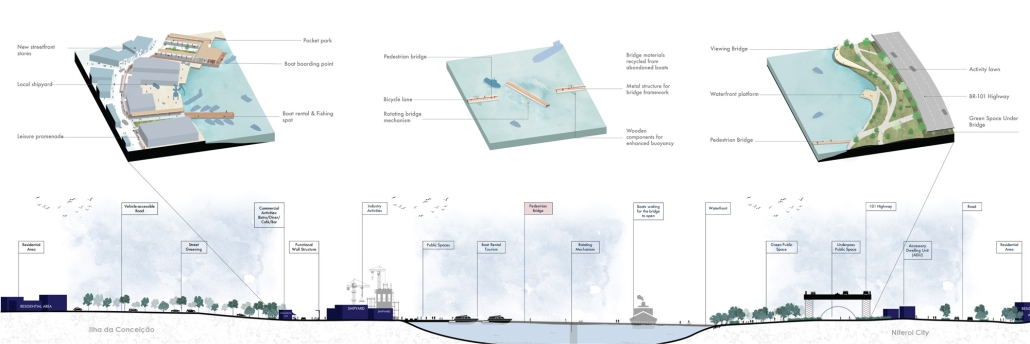
WHAT IF THE WATERWAY IS REOPENED, BROUGHT COMMUNITY ACTIVITIES TO ITS SHORES, AND REIMAGINED THE ECONOMY AND INDUSTRY ALONG THE BANKS?

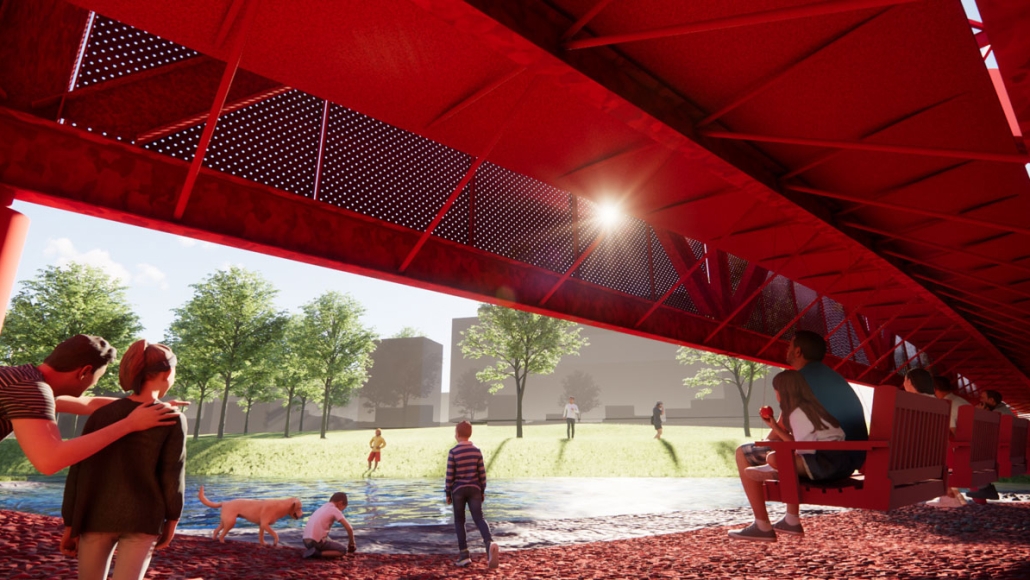
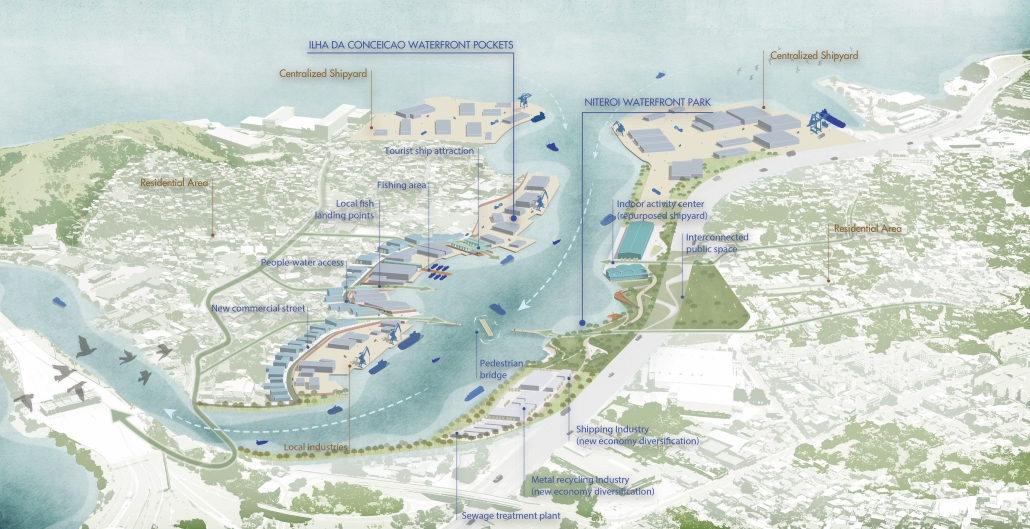
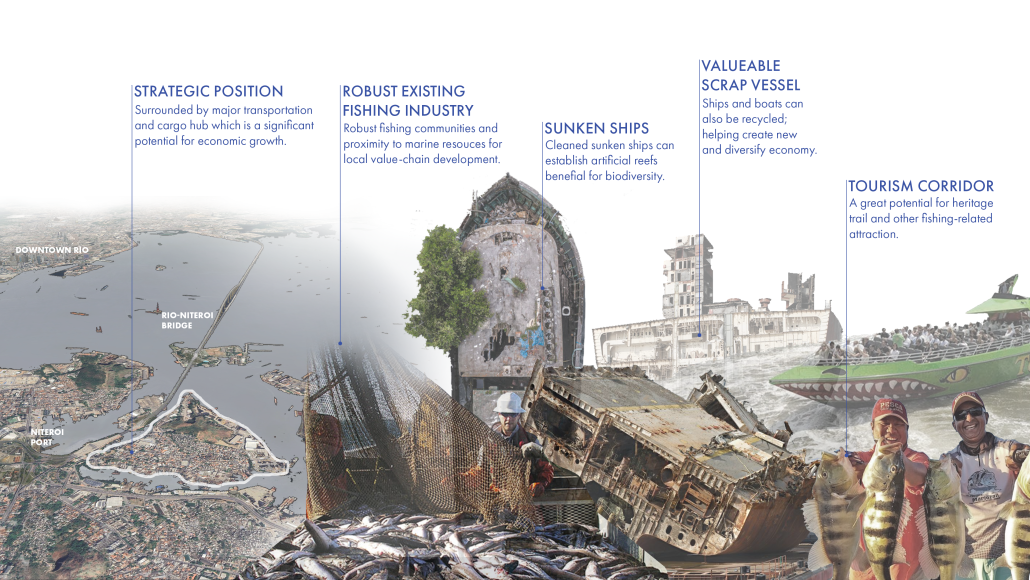
In the past, the island of Ilha da Conceição was composed of three separate islets located within Guanabara Bay. The construction of Niterói’s port and the later Rio–Niterói Bridge, which was driven by the expanding oil industry, filled in the channels that separated the two islands. This effectively annexes the islands to the city while also obstructing the natural flow of water. In addition to the accumulation of derelict ships, this land reclamation has resulted in the accumulation of wastewater and industrial runoff, which has resulted in the transformation of once-clean currents into polluted pools that are stagnant.

The shoreline is now dominated by industrial activity, which has cut off communities from the water and undermined both the quality of the catch and traditional ways of making a living. Local fishermen used to thrive in this area previously.

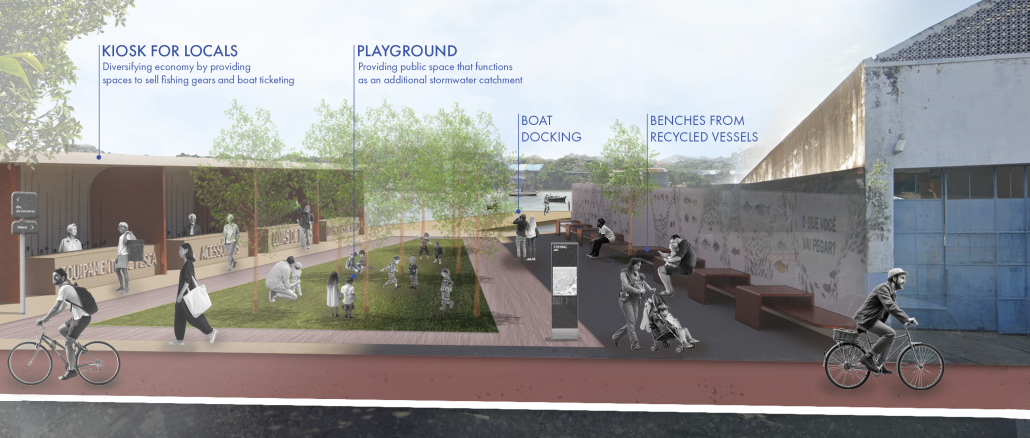
The ‘what if’ scenario that we have envisioned involves reestablishing water circulation without displacing any industry. By relocating factories to nearby locations and innovatively repurposing vessels that have been abandoned, we could bring back a canal that is cleaner and flows more freely. Residents of Ilha da Conceição and Niterói would be brought together through the creation of new public spaces along its banks. These spaces would serve as natural filtration zones and social connectors.

What is the end result? improved water quality, revitalized community fishing, and parks along the water’s edge that are very inviting. The demonstration that industry, ecology, and community can coexist in harmony would be [highlighted] by the fact that improved access to the bay would stimulate the creation of jobs, broaden access to goods and services, and ignite local economic growth.

Click here to learn more. 

Instagram: @runikarunia, @enoxizi, @mehtageeta999 @eadmassu, @sdelpino_arq, @gabrielvergarag, @lucascoelhonetto, @cauecapille, @shrey_patel1999

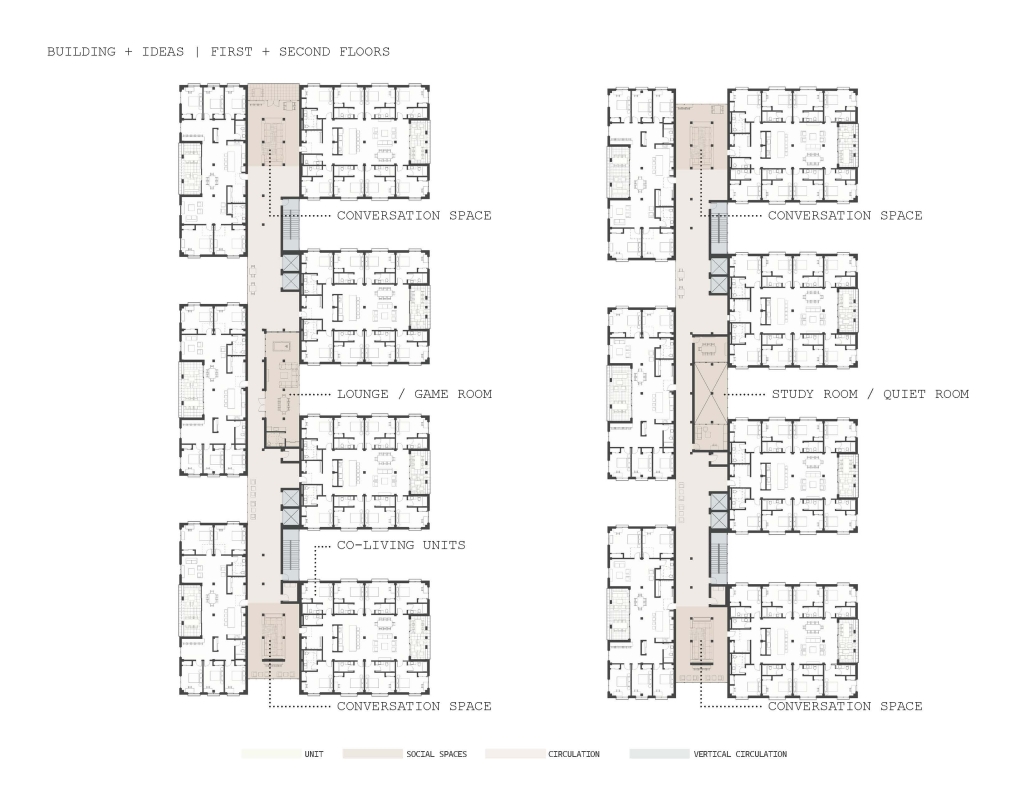
City Within a Shell, Reclaiming underutilized buildings for living learning and belonging. by Kush Choganwala, M.Arch ’25
Boston Architectural College | Advisors: Ralph Jackson &  Ian F. Taberner

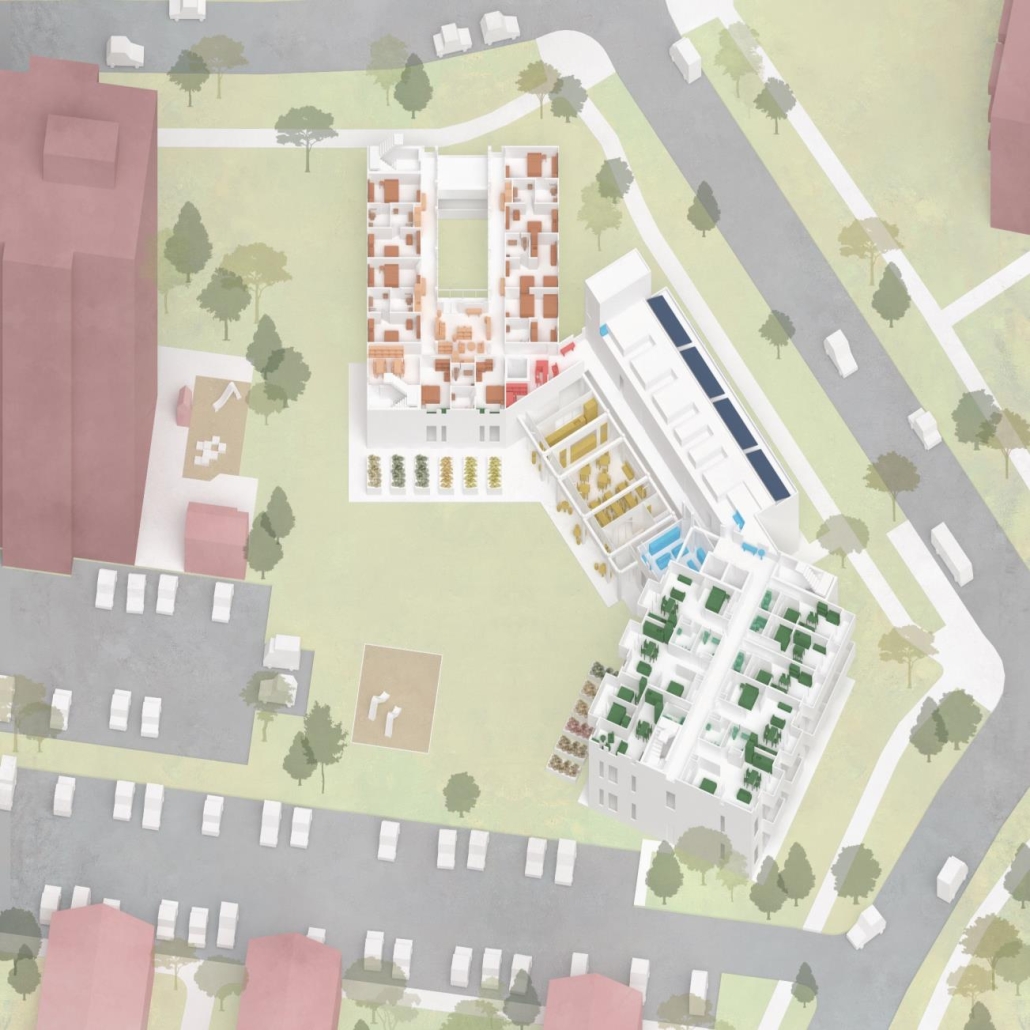
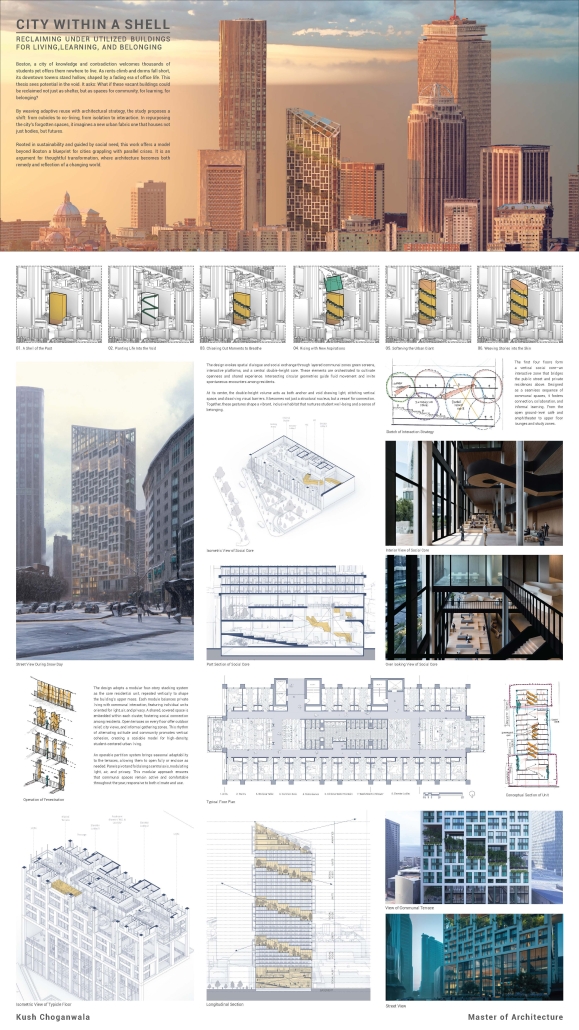
In a city defined by knowledge and ambition, where students arrive with dreams larger than their square footage, a quieter truth rises between the lines of the skyline: vacancy. Beneath the towers of Back Bay, amid the noise of commerce and culture, stand buildings built for another time empty, waiting, still. “City Within a Shell” is a thesis rooted in this urban contradiction. It asks: What if the city’s forgotten rooms could be reimagined for those still finding their place within it? What if architecture, instead of beginning with demolition, began with listening to the structures that remain, and the lives that need them?

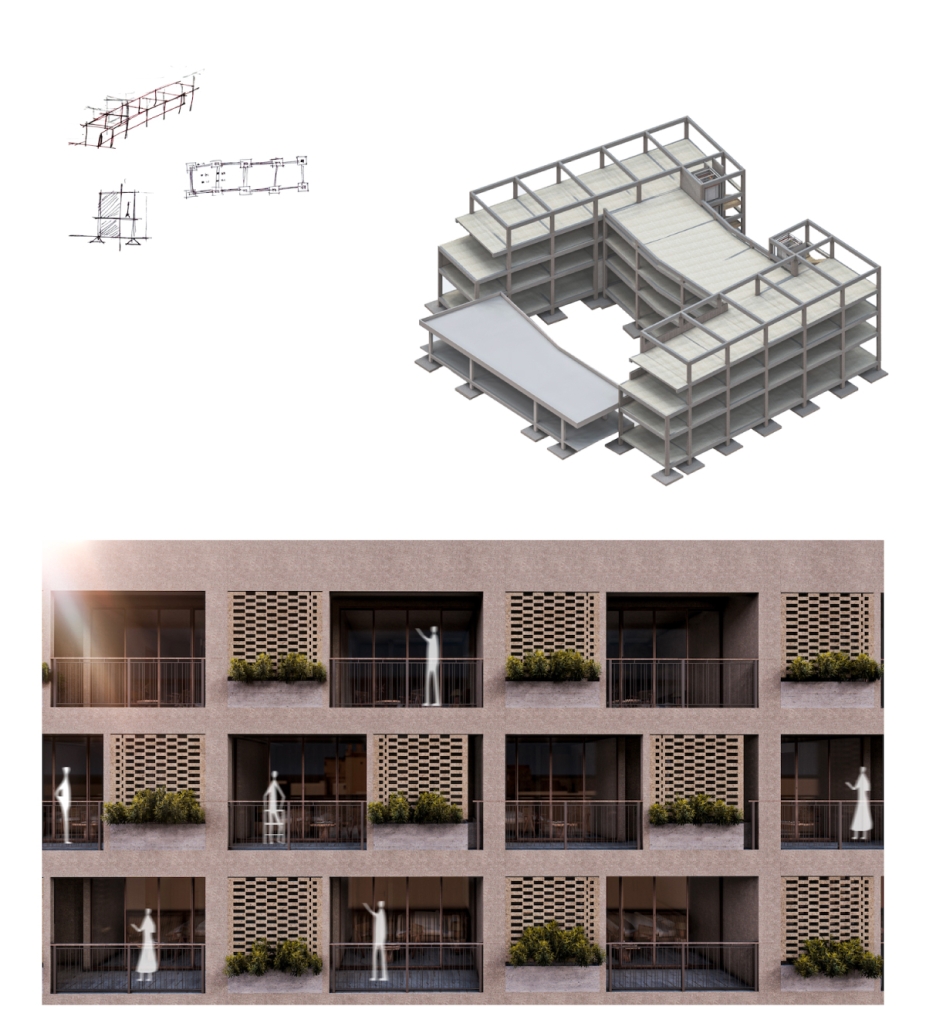
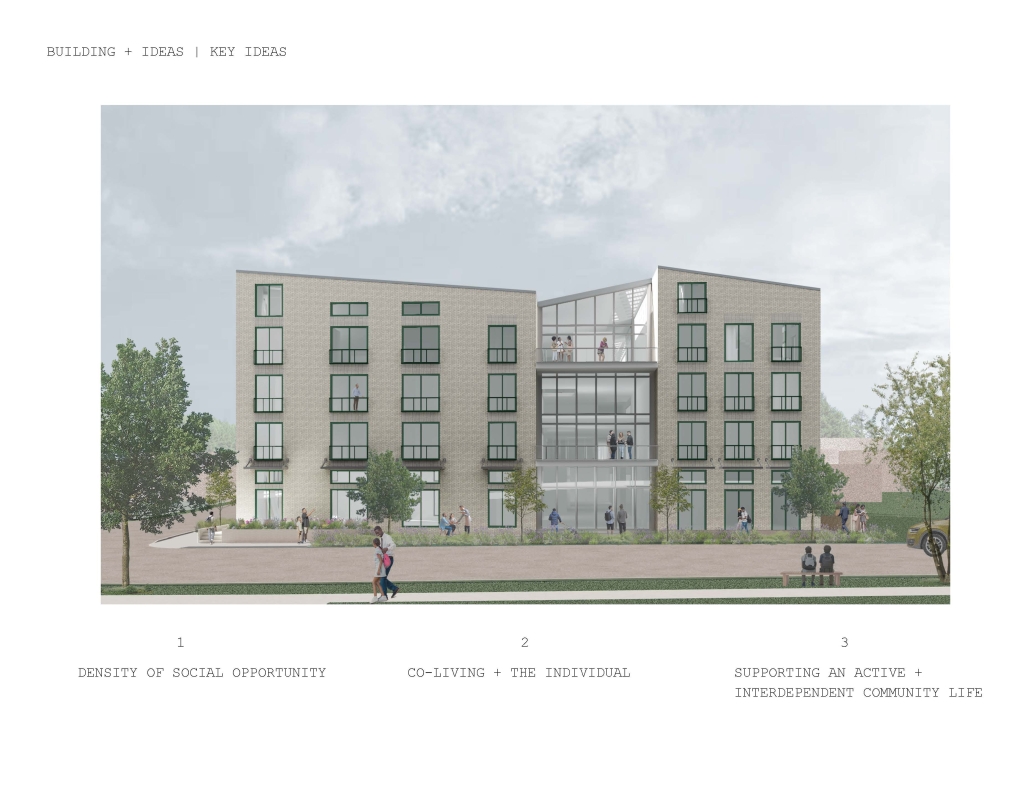
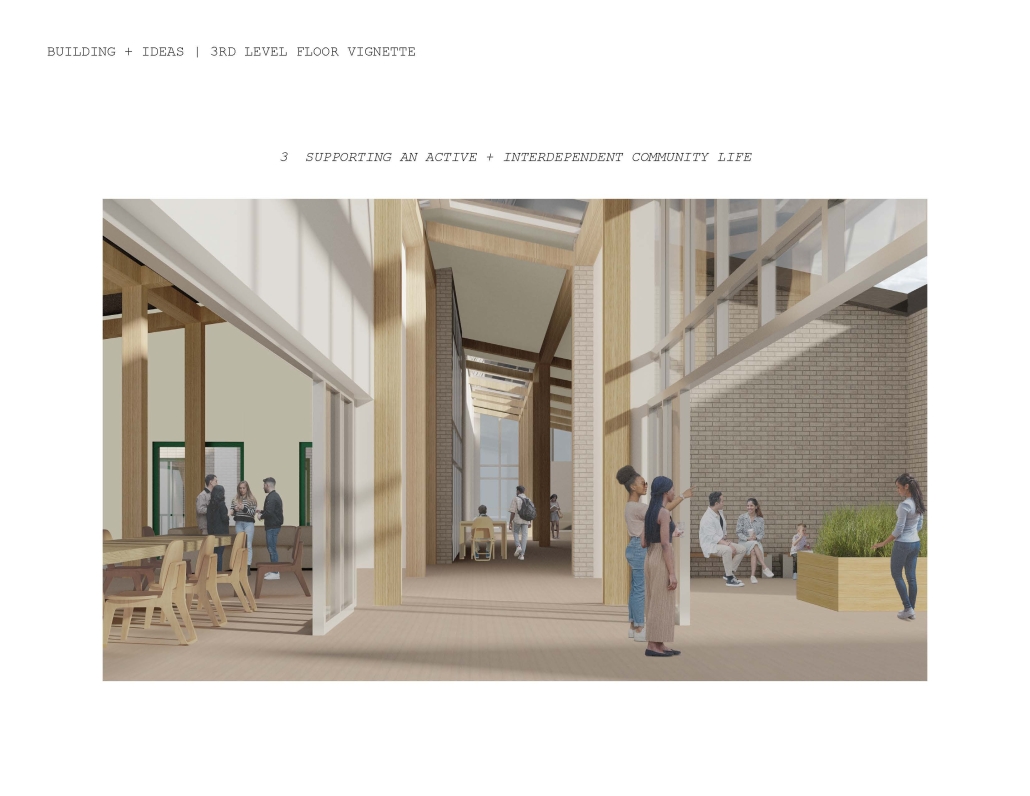
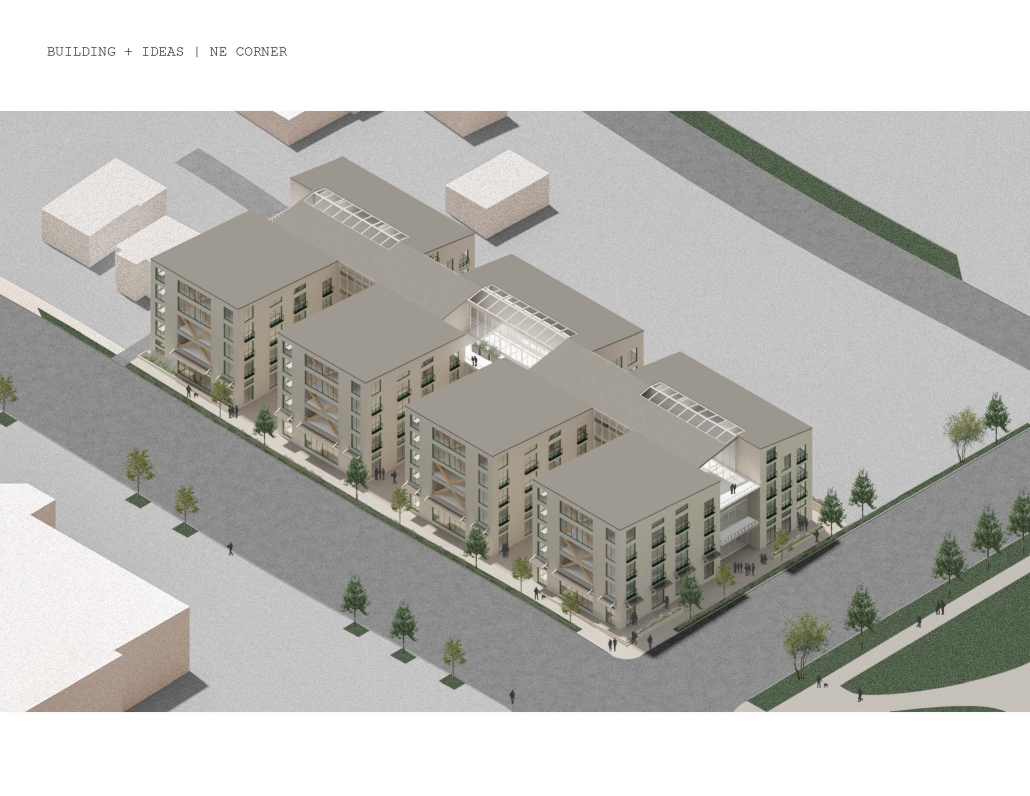
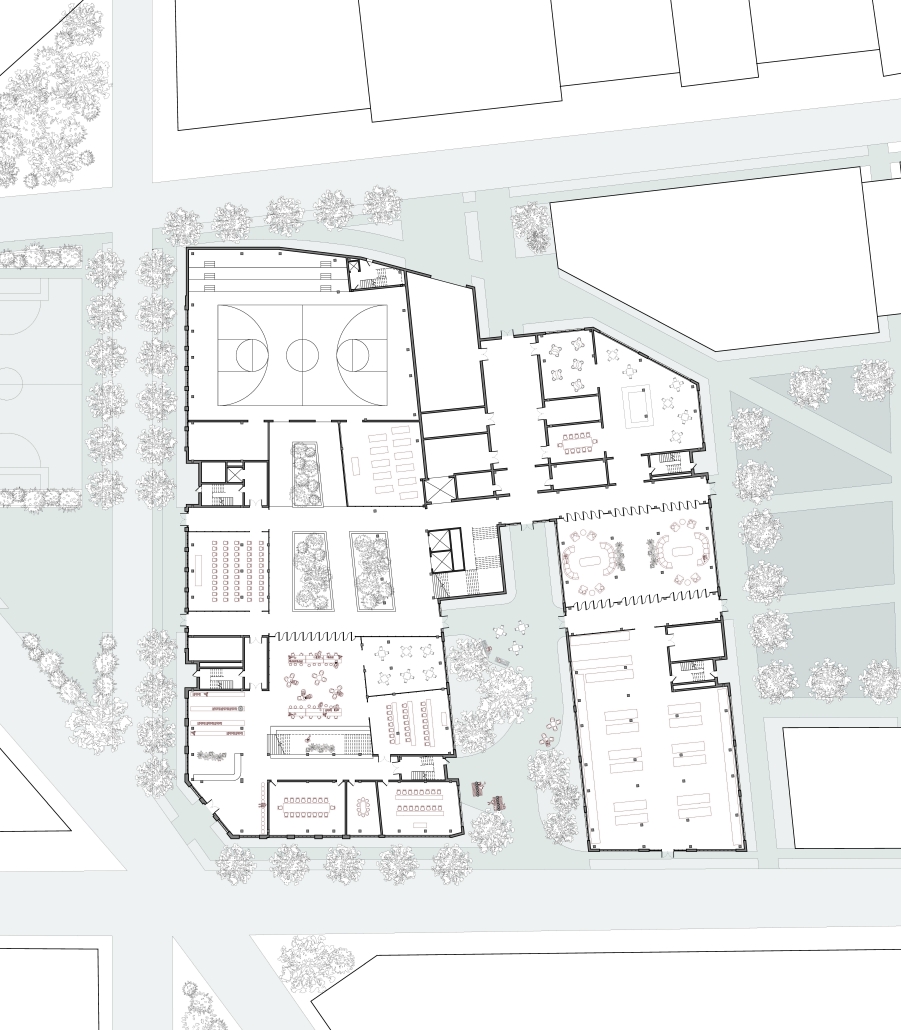
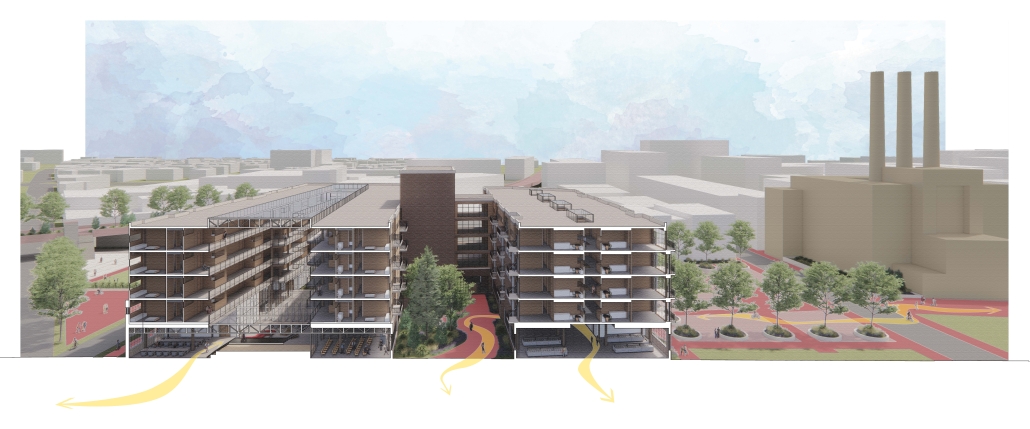
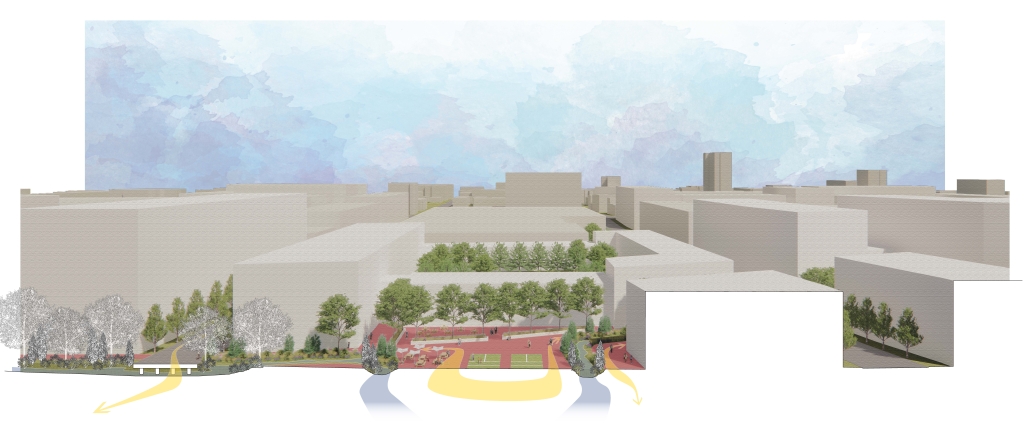
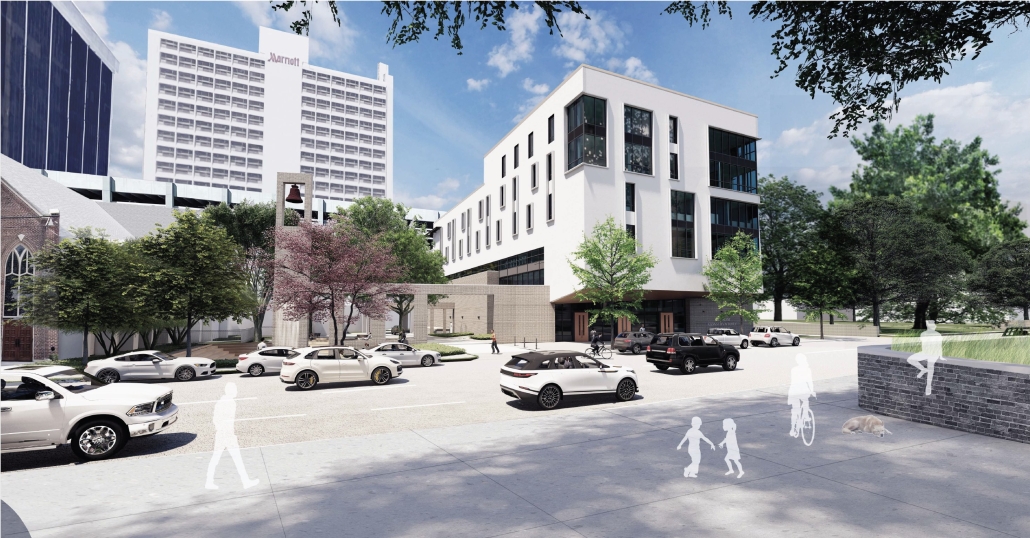
This project proposes the adaptive reuse of the Sheraton Boston Hotel’s South Wing, transforming a vacated hospitality structure into a vertical co-living environment for students. Located in the academic epicenter of Boston, surrounded by institutions like Northeastern, Berklee, and the Boston Architectural College, the site holds the potential to serve the very population it has long overlooked. 

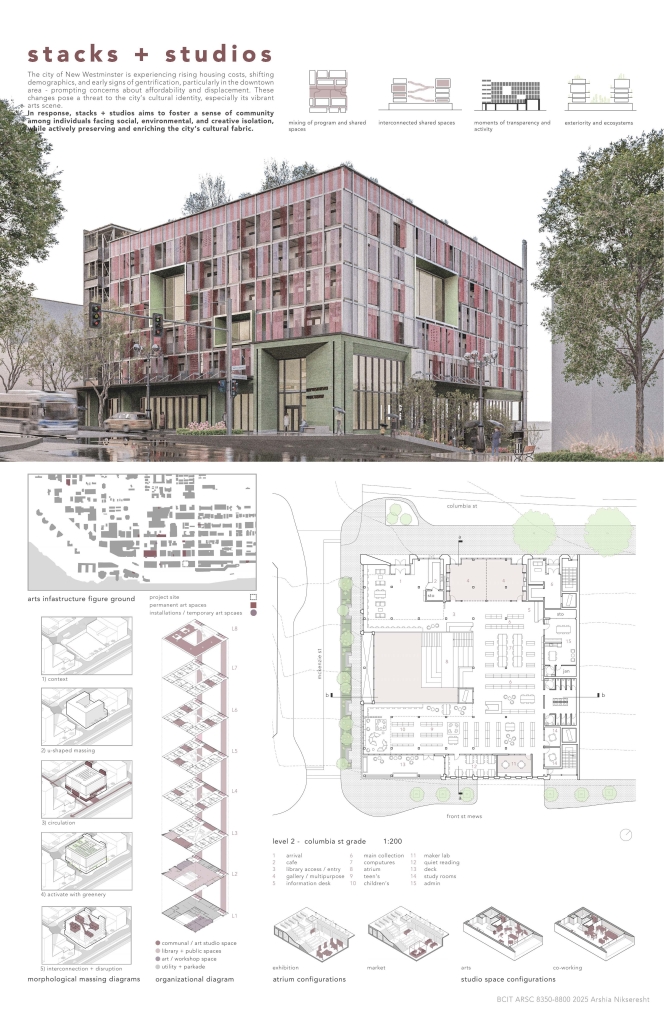
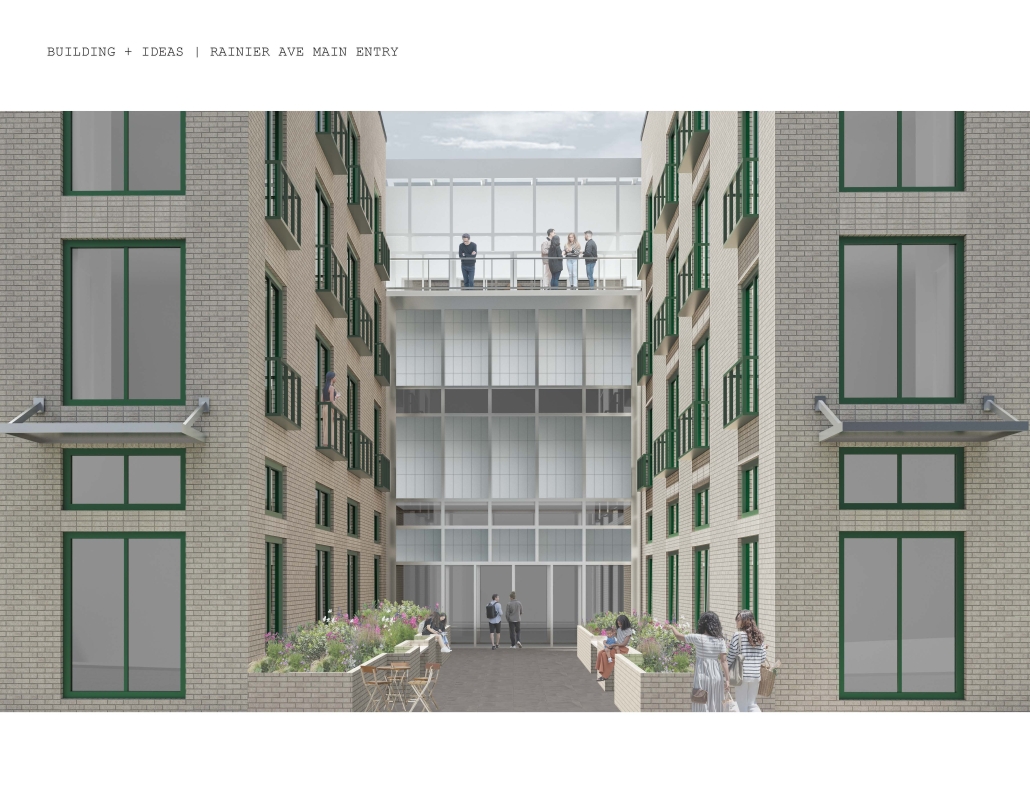
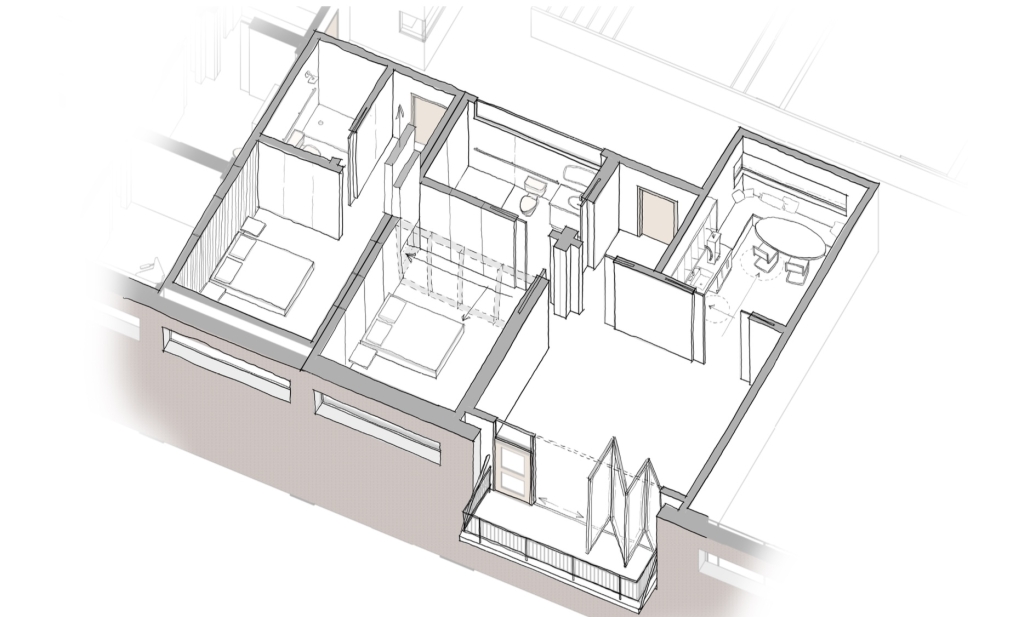
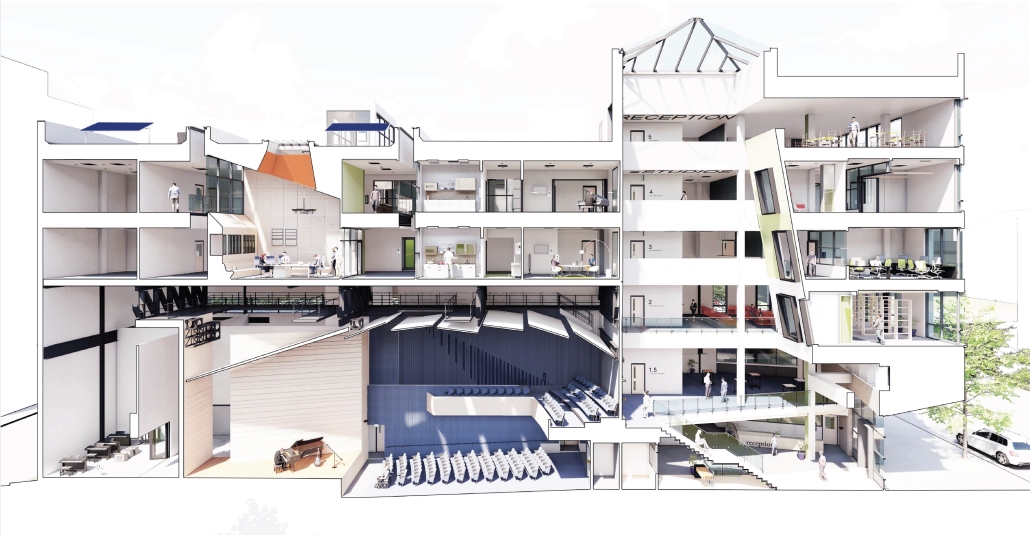
The design strategy centers on a modular four-story stacking system that integrates living units with shared kitchens, study lounges, wellness pods, and green terraces. These clusters spiral around a central spine, a vertical social core that weaves moments of interaction into the daily rhythm of living. The new facade becomes a living skin: softened with balconies, filtered with light, wrapped in green, inviting the city to witness a transformation not just of form, but of purpose. Methodologically, the thesis draws from precedent case studies in New York, Philadelphia, and Berlin, where adaptive reuse and cooperative housing models have reshaped the residential landscape. Site analysis, zoning and policy review, economic feasibility studies, and environmental performance simulations ground the proposal in practical viability while guiding its architectural expression. But beyond numbers and plans, this work is a meditation on belonging. It acknowledges that housing is not just a commodity, but a condition for well-being. It positions design as a tool not only for efficiency, but for empathy. And it offers a replicable framework—both spatial and strategic for cities grappling with similar imbalances between abundance and need.

City Within a Shell challenges the idea that buildings expire when their original function fades. Instead, it proposes that architecture can evolve layered, resilient, and generous. It suggests that within the walls we inherit, there is room to imagine something better: a city where vacancy is not a failure, but a beginning. Through this thesis, architecture becomes an act of reclamation of space, of purpose, and of the right to belong.

This project won the Edwin T. Steffian Award, Best of M.Arch Thesis. 

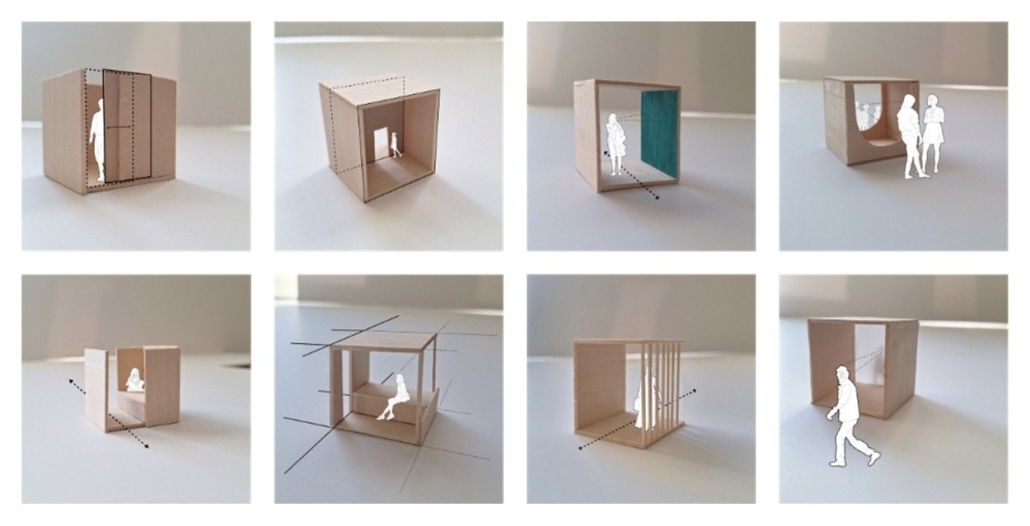
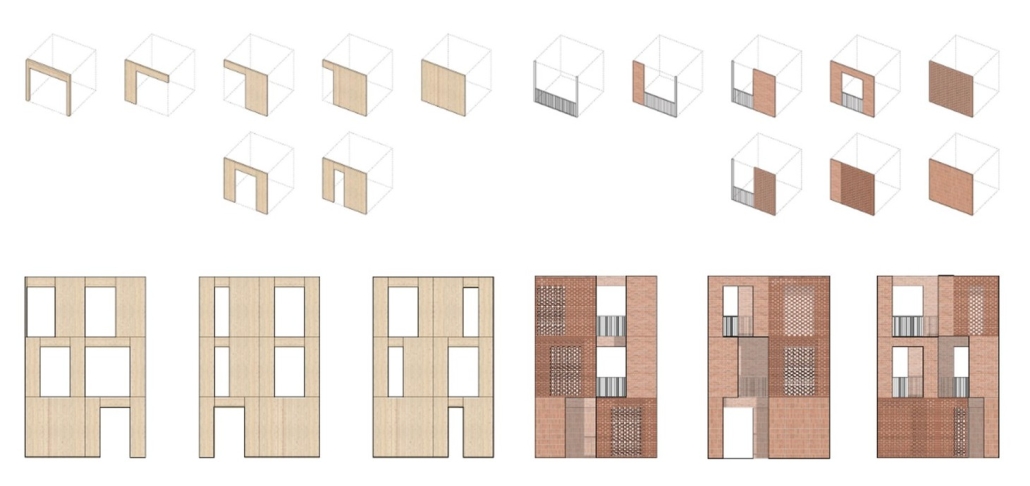
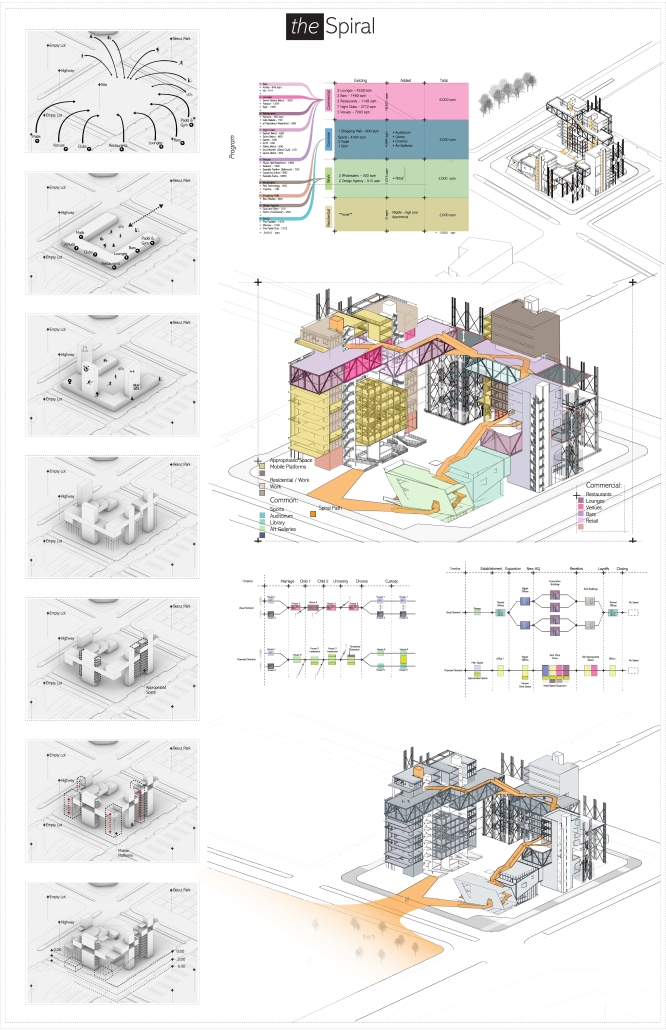
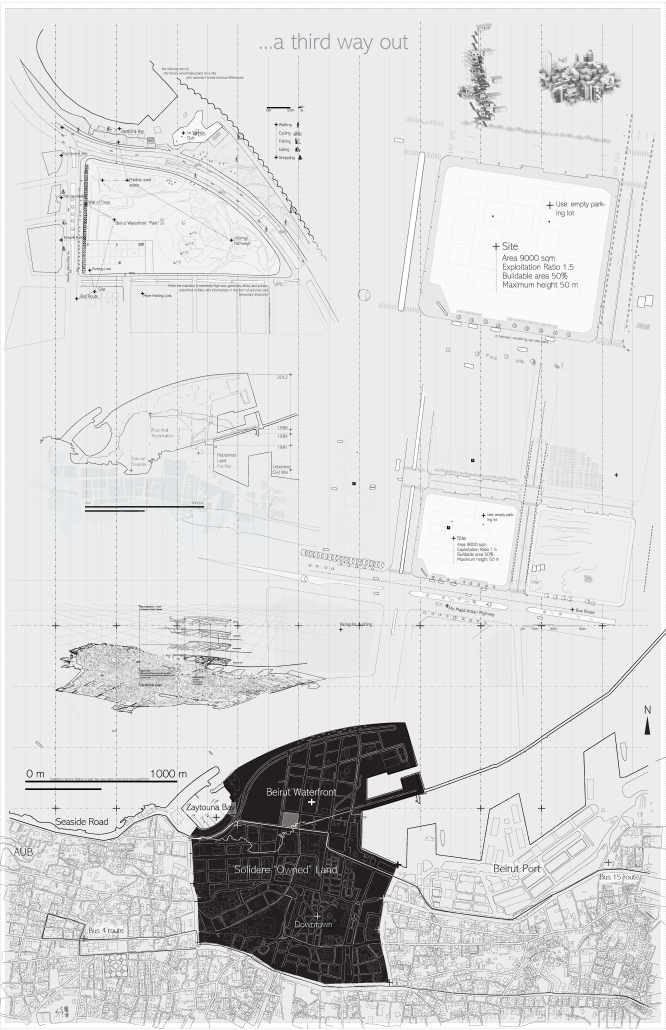
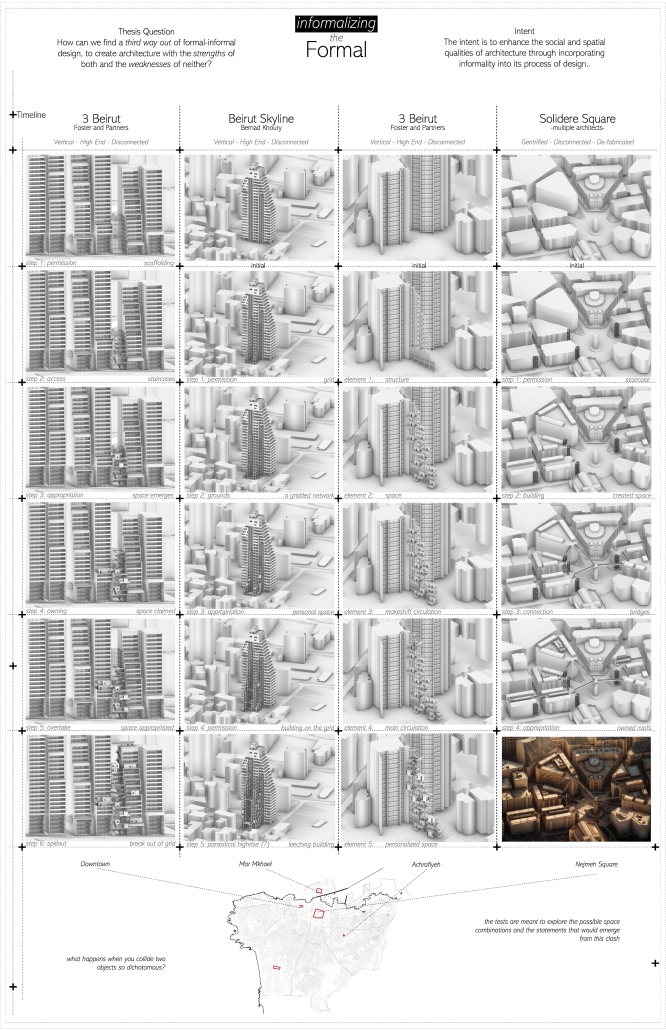
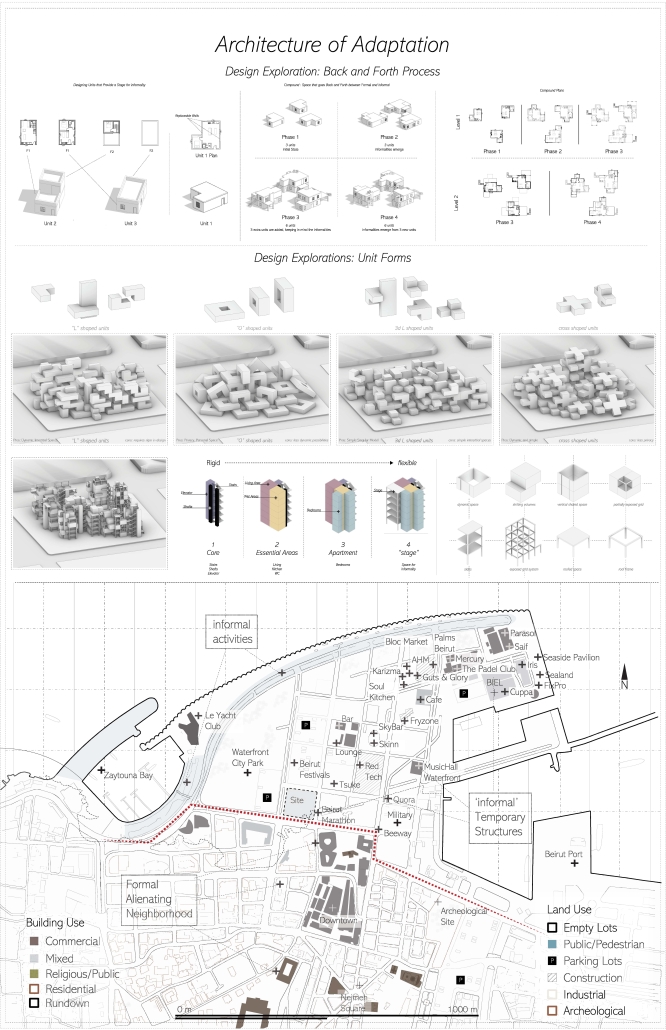
the informal Formal: a third way out by Yamen al Mohtar, B.Arch ’25
American University of Beirut | Advisor: Makram Al Kadi

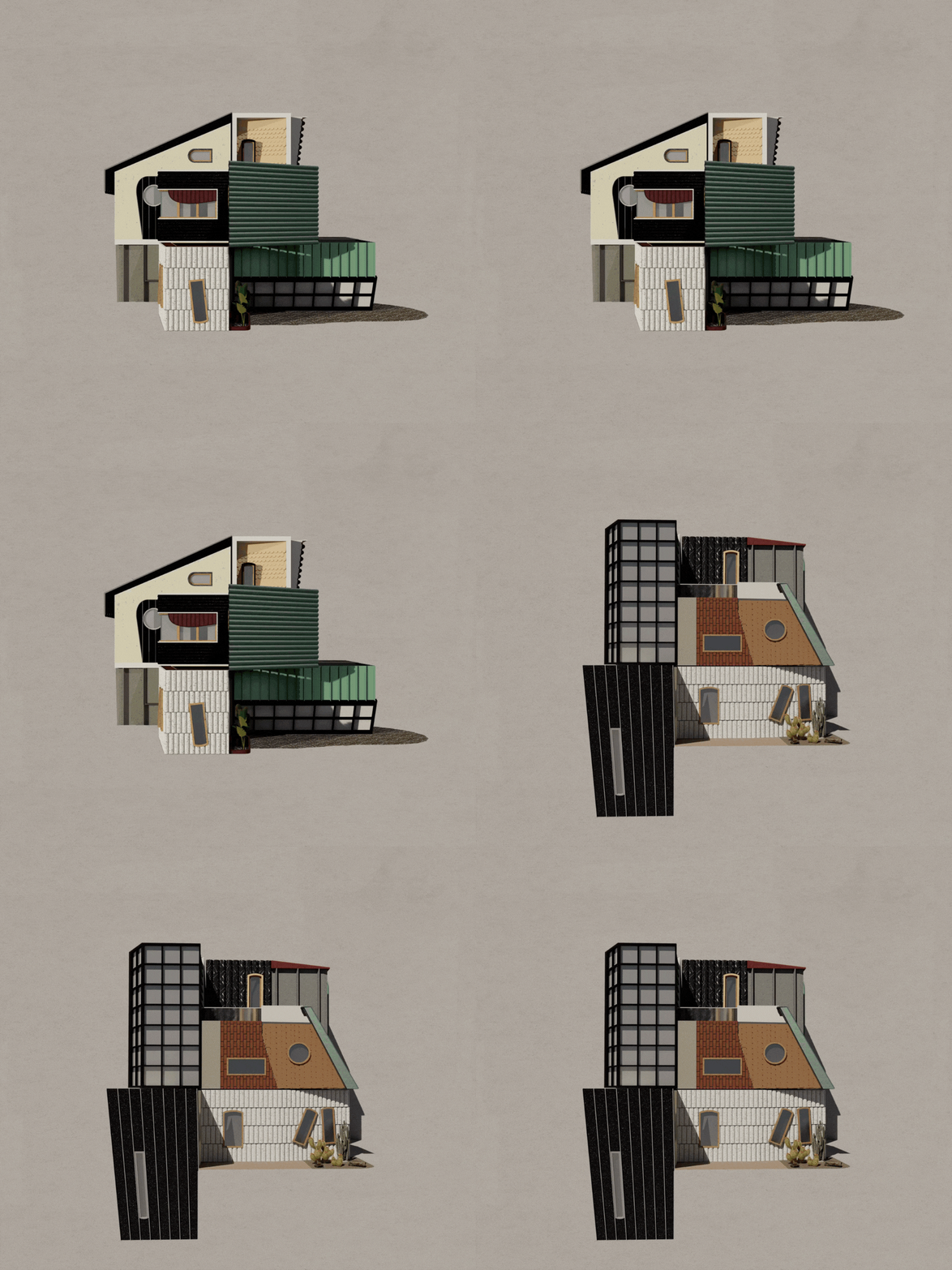
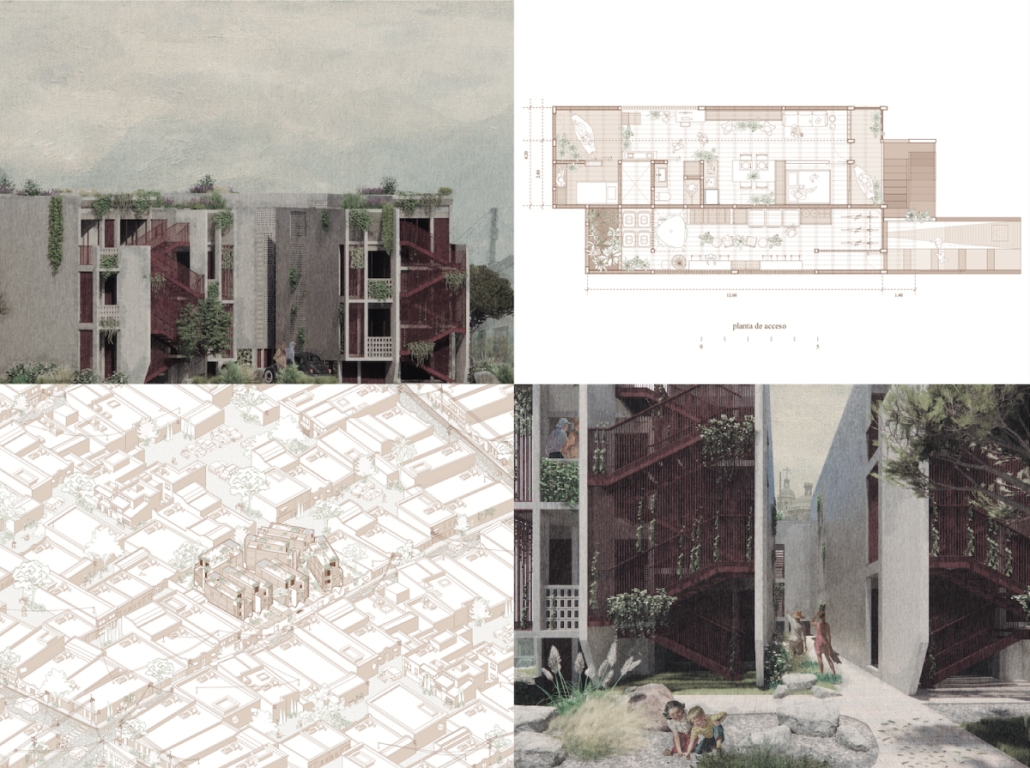
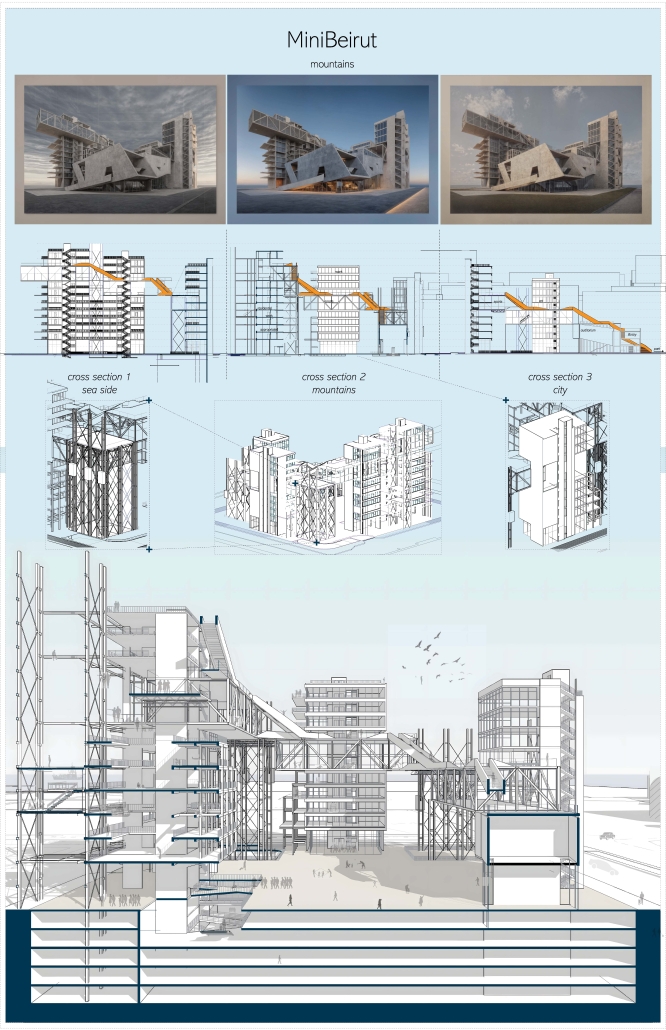
In today’s world, where architecture is designed down to every small detail, spontaneity has been cast aside in favor of control. However, while being true in certain cities, this reality is in no way universal. That is because in most countries and cities, designed architecture is only a fraction of what is built. Most buildings are built without architects, without engineers or professionals, sometimes even without builders. This language of architecture is embodied in various informalities, ranging from informal neighborhoods and slums to temporary structures and “spontaneous” buildings built out of necessity.

This thesis exploration delves into questions regarding this untapped space, asking questions like: What if informality emerges not as a product of circumstance, but as a personalized method of design? What if different classes of society can be brought together through the incorporation of the informal into formal design? How can we use informality as a design method that could be applied universally, providing unique spatial qualities that would otherwise be exclusive to a few? What if there’s a new design process? One which is neither formal nor informal, but one which has the virtues of both and the downsides of none?

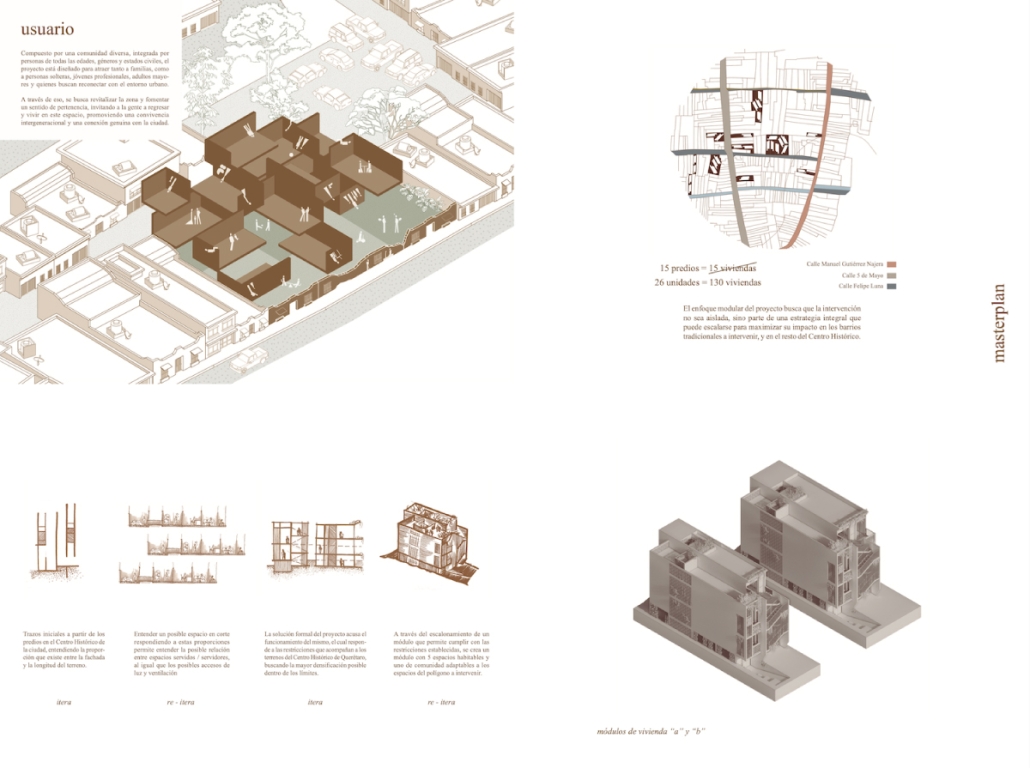
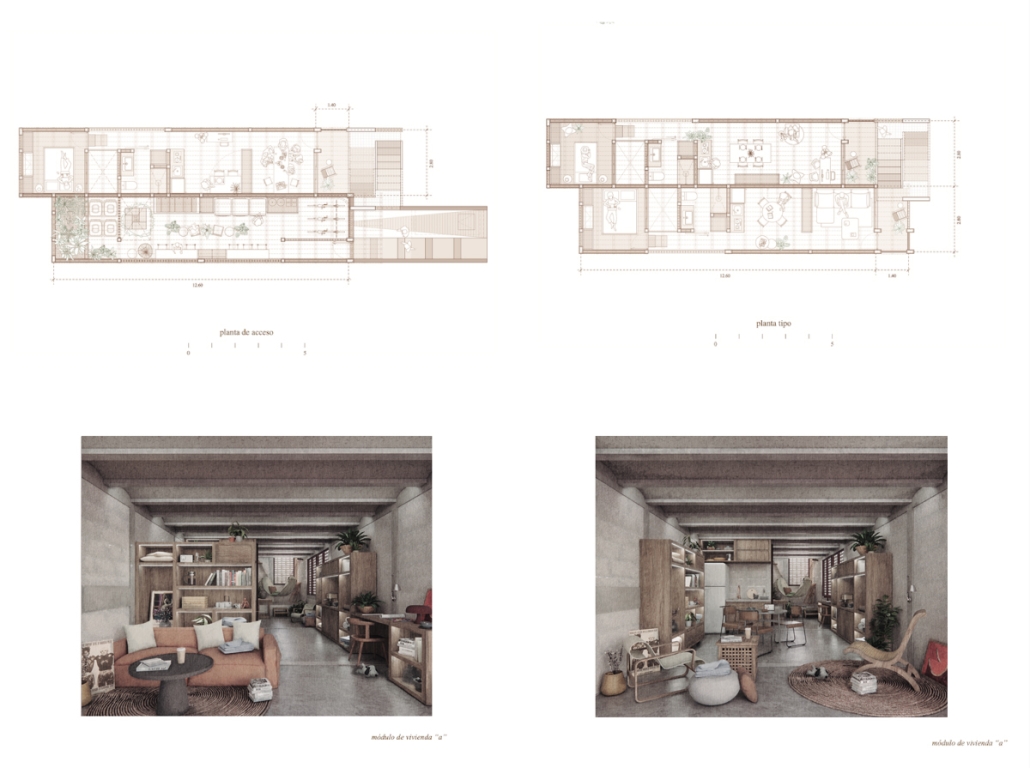
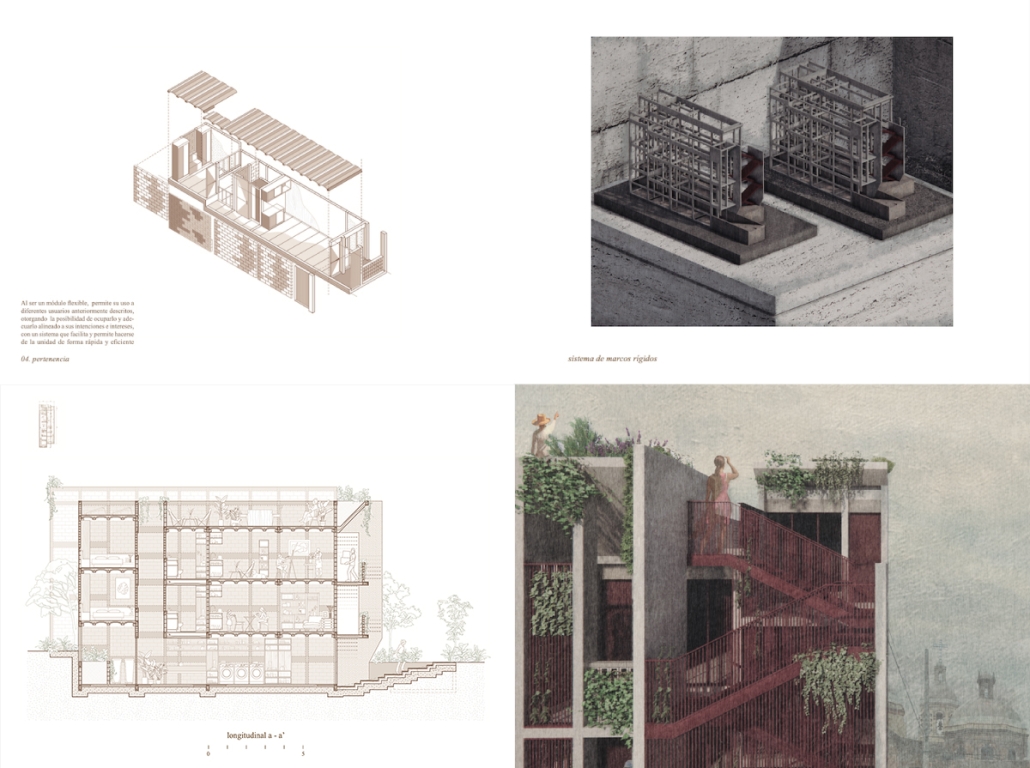
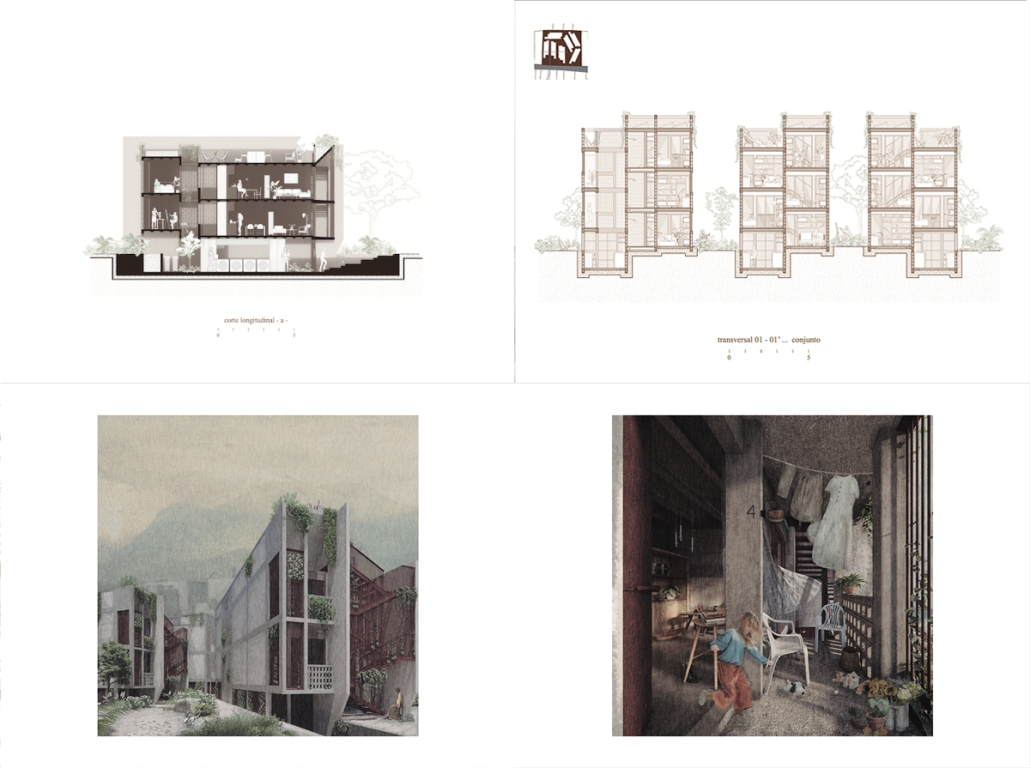
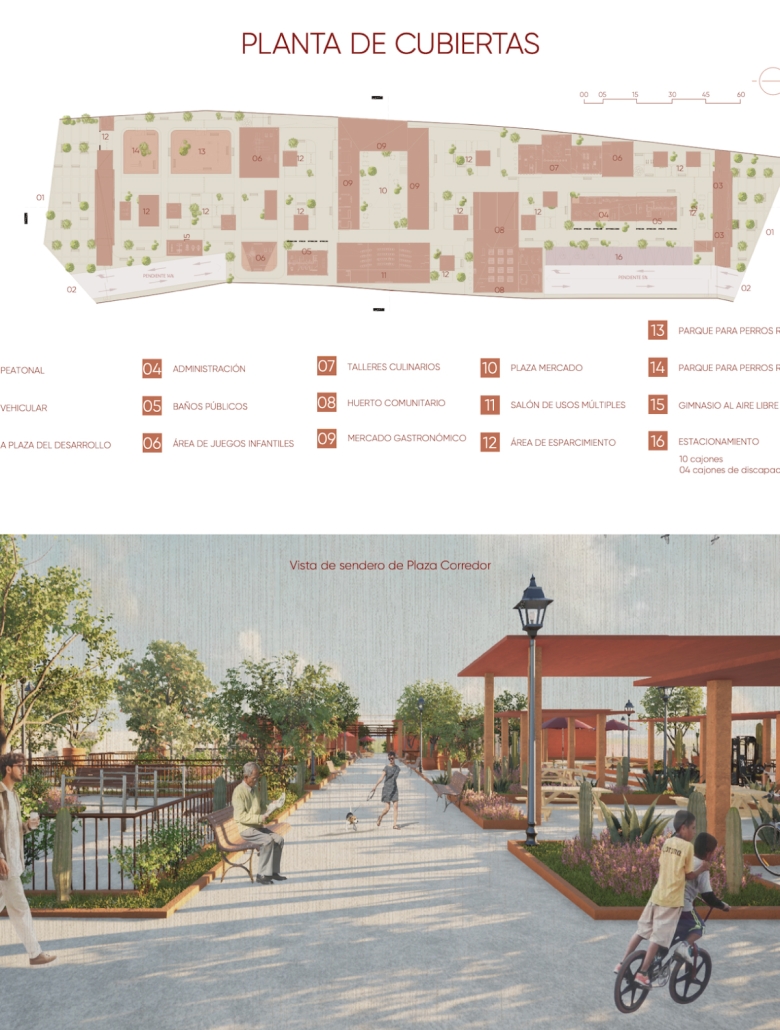
The Corridor, Neighborhood Center by Alejandro Rodríguez Torres, B.Arch ’25
Universidad Anáhuac Querétaro | Advisors: Guillermo Márquez, Patricia Cutiño & Jorge Javier

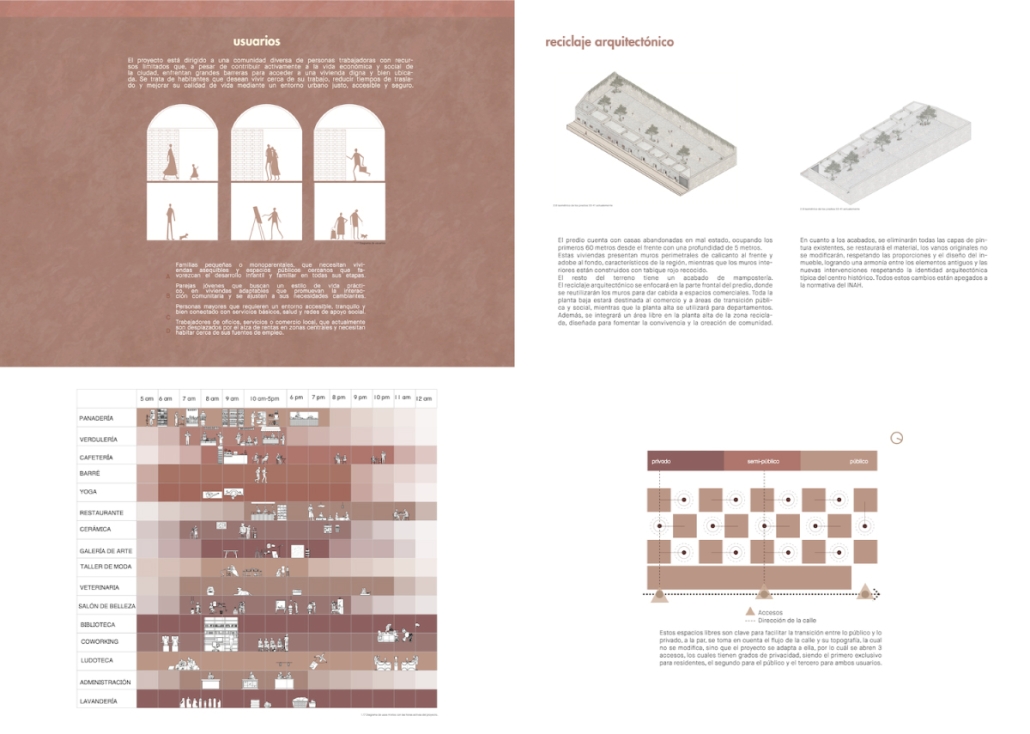
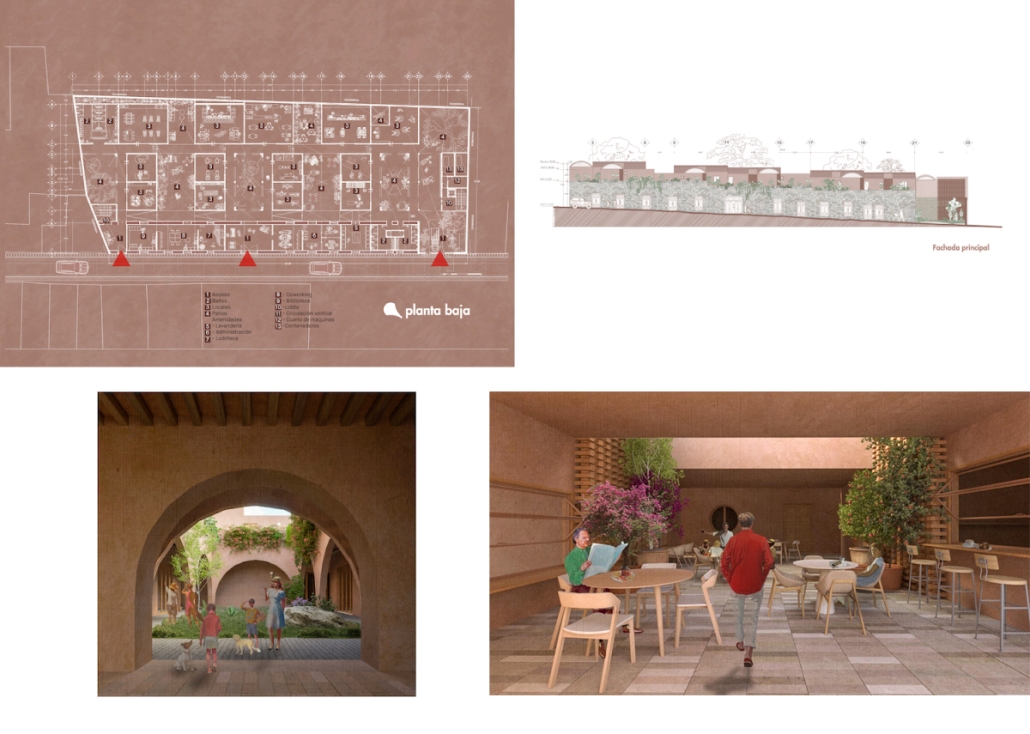
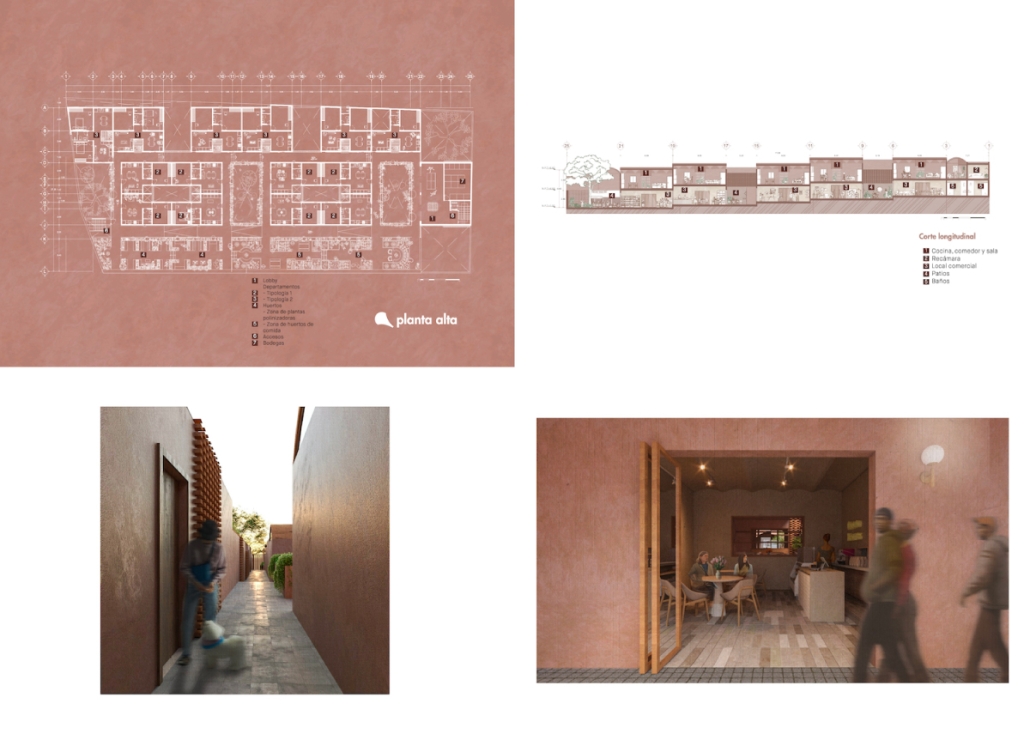
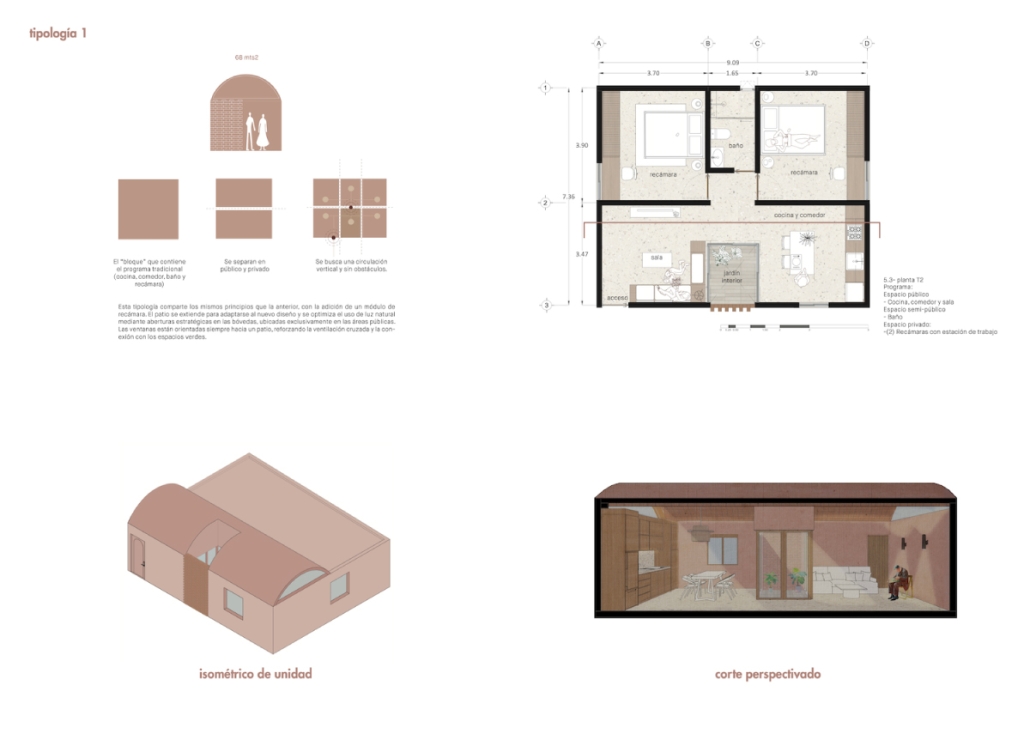
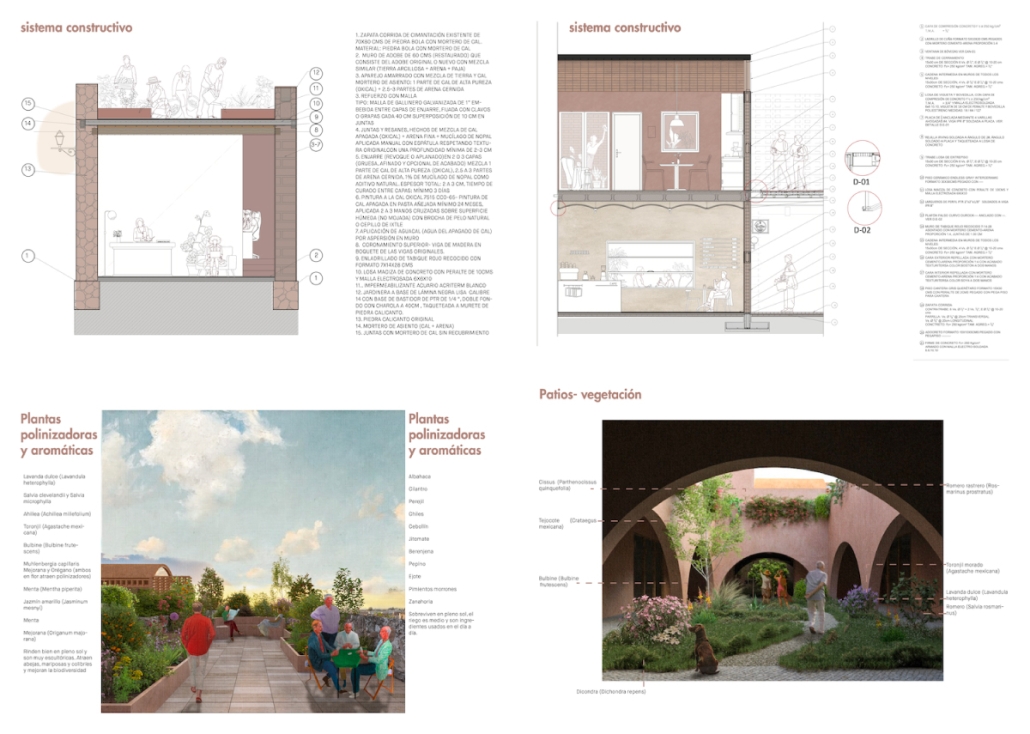
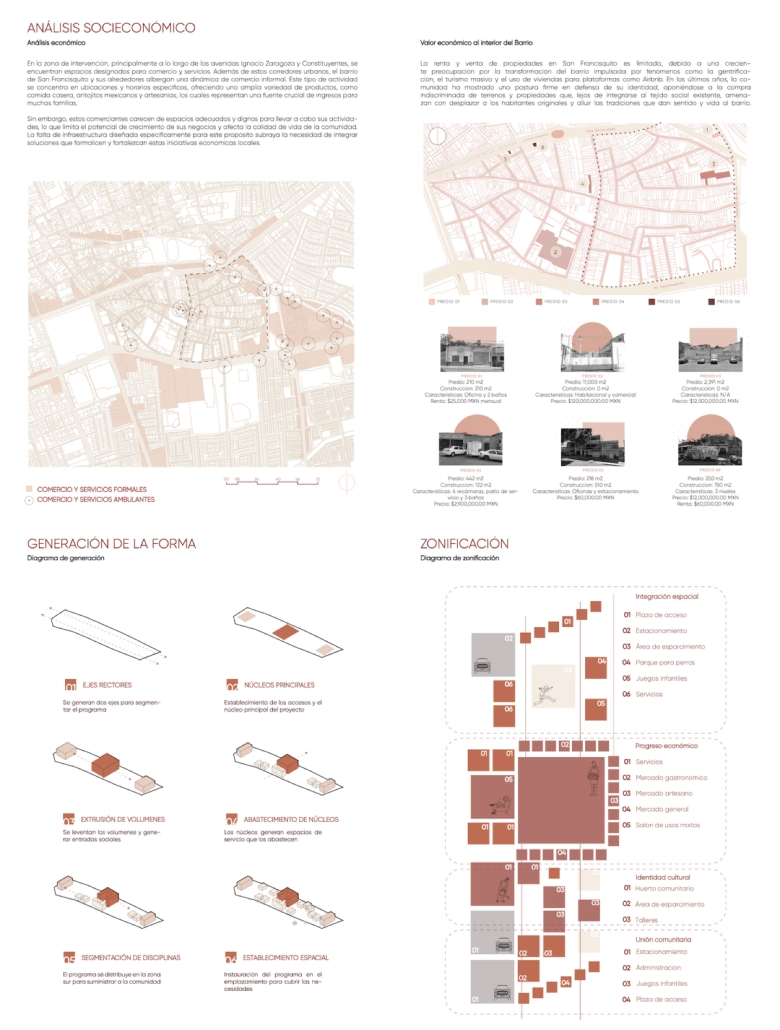
The goal of the project is to meet the need for a dignified central space that honors the history and cultural legacy of the San Francisquito neighborhood. It seeks to strengthen community unity through a specialized program that will position the project as a local and regional landmark. This space will integrate areas dedicated to recreation, culture, gastronomy and coexistence, key aspects to revitalize and strengthen the social fabric of the community.

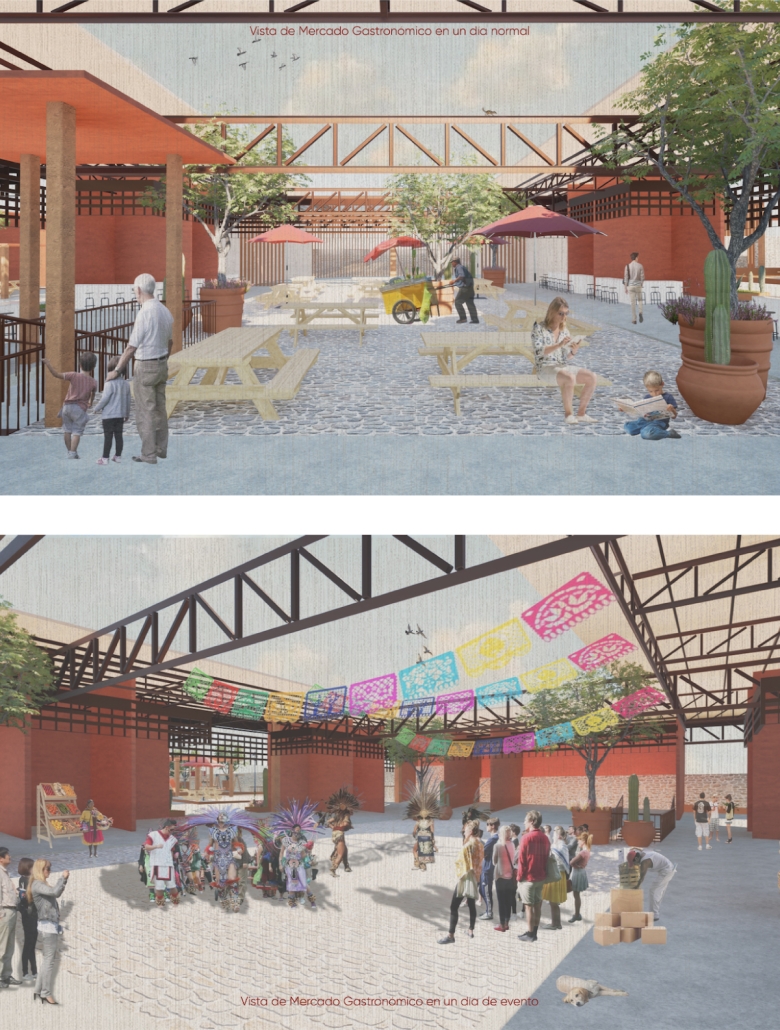
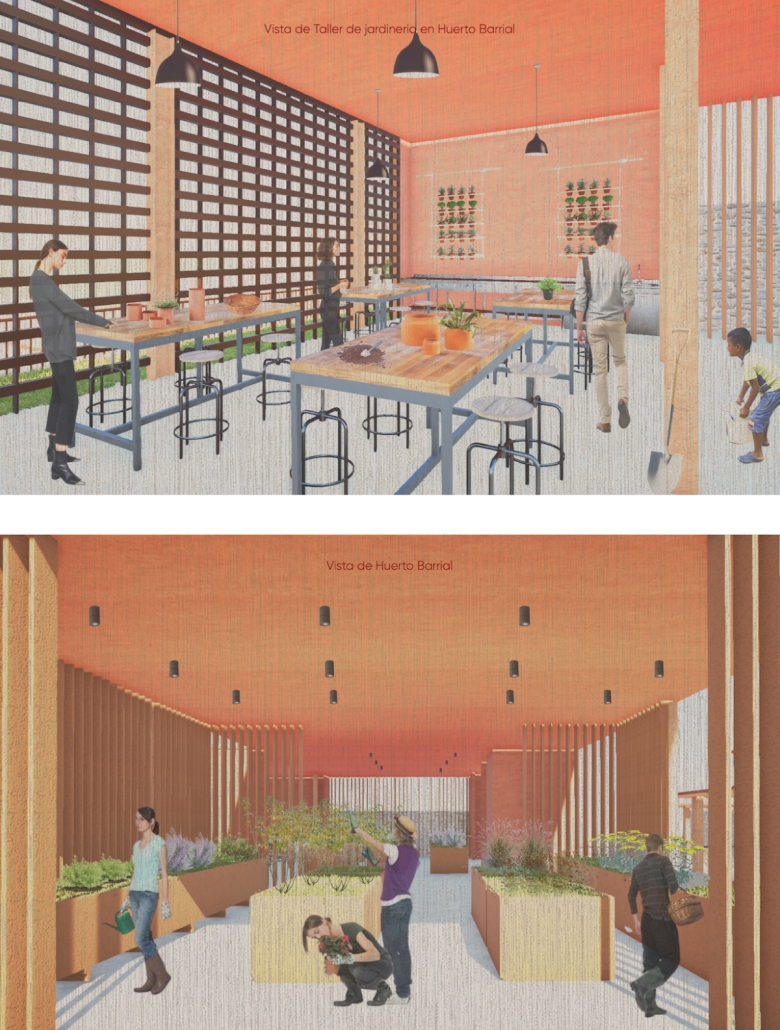
Located in front of the Divina Pastora parish church, ‘El Corredor’ will become the main square of the neighborhood, housing a food market, culinary workshops and a multi-purpose esplanade. This space will host sporting, cultural, religious and recreational events, consolidating, together with the parish church, as the main cultural and social centre of the San Francisquito neighborhood.

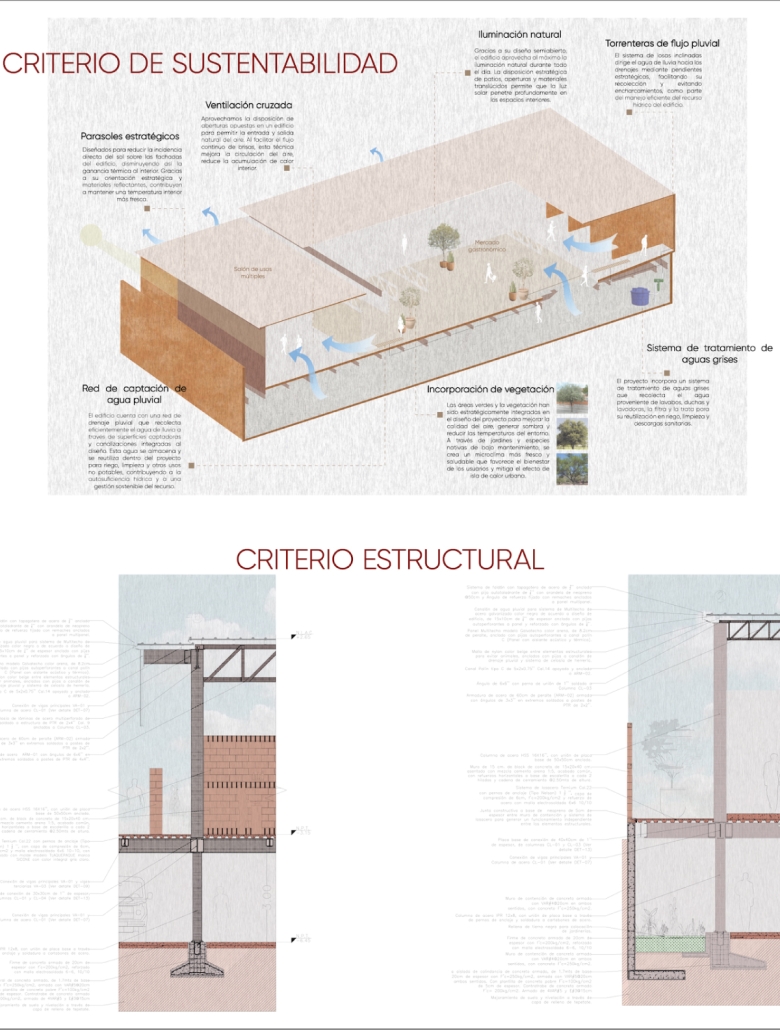
The architectural approach focuses on creating a vibrant and cohesive neighborhood centre that not only revitalizes a neglected environment, but also becomes the beating heart of the community. Designed to bring residents together, our space promotes coexistence and collaboration, while driving local economic development and celebrating the rich cultural diversity of the neighborhood. By integrating recreational, commercial and cultural zones, we have conceived a place where every corner invites interaction, learning and creativity. This project will not only transform the urban landscape but also strengthen community ties, providing an environment where everyone feels included and valued.

Instagram: @atorres025, @arquitectura_anahuac

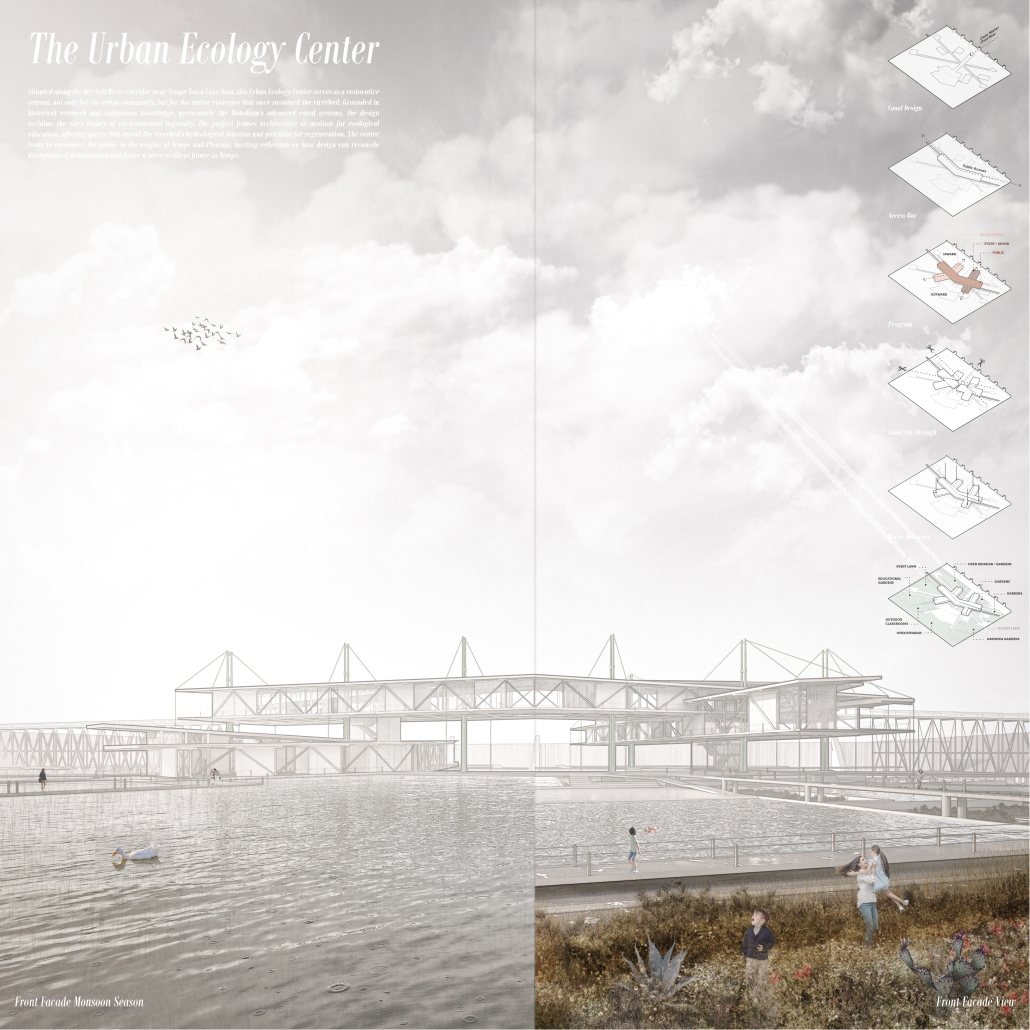
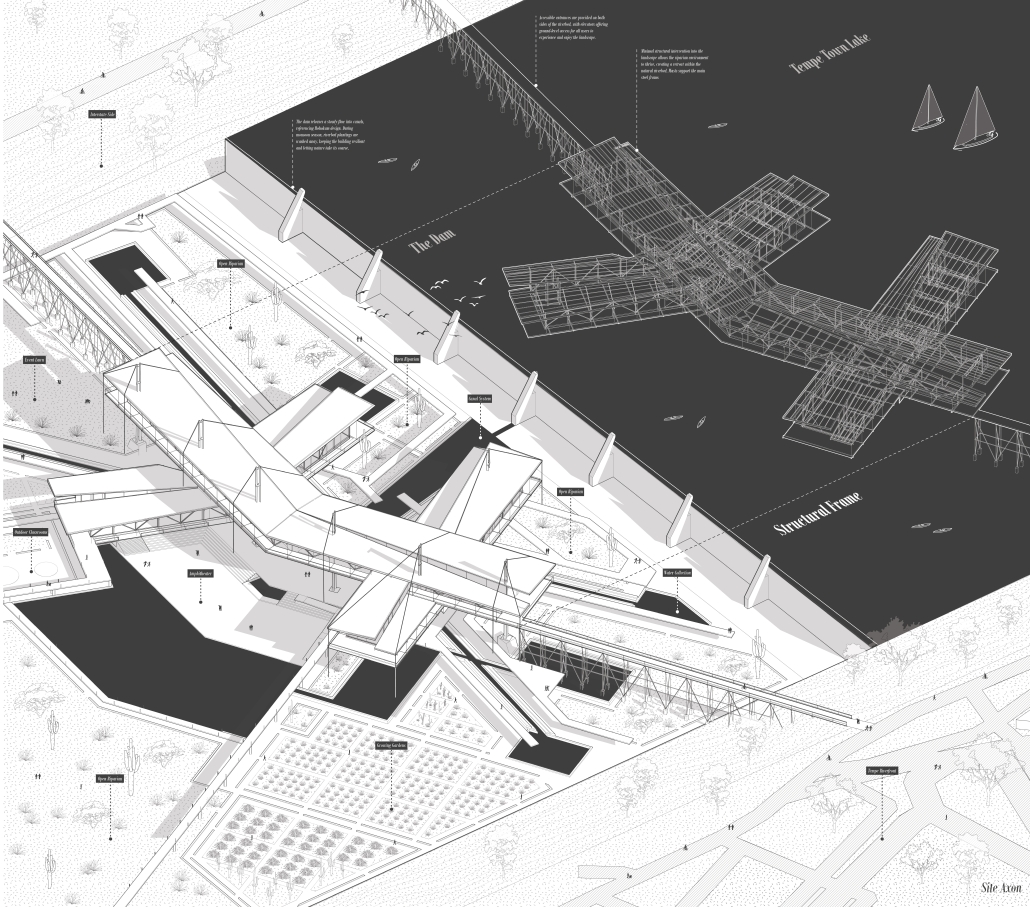
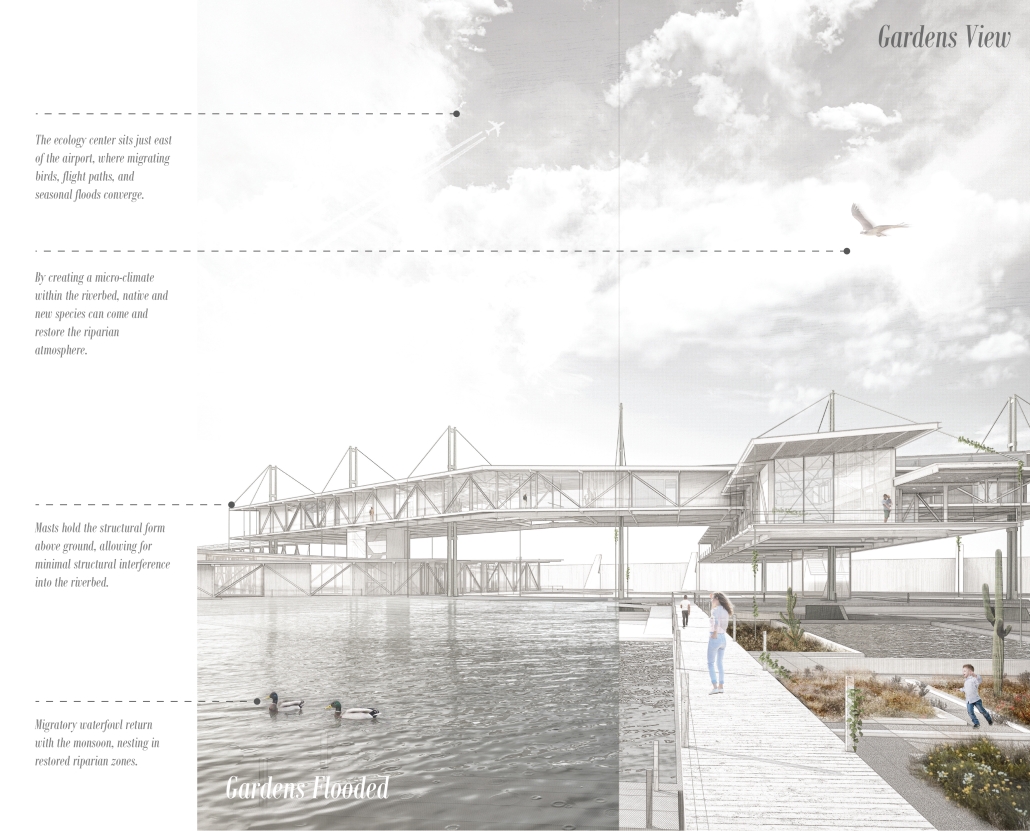
The Urban Ecology Center by Sydney Tucker, M.Arch ’25
Kansas State University | Advisor: Chad Schwartz

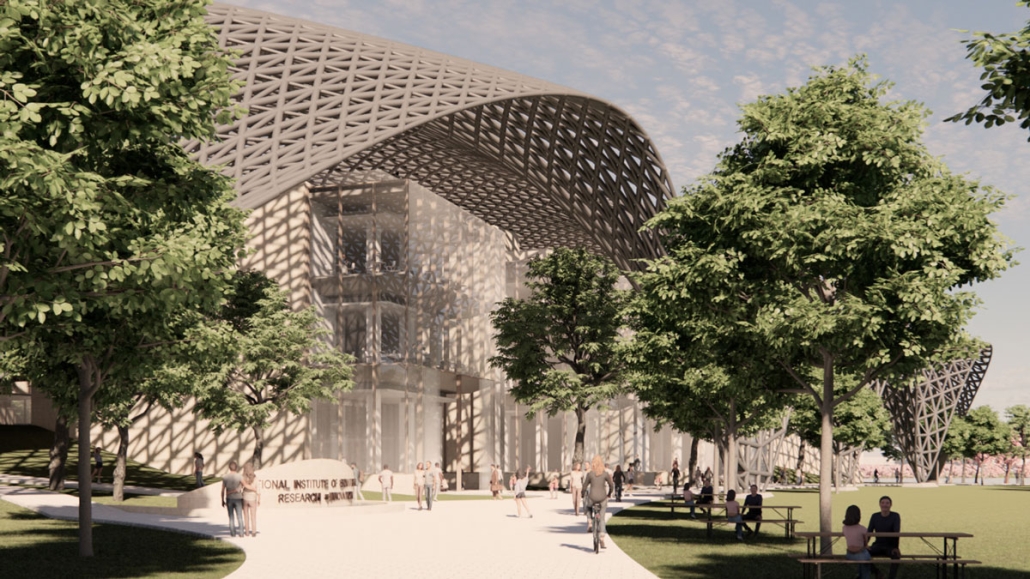
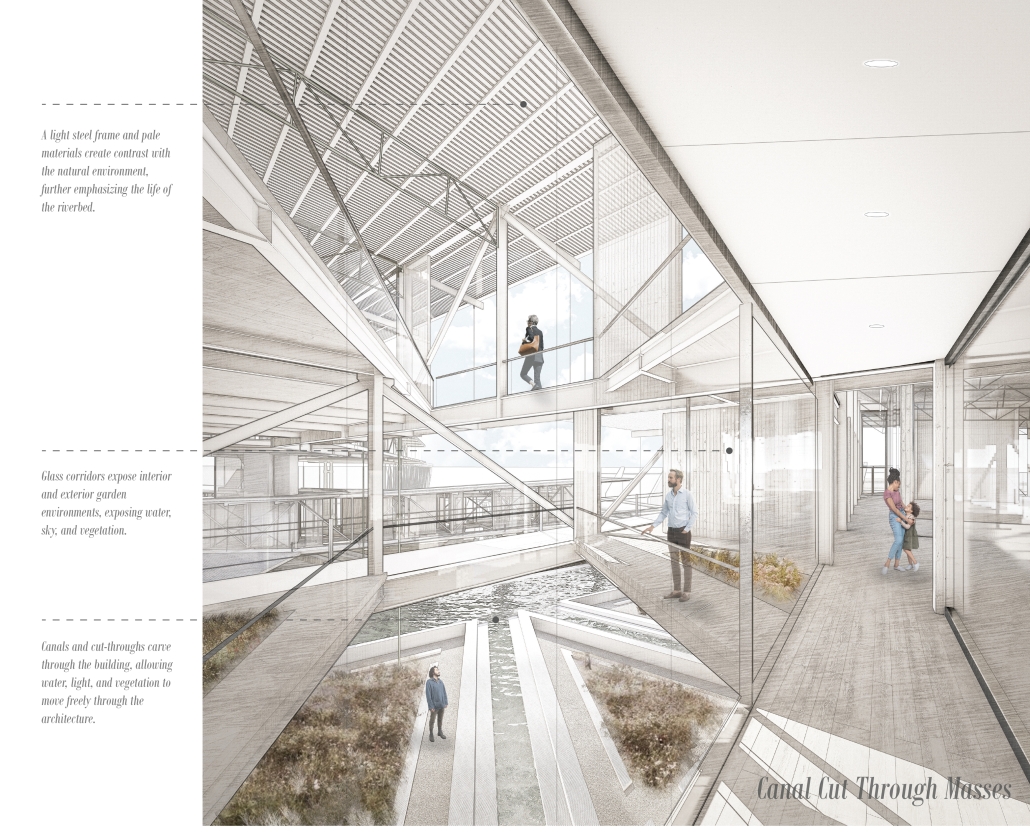
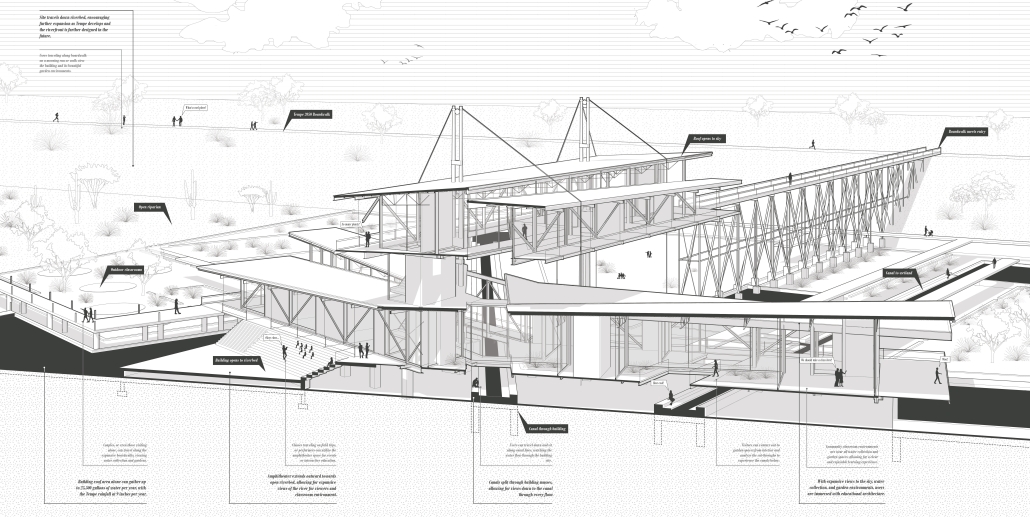
Situated along the dry Salt River corridor near Tempe Town Lake Dam, this Urban Ecology Center serves as a restorative retreat, not only for the urban community, but for the native ecologies that once sustained the riverbed. Grounded in historical research and indigenous knowledge, particularly the Hohokam’s advanced canal systems, the design reclaims the site’s legacy of environmental ingenuity. The project frames architecture as a medium for ecological education, offering spaces that reveal the riverbed’s hydrological function and potential for regeneration. The center looks to reconnect the public to the origins of Tempe and Phoenix, inviting reflection on how design can reconcile disruptions of urbanization and foster a more resilient future in Tempe.

Instagram: @sydneytucker1, @cjs_arch

Eco-corridor by Tinarith Tann, B.Arch ’25
New York Institute of Technology | Advisor: Jeannette Sordi

Far Rockaway, located at the eastern end of the Rockaway Peninsula in Queens, New York, is a coastal community uniquely situated between two bodies of water: Jamaica Bay to the north and the Atlantic Ocean to the south. Despite offering natural beauty, its geographical setting is vulnerable to flooding, especially during extreme weather conditions such as hurricanes, nor’easters, and intense coastal storms.

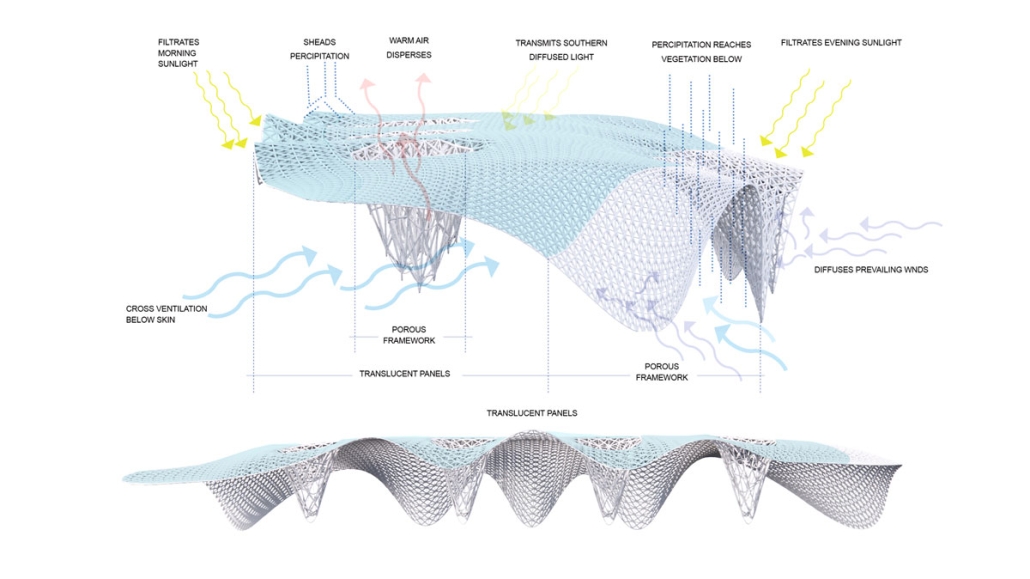
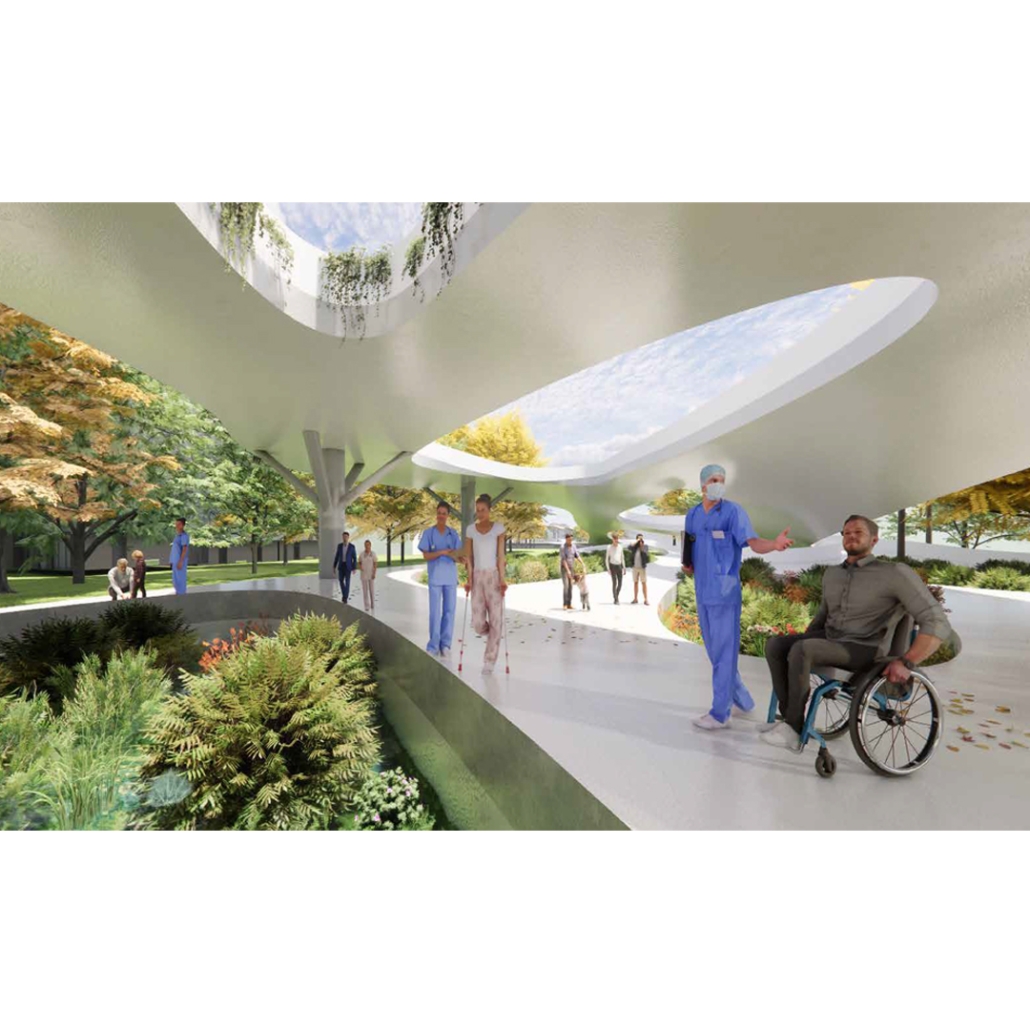
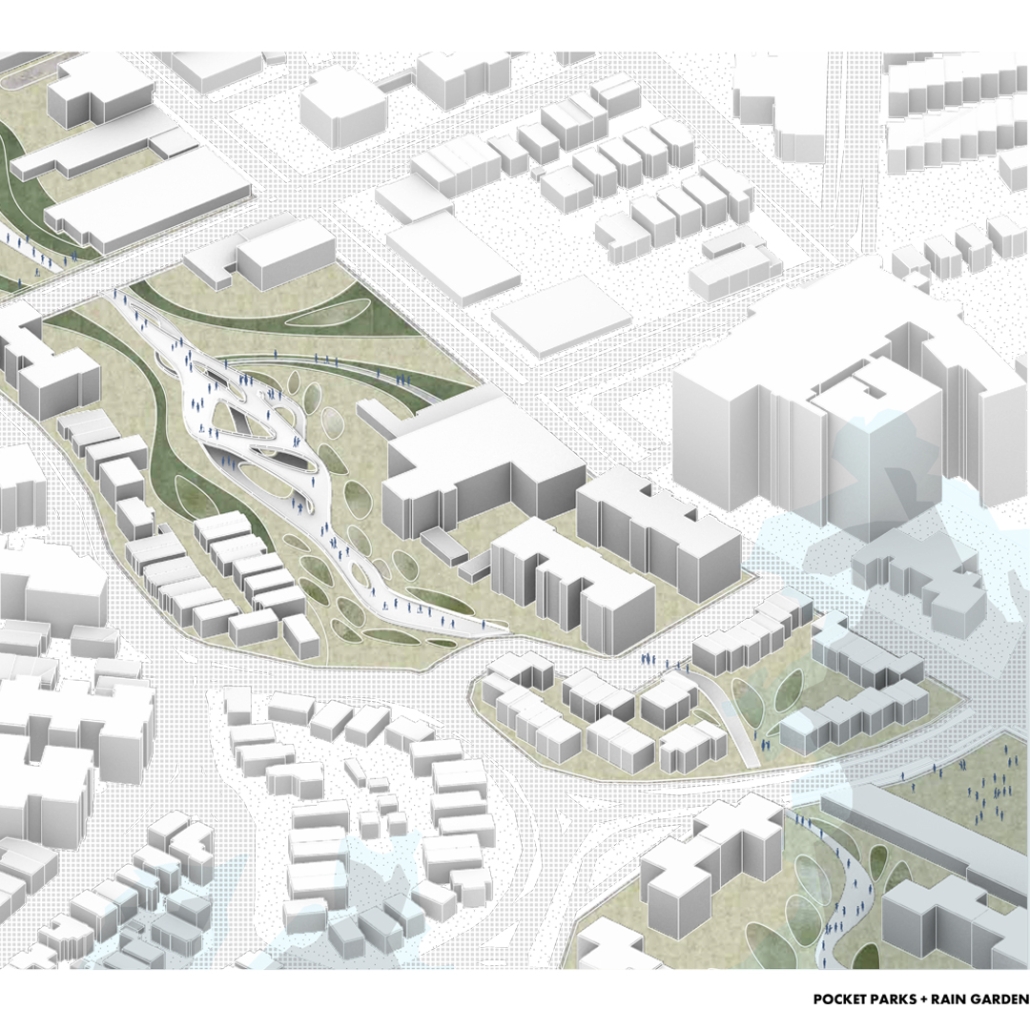
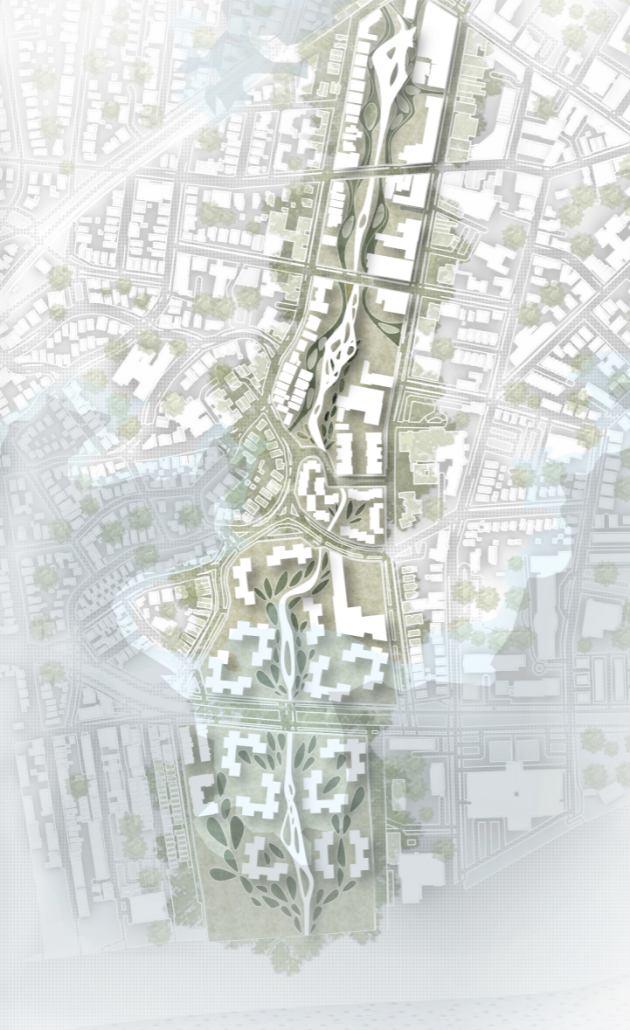
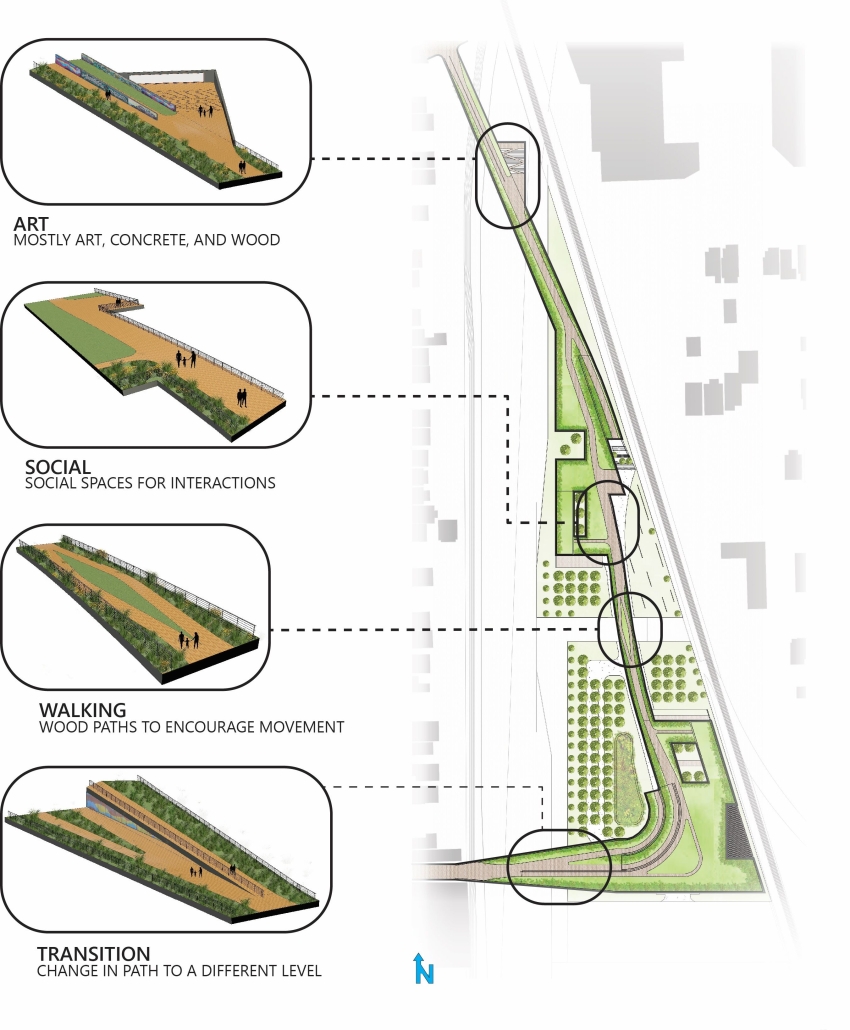
This thesis project designs eco-corridors—living pathways that transform unused urban spaces into a continuous green network stretching from downtown Far Rockaway to the water. These connections will revive neglected areas while addressing multiple challenges at once: managing stormwater and providing people with beautiful, functional natural and indoor spaces.

Click here to learn more.

This project was featured in the NYC Design Week, NYIT Exhibition.

Instagram:  @narith___, @jeannettesordi

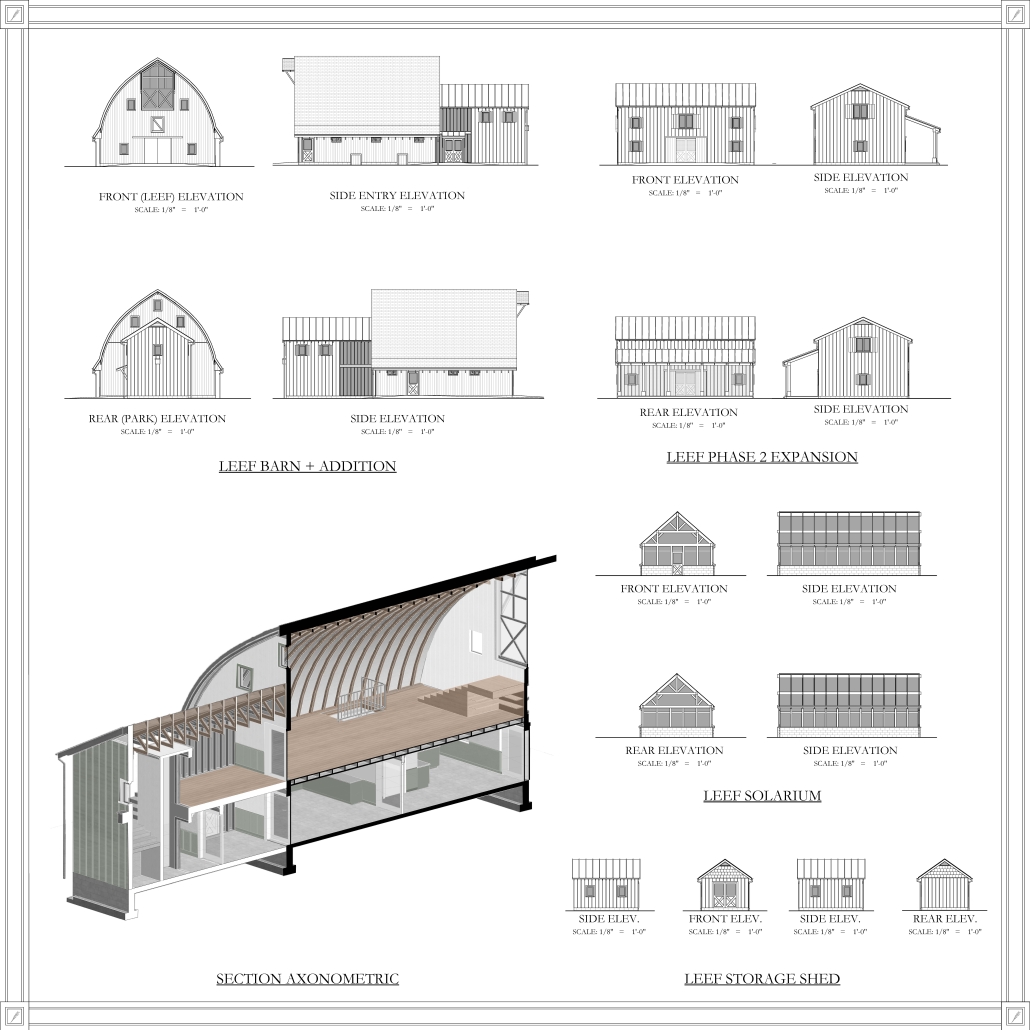
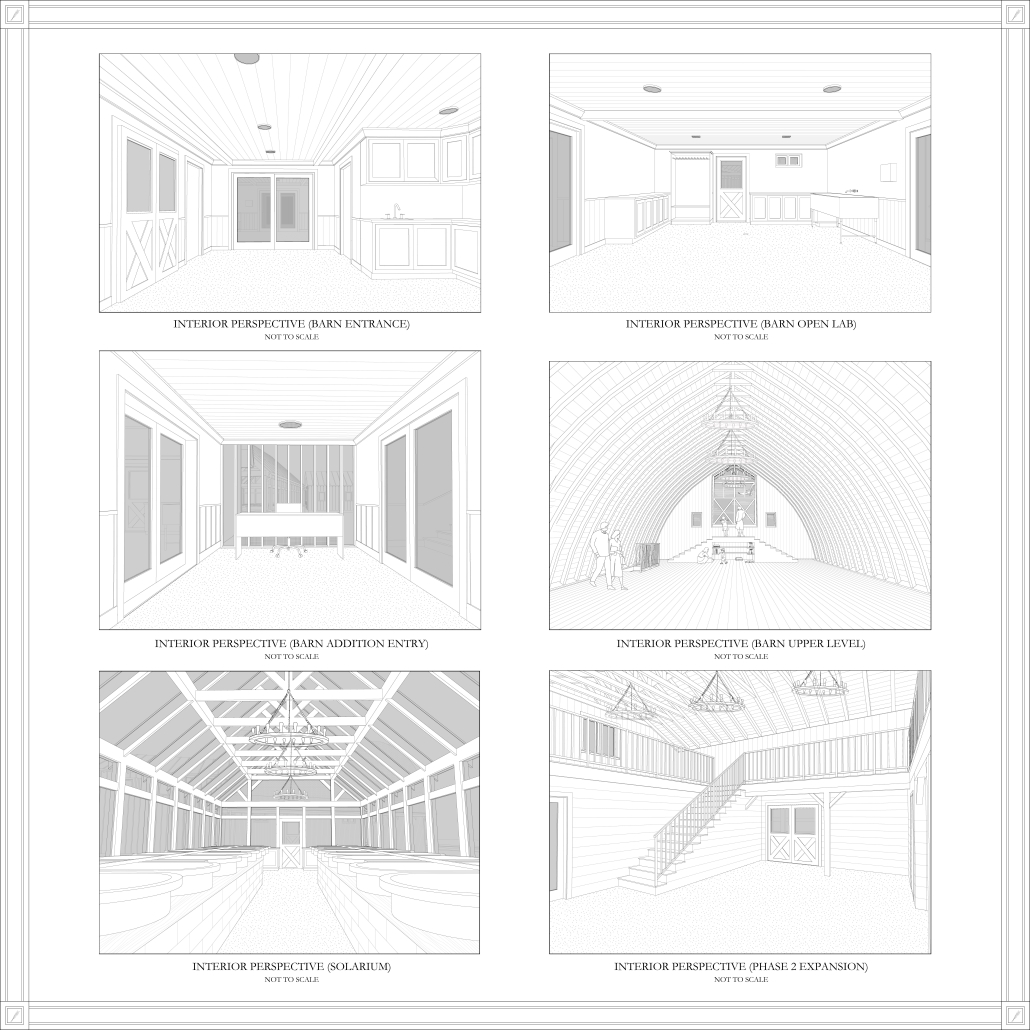
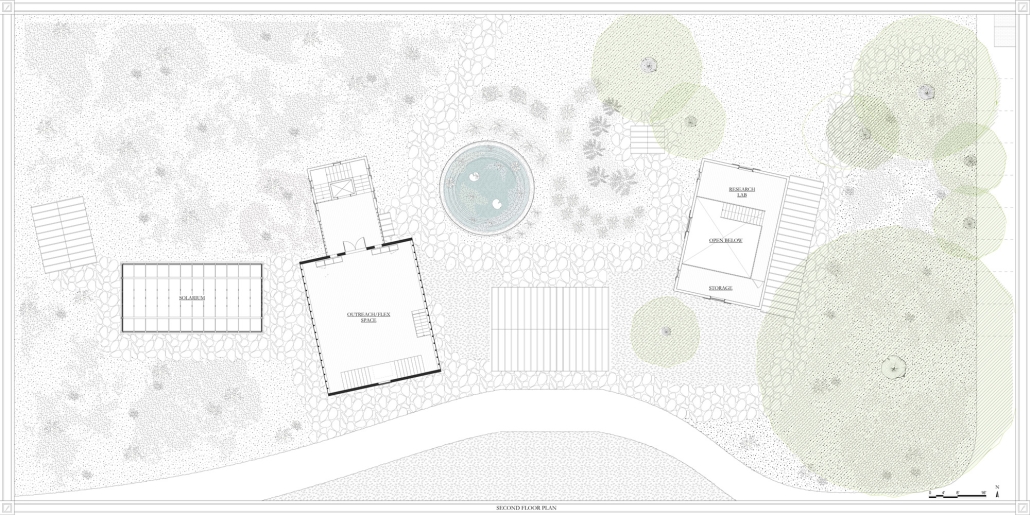
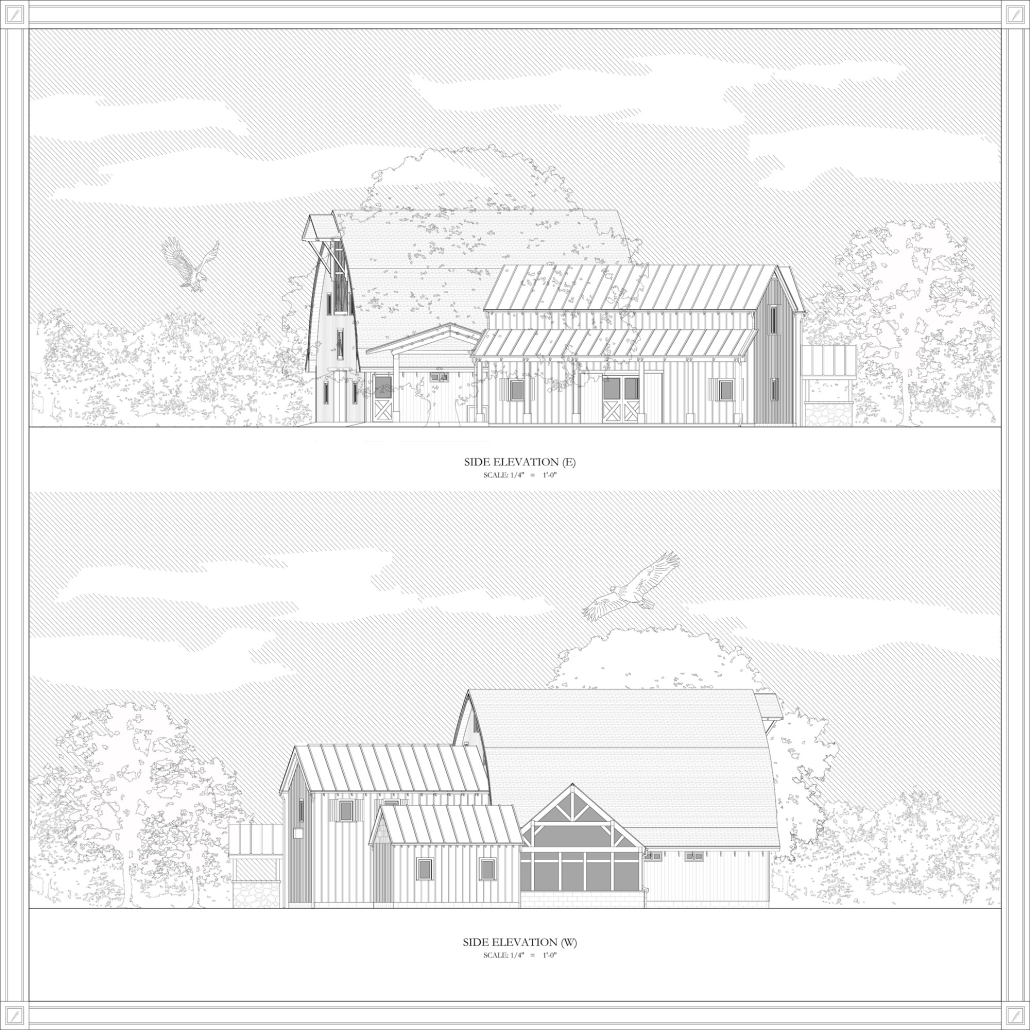
BARN REIMAGINED: Adaptive Reuse as Environmental Stewardship by Kevin Johnson & Leanne Vera, M.Arch ’25
University of Notre Dame | Advisor: Ming Hu

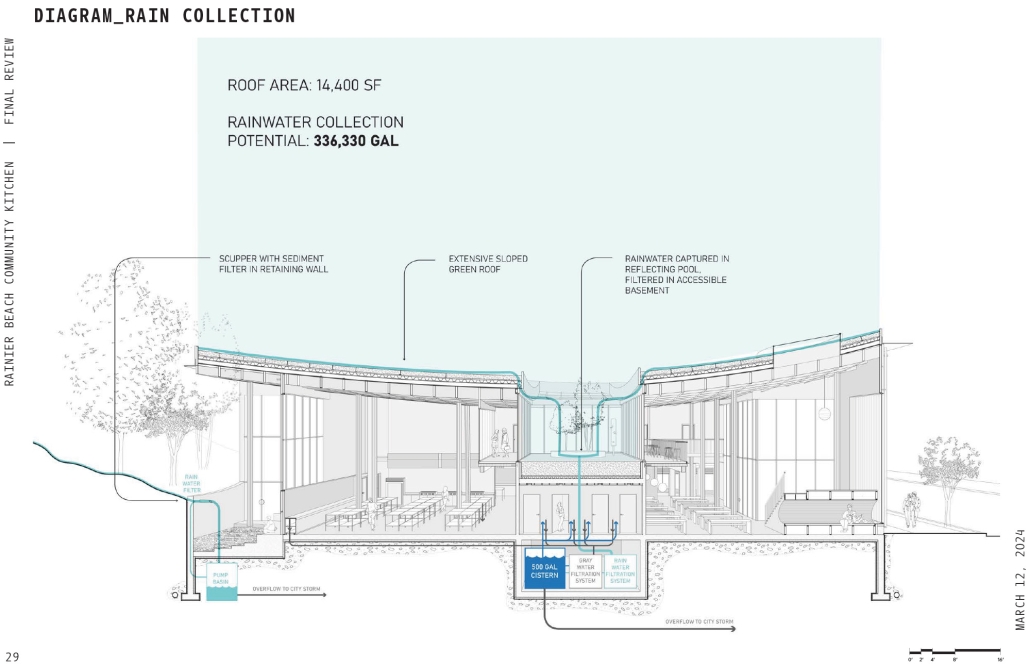
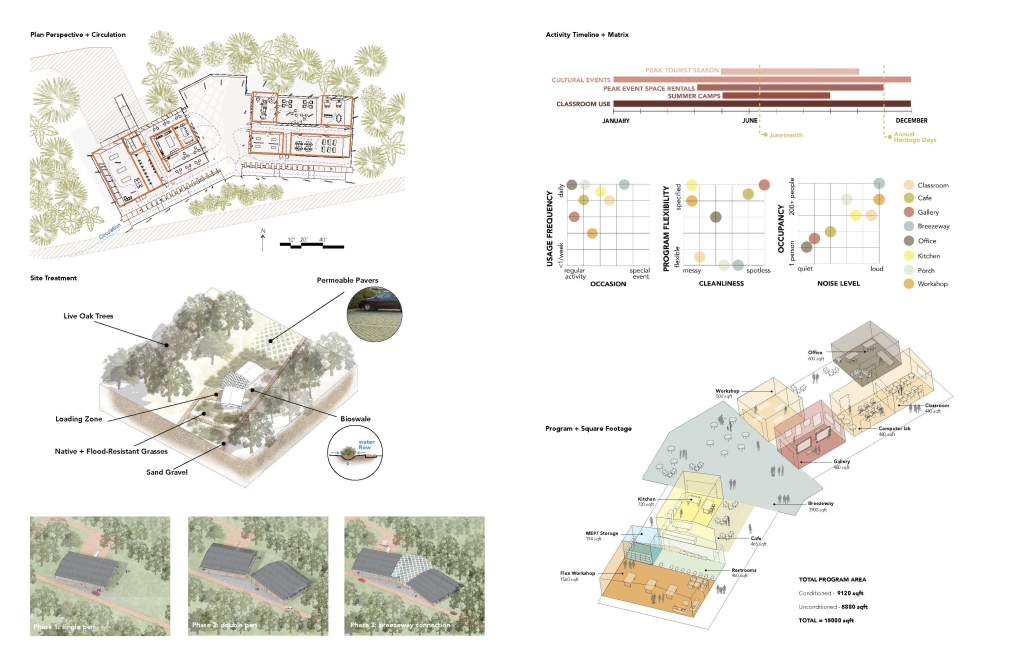
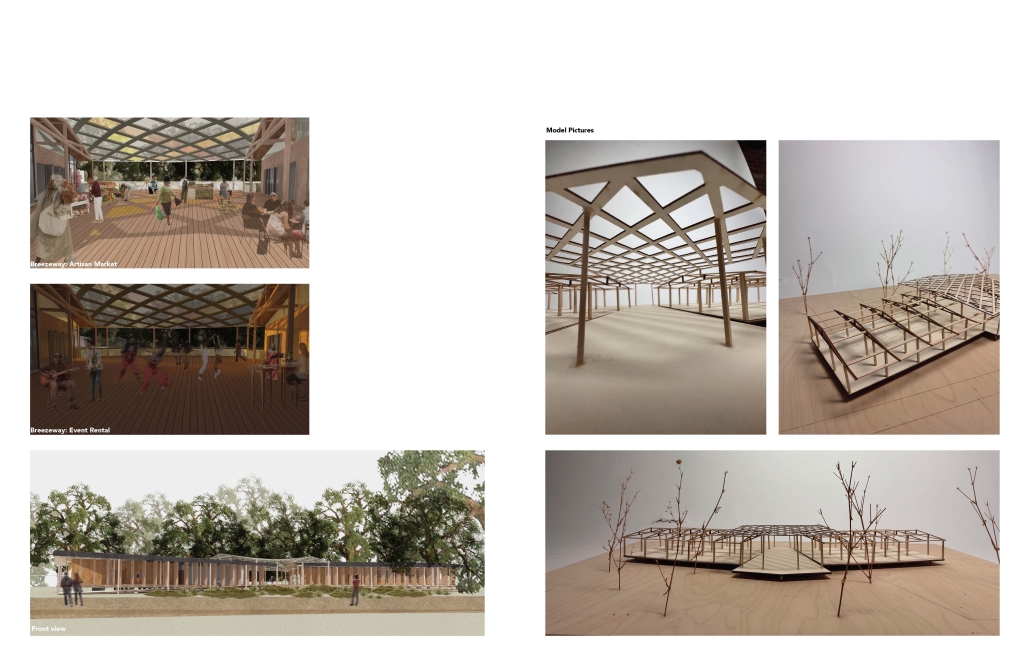
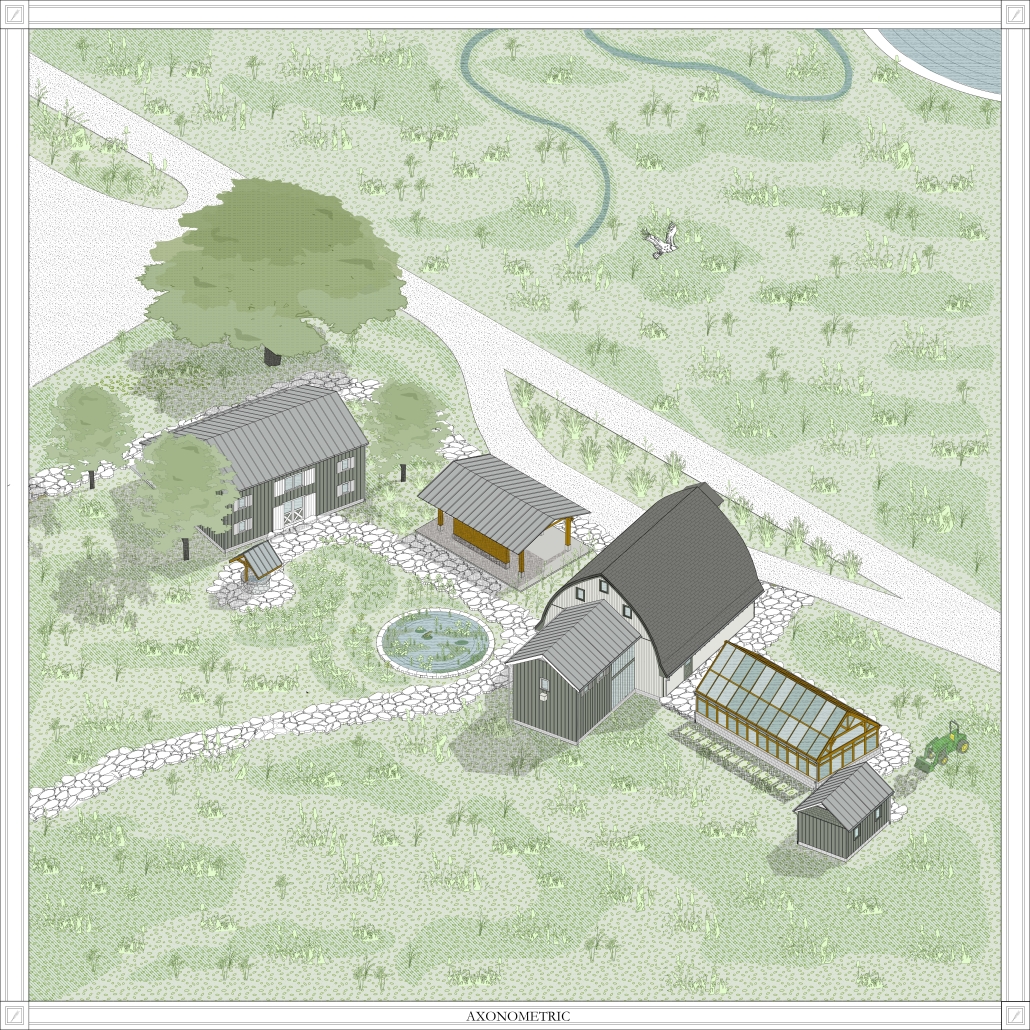
This design aims to propose a barn complex that addresses LEEF’s mission of “Science Serving Society”, creating a functional complex that meets the need for public and private uses, enhances user views towards the Eagle’s Nest, and responds sensitively to the climatic conditions of the site while integrating into the landscape with minimal interventions to appear as if it were always there. At the core of the project, we sought to integrate sustainable design strategies as a link between LEEF’s mission and the architect’s duty to the environment.

We decided to orient the barn’s front facade, which contains the large triangular window, directly towards the existing Eagle’s Nest, which is a mainstay of the existing LEEF site. This orients the building roughly SE and maximizes the barn’s solar capabilities. The Solarium takes the orientation of the existing pavilion in order to maximize solar gain.

By keeping the building footprints small and separating the massings, we were able to reduce excessive heating, cooling and energy expenses. We also emphasized the importance of the natural prairie habitat as the predominant landscape and tried to minimize additional landscaping. Additionally, we propose utilizing local materials and adding a rainwater collection system for reuse in the LEEF facilities.

Our project embodies a holistic approach to adaptive reuse by thoughtfully preserving the historic Gothic arch barn and integrating it within a sustainably designed complex that supports LEEF’s mission of “Science Serving Society.” By achieving net-zero energy usage, implementing rainwater harvesting, restoring prairie ecosystems, and utilizing locally sourced materials, our proposal not only preserves the historic barn but also sets a precedent for future environmentally conscious adaptive reuse projects. 

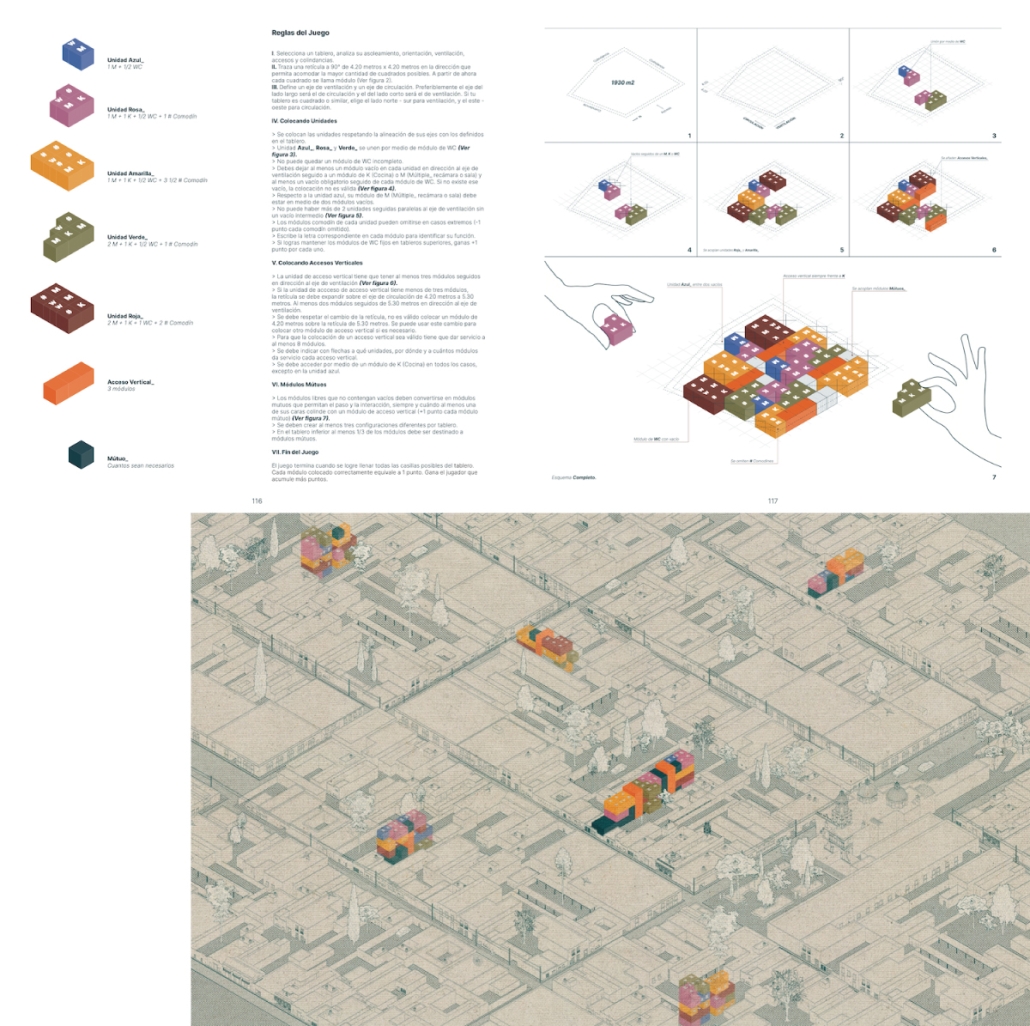
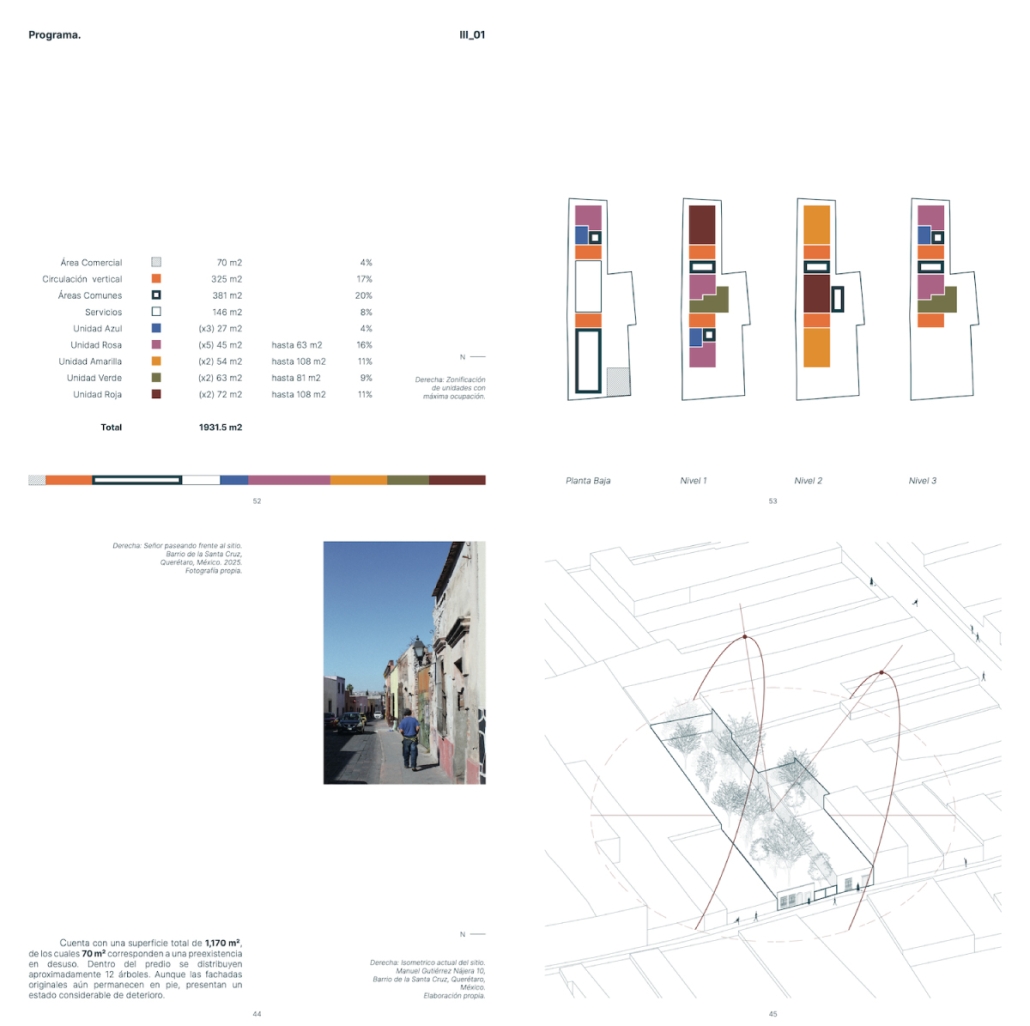
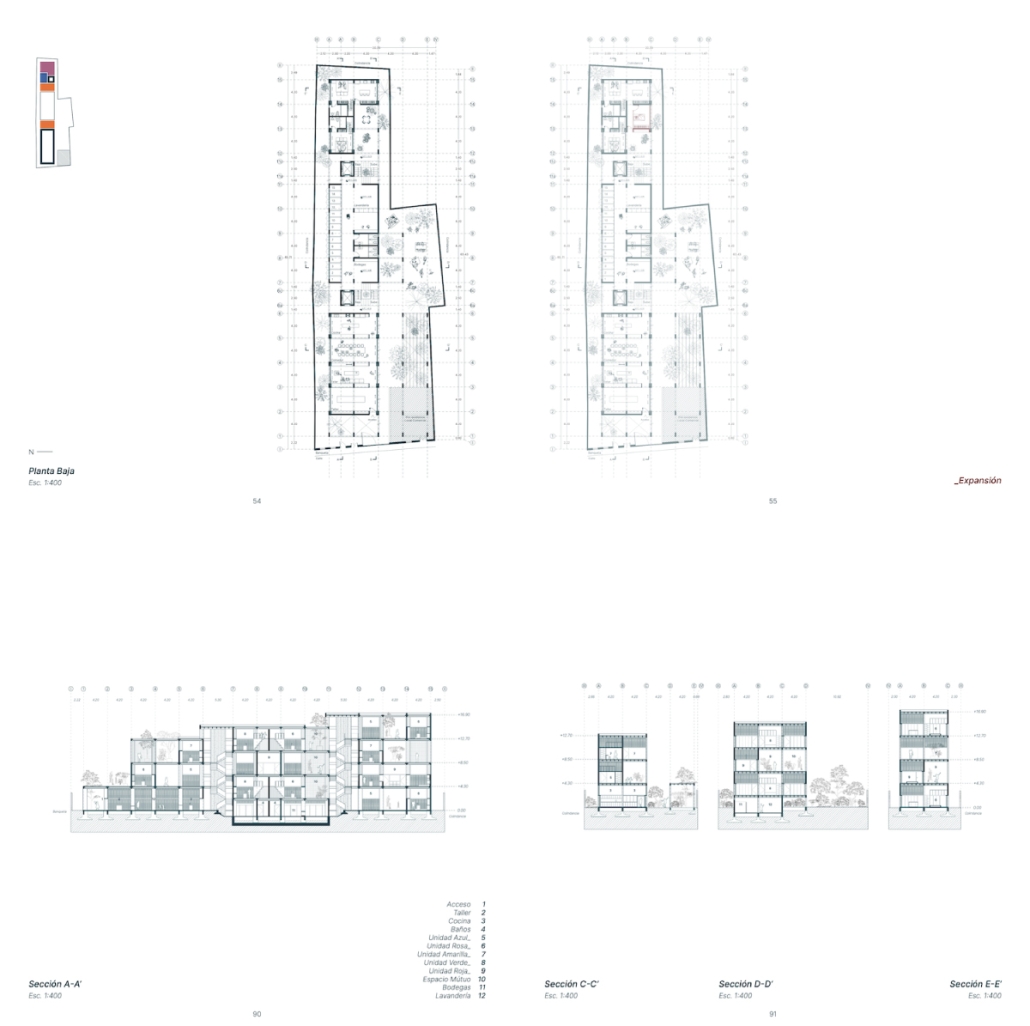
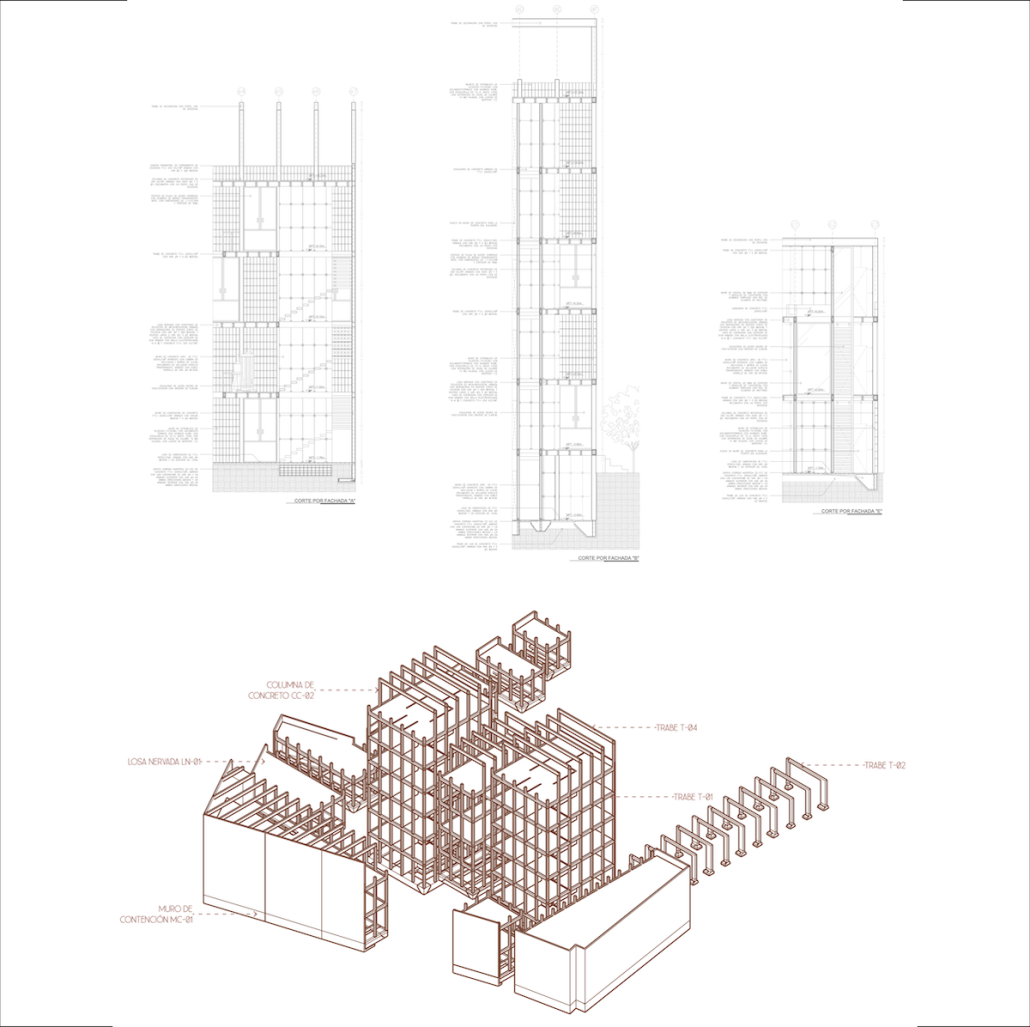
La Factoría del Pueblo, Artist’s temporary internship by Estefania Vizcaya, B.Arch ’25
Universidad Anáhuac Querétaro | Advisors: Guillermo Márquez, Patricia Cutiño & Jorge Javier

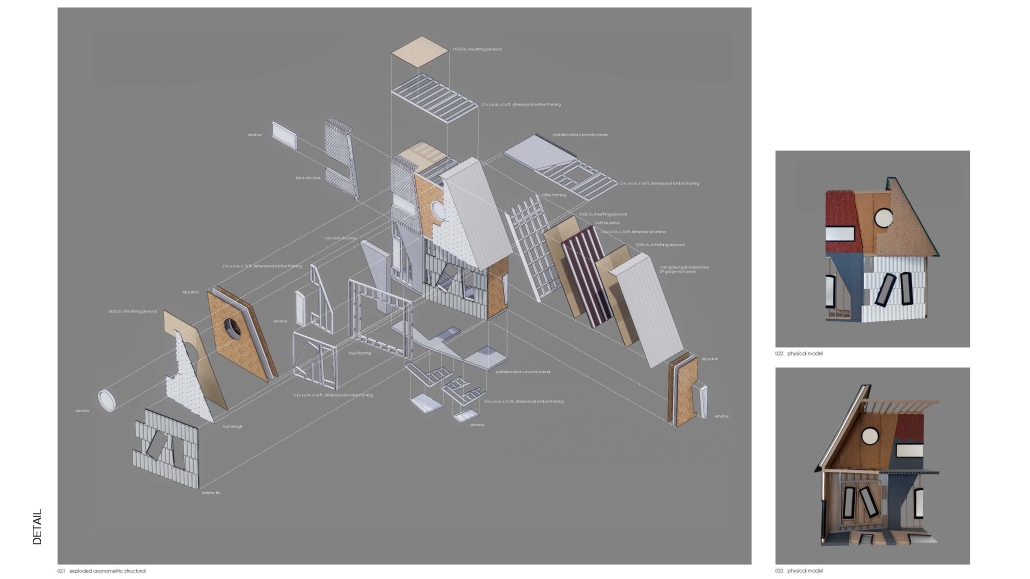
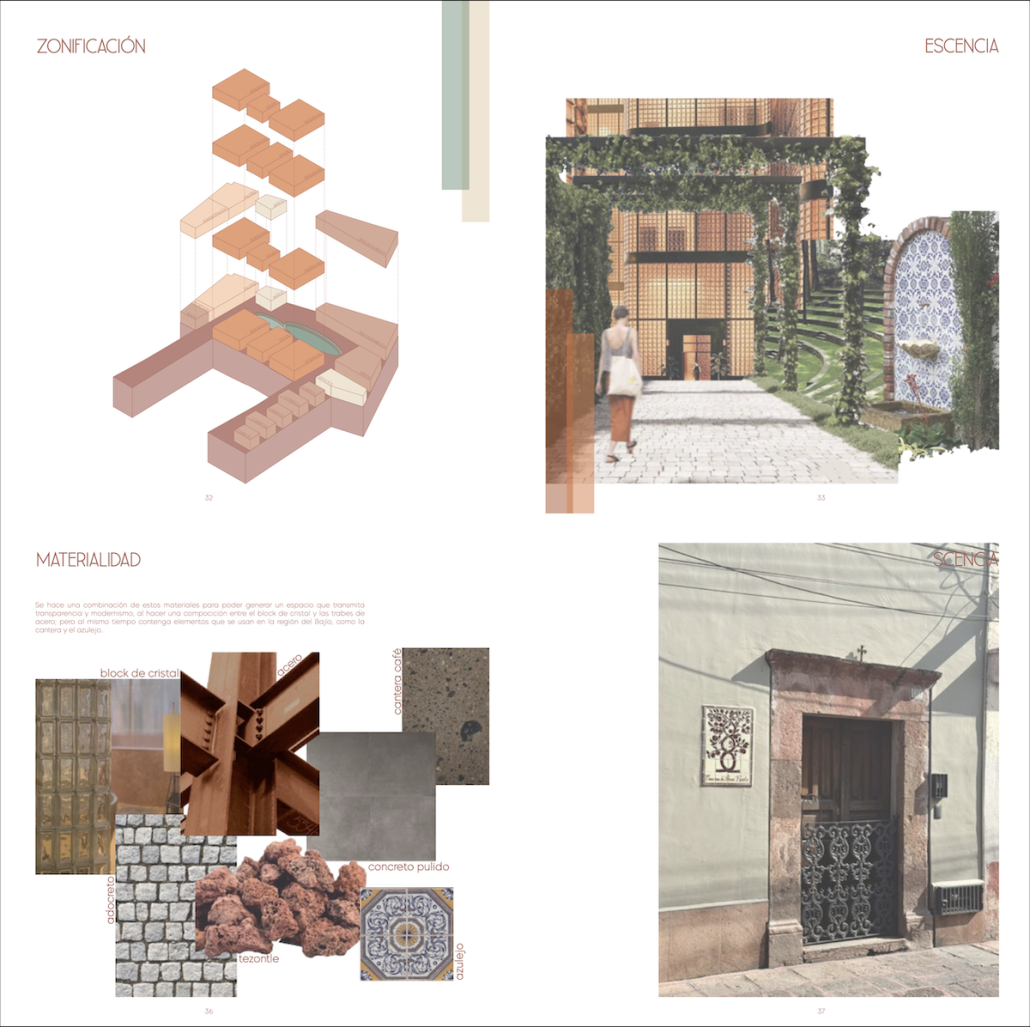
The project “La Factoría del Pueblo” is about La Santa Cruz, and [was] created to provide temporary housing for artists seeking support to grow in the creative sector of the visual arts (painting and sculpture), in addition to creating a community among people who are interested in this subject and want to learn and soak up this art.

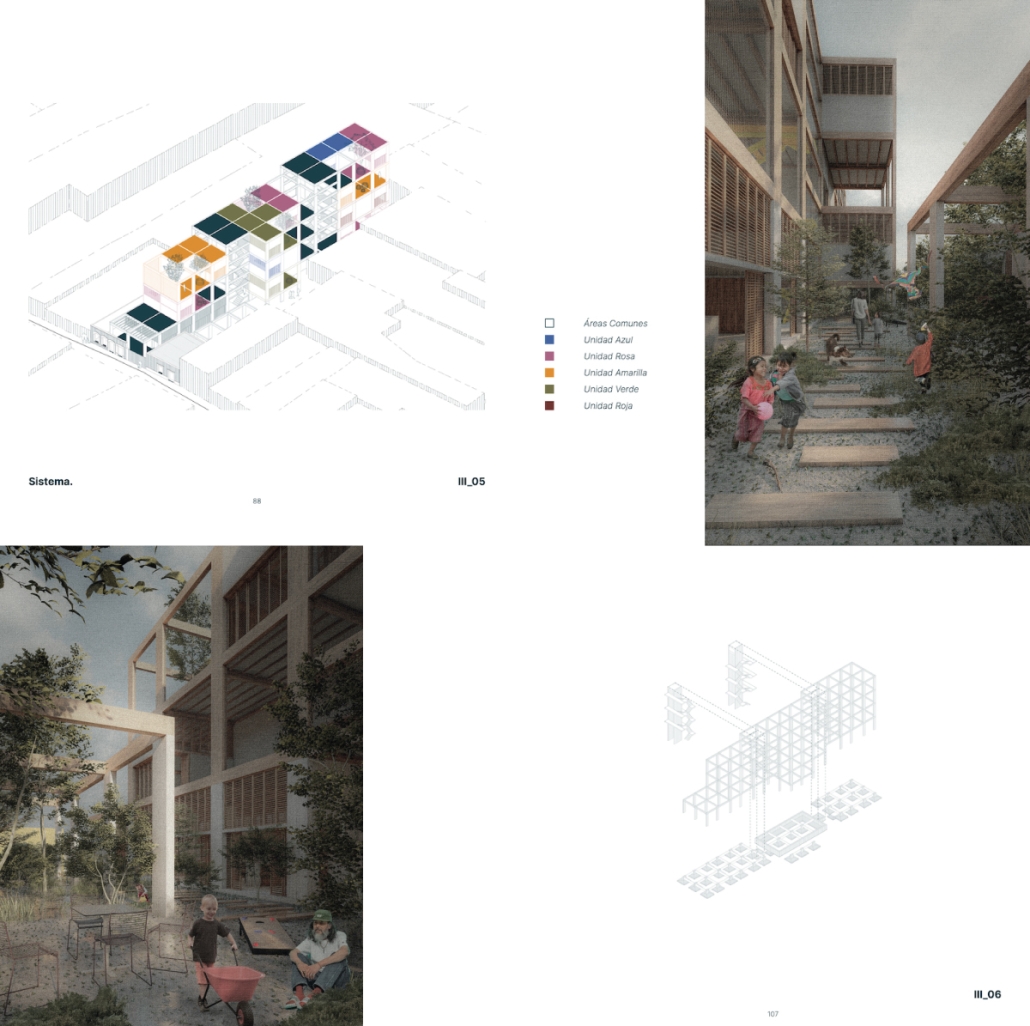
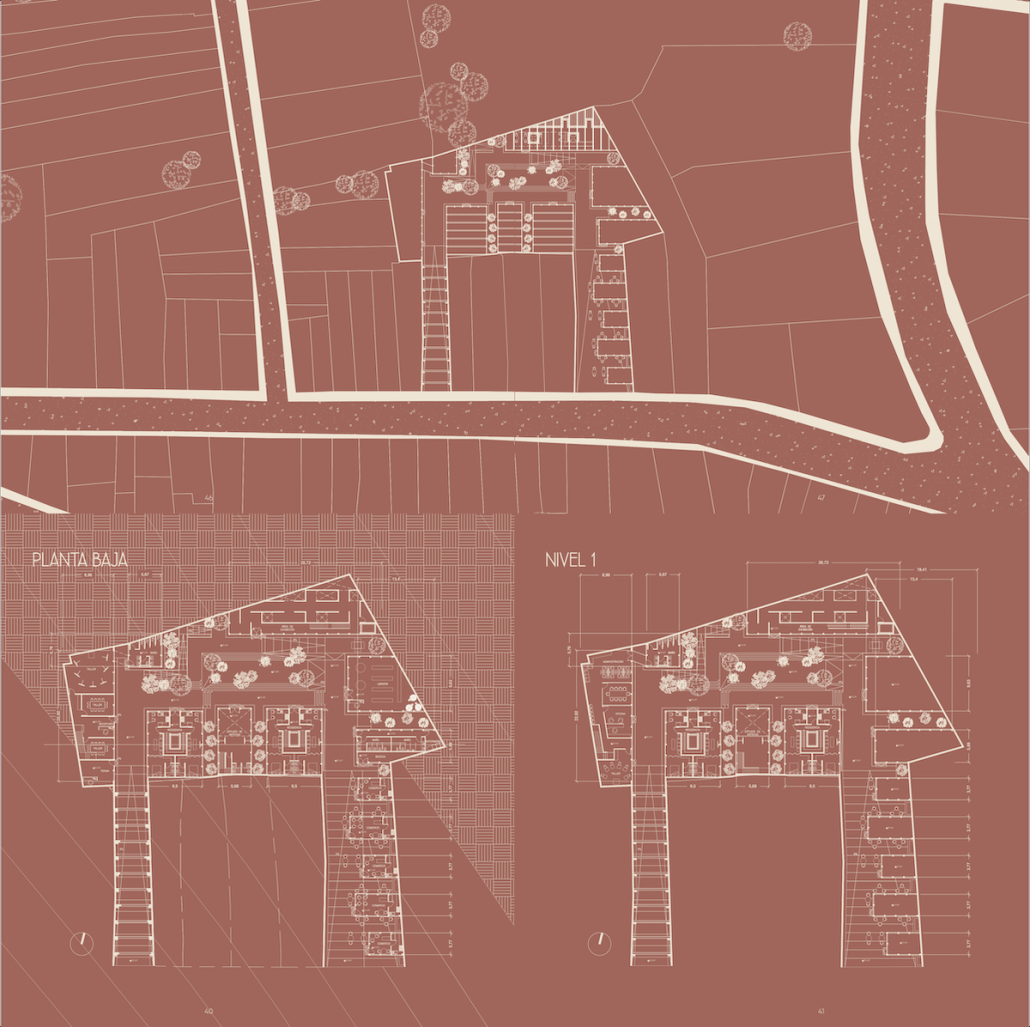
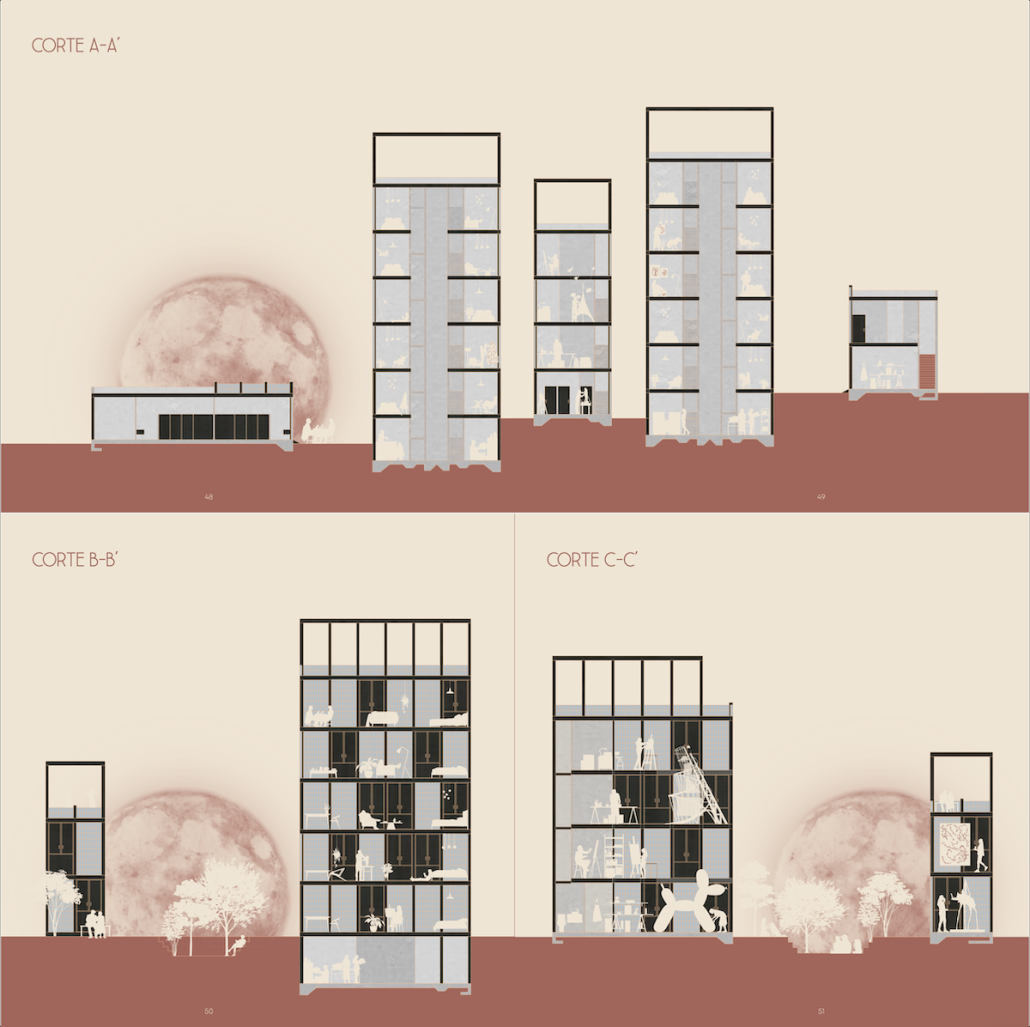
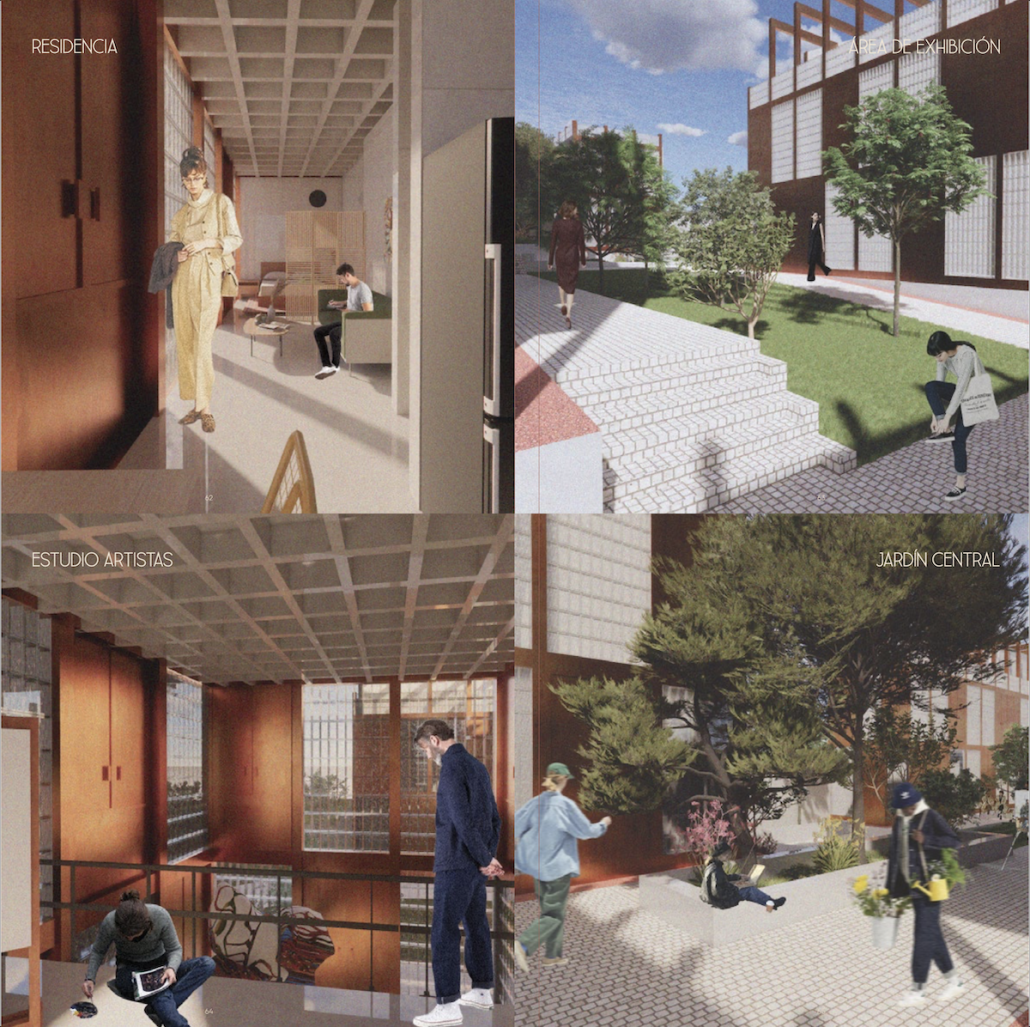
The design is sectioned to create different buildings and between them, small niches that help creativity and environment, all of them are united by a central square that has different ways of use, all with the purpose of uniting people who live there or visit the space to create a community. 

The materiality was chosen to minimize maintenance requirements for the space, as it is social. Therefore, we also created modules with frosted glass brick featuring thermal insulation to provide privacy and comfort to the space. We also have the steel rusted so that the spaces have more color; on the other hand, the materiality of slabs and walls is of apparent concrete. But also with the exteriors, the circulation is of paving stone, which is used locally for the different spaces.

Finally, the construction system is very important; the concrete was fused with steel, which led to having columns of HSS beams that are poured with concrete and perimeter beams covered with CPS profiles. In this way, it is possible to make a union with the apparent ribbed slab that has a support for the concrete retaining wall.

Instagram: @fannyvizcaya, @arquitectura_anahuac, @arqwave

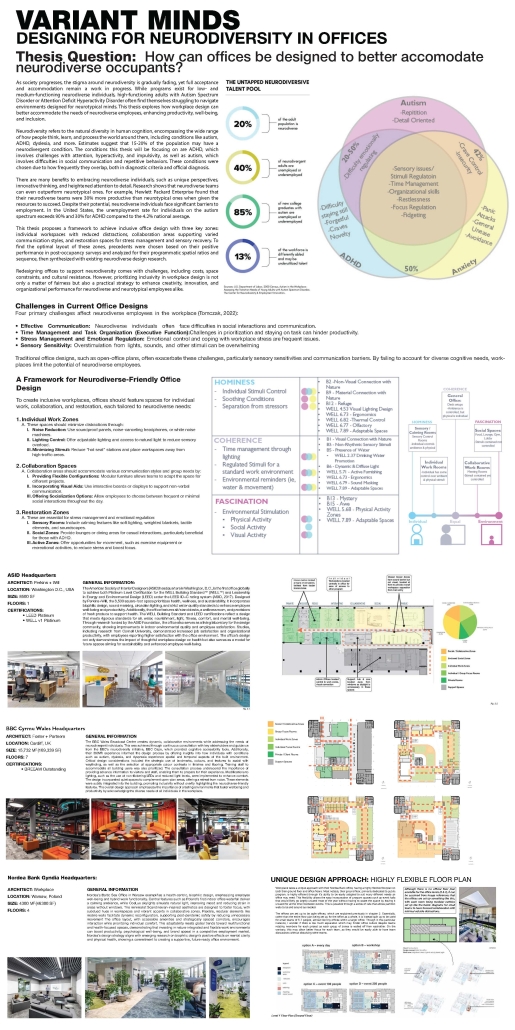
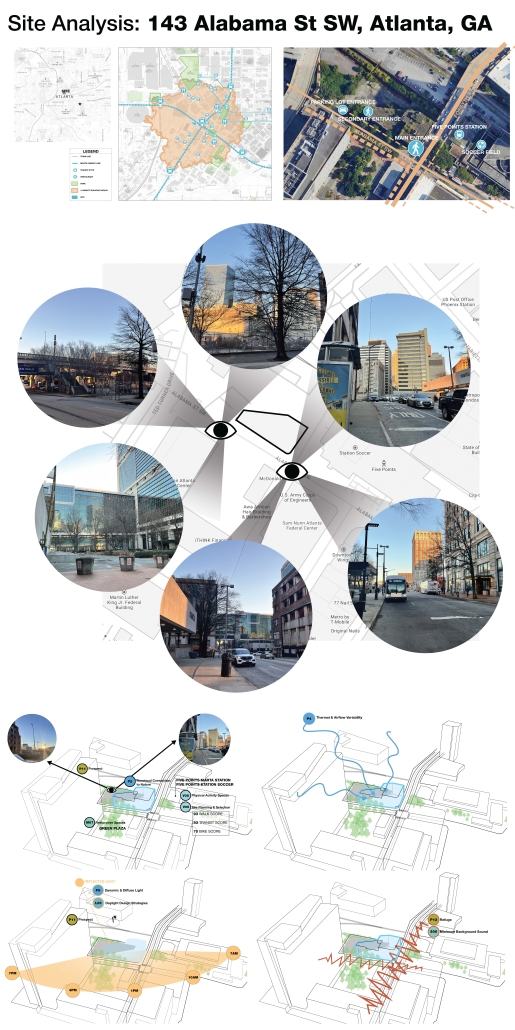
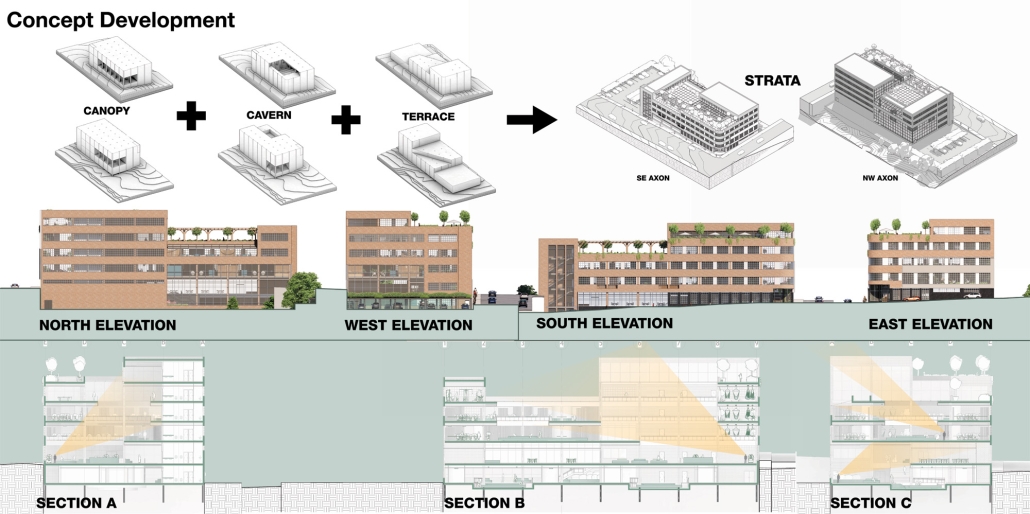
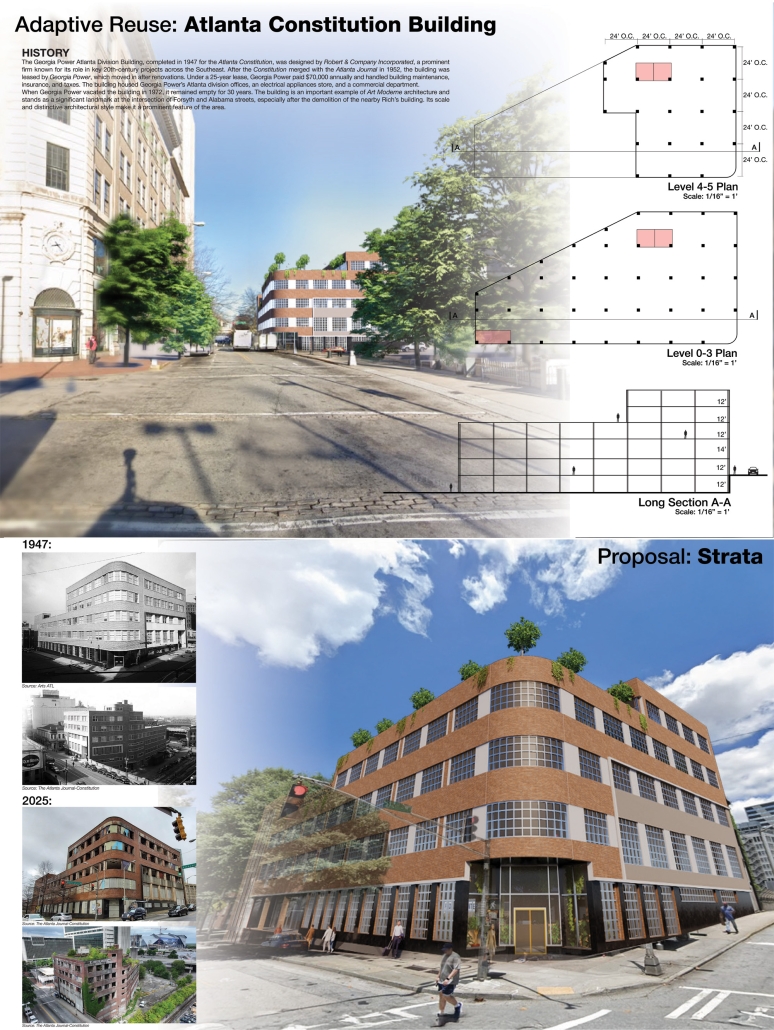
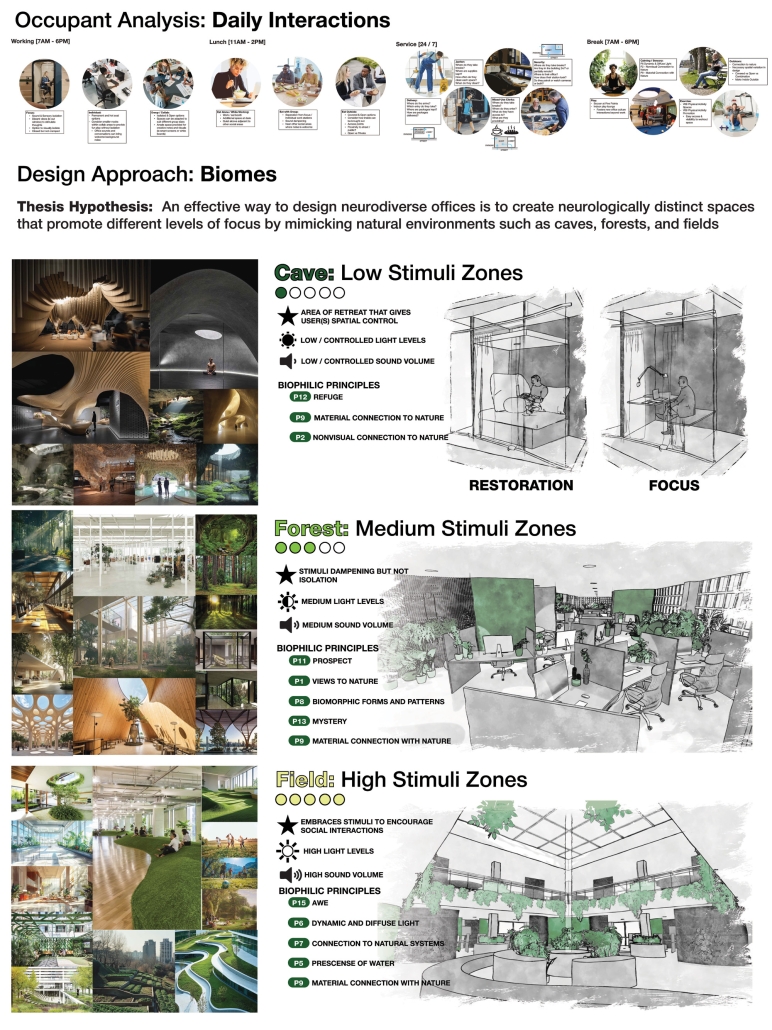
VARIANT MINDS: DESIGNING FOR NEURODIVERSITY IN OFFICES by Maya Schiltz, B.Arch ’25
Kennesaw State University | Advisor: Robin Puttock

As society progresses, the stigma around neurodiversity is gradually fading, yet full acceptance and accommodation remain a work in progress. While programs exist for low- and medium-functioning neurodiverse individuals, high-functioning adults with Autism Spectrum Disorder or Attention Deficit Hyperactivity Disorder often find themselves struggling to navigate environments designed for neurotypical minds. This thesis explores how workplace design can better accommodate the needs of neurodiverse employees, enhancing productivity, well-being, and inclusion.

Neurodiversity refers to the natural diversity in human cognition, encompassing the wide range of how people think, learn, and process the world around them, including conditions like autism, ADHD, dyslexia, and more. Estimates suggest that 15-20% of the population may have a neurodivergent condition. The conditions this thesis will be focusing on are ADHD, which involves challenges with attention, hyperactivity, and impulsivity, as well as autism, which involves difficulties in social communication and repetitive behaviors. These conditions were chosen due to how frequently they overlap, both in diagnostic criteria and social diagnosis. There are many benefits to embracing neurodiverse individuals, such as unique perspectives, innovative thinking, and heightened attention to detail. Research shows that neurodiverse teams can even outperform neurotypical ones. For example, Hewlett Packard Enterprise found that

their neurodiverse teams were 30% more productive than neurotypical ones when given the resources to succeed. Despite their potential, neurodiverse individuals face significant barriers to employment. In the United States, the unemployment rate for individuals on the autism spectrum exceeds 90% and 30% for ADHD, compared to the 4.2% national average.

This thesis proposes a framework to achieve inclusive office design with three key zones: individual workspaces with reduced distractions, collaboration areas supporting varied communication styles, and restoration spaces for stress management and sensory recovery. To find the optimal layout of these zones, precedents were chosen based on their positive performance in post-occupancy surveys and analyzed for their programmatic spatial ratios and sequence, then synthesized with existing neurodiverse design research. Redesigning oces to support neurodiversity comes with challenges, including costs, space constraints, and cultural resistance. However, prioritizing inclusivity in workplace design is not only a matter of fairness but also a practical strategy to enhance creativity, innovation, and organizational performance for neurodiverse and neurotypical employees alike.

This project was recognized as a Thesis Finalist (Top 5 of 90+).

Click here to learn more.

Instagram: @mayaschiltz, @robinzputtock

Urban Poverty: The Villas in Argentina by Lizbeth M. Padilla-González, B.Arch ’25
Pontifical Catholica University of Puerto Rico | Advisors: Jesús O. García-Beauchamp & Pedro A. Rosario-Torres

Urban poverty has emerged as a complex challenge affecting millions globally, profoundly impacting residents of informal settlements and marginalized neighborhoods. This multifaceted issue extends beyond economic deprivation to encompass inadequate access to essential services, substandard housing, food insecurity, limited educational opportunities, and systemic social exclusion. These challenges are intrinsically linked to economic inequality, spatial segregation, and evolving urban structures.

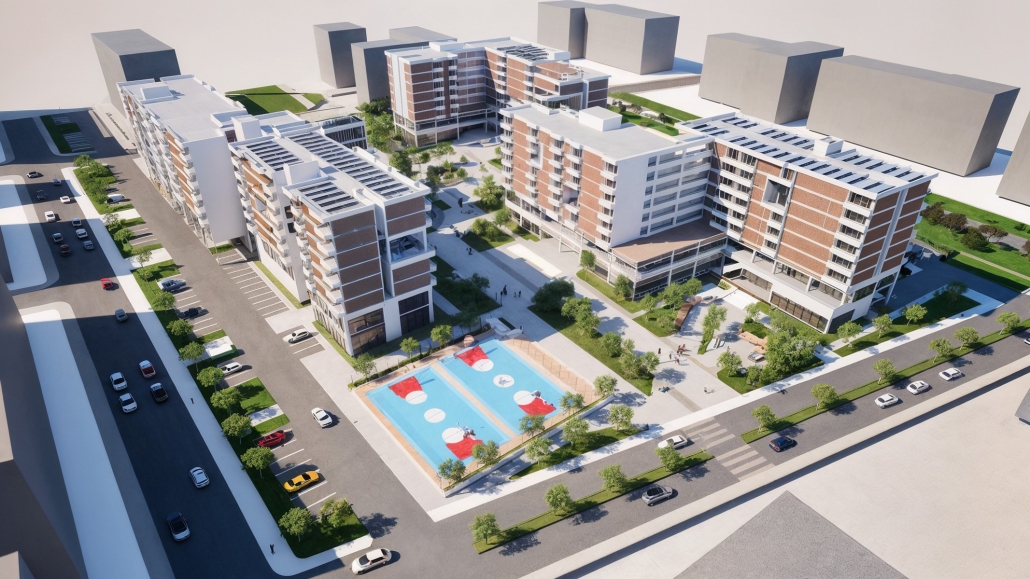
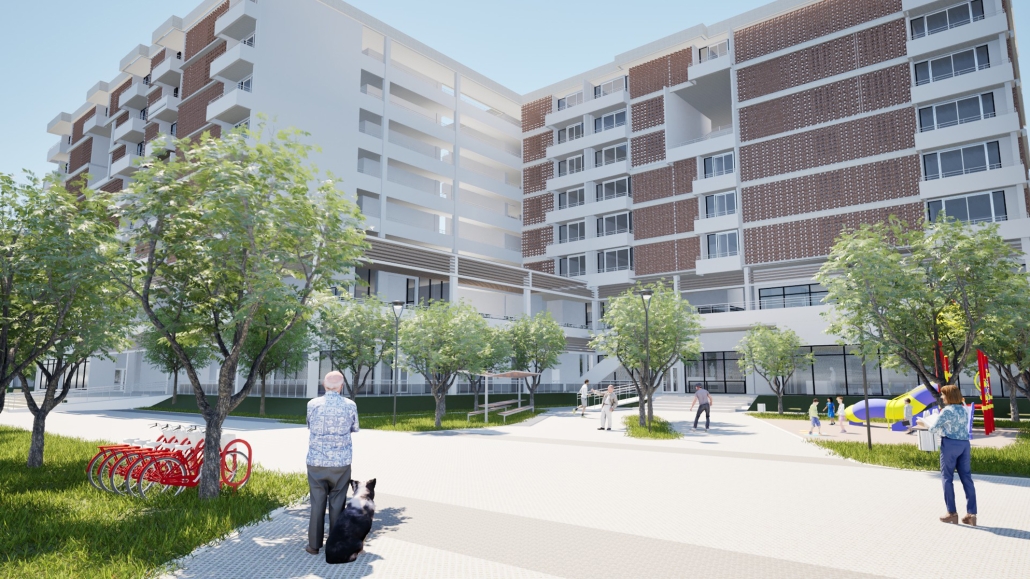
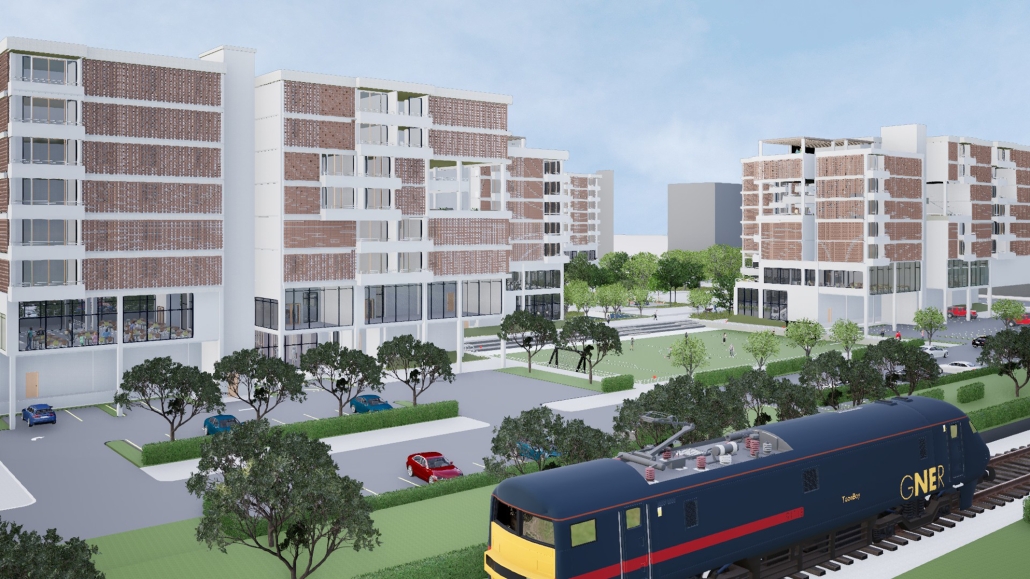
This architectural proposal addresses these challenges within Villa 21-24 (Villa Zavaleta) in Argentina through a comprehensive urban master plan that reimagines the existing urban fabric. Drawing inspiration from the consolidated city’s formal grid system, the design introduces strategic reorganization that enhances spatial articulation, improves connectivity, and establishes a foundation for transformative architectural interventions.

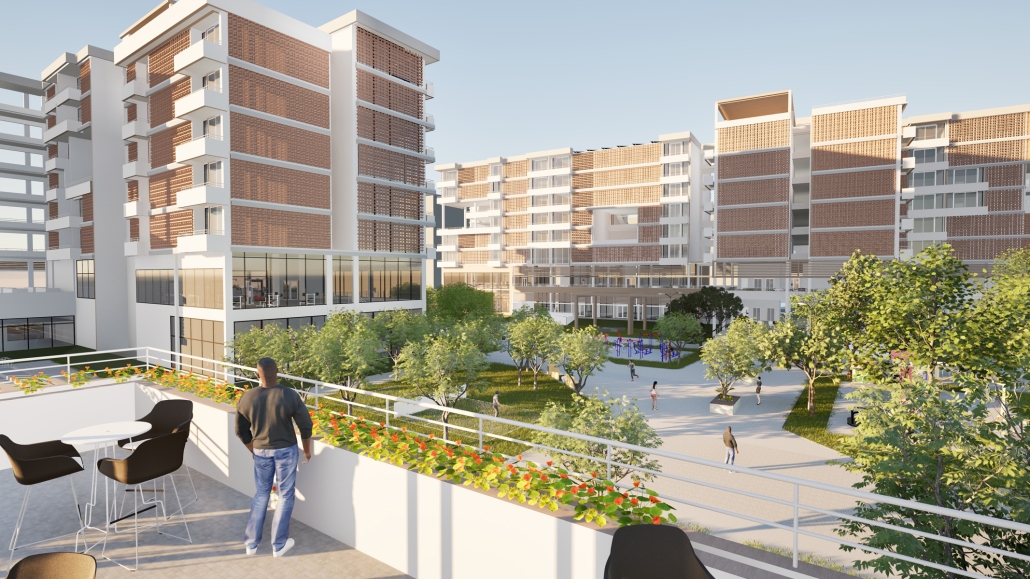
The project’s cornerstone is a major linear park traversing the settlement from north to south, serving as both an organizing spine and vital public space for community cohesion. Three strategically positioned mixed-use buildings line this central corridor, creating a dynamic interface between public and private realms. The ground and second levels house essential community programs, including dining facilities, technology education centers, libraries, vocational workshops, gymnasiums, children’s recreation areas, and flexible rental spaces for local entrepreneurs. These elements were selected through comprehensive community needs assessments to strengthen social networks, enhance quality of life, and foster comprehensive development pathways.

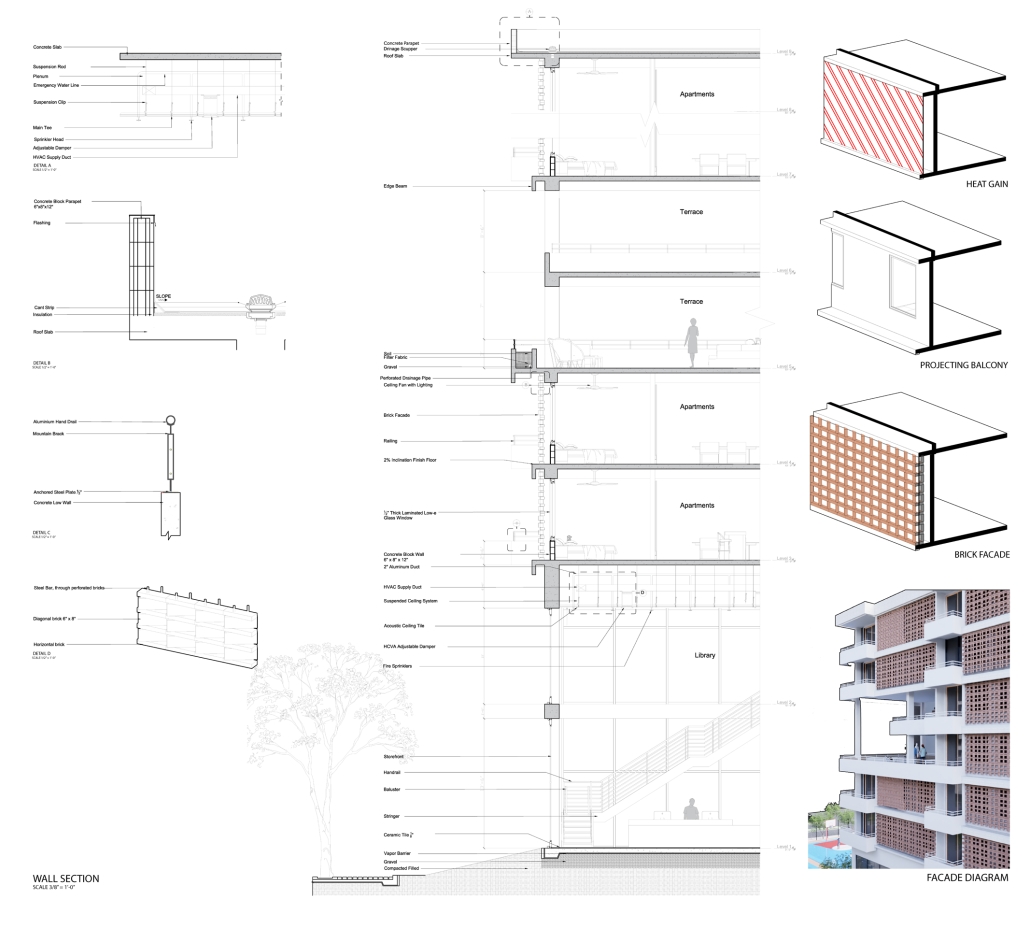
The upper levels accommodate diverse residential typologies, from studio units to three-bedroom apartments, serving varied family structures within the community. Each dwelling incorporates terraces and balconies strategically oriented toward recreational areas, fostering visual connections with green infrastructure and reinforcing the relationship between private living spaces and communal areas. The buildings employ a brick façade system providing effective solar protection and thermal regulation while maintaining authentic integration with the existing urban landscape, where brick represents one of the most prevalent and culturally significant building materials in the region. This material choice exemplifies the project’s commitment to environmental responsiveness and contextual sensitivity.

Click here to learn more.

Instagram: @Lizbethmarie_1

Quintero Bay: A Breakthrough by Georgia Fernandes, Maïssa Eid, Patricio Munoz & Dutt Patel, M.S.AUD (Masters of Science in Architecture and Urban Design) ’25
Columbia University | Advisors: Kate Orff, Geeta Mehta, Gabriel Vergara, Sebastian Delpino, Emanuel Admassu & Lucas Coelho

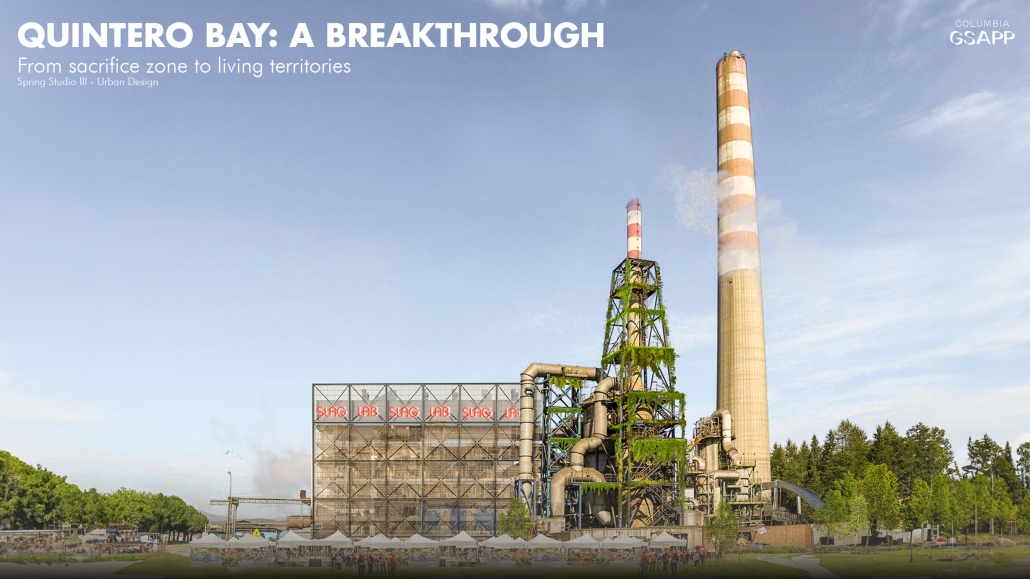
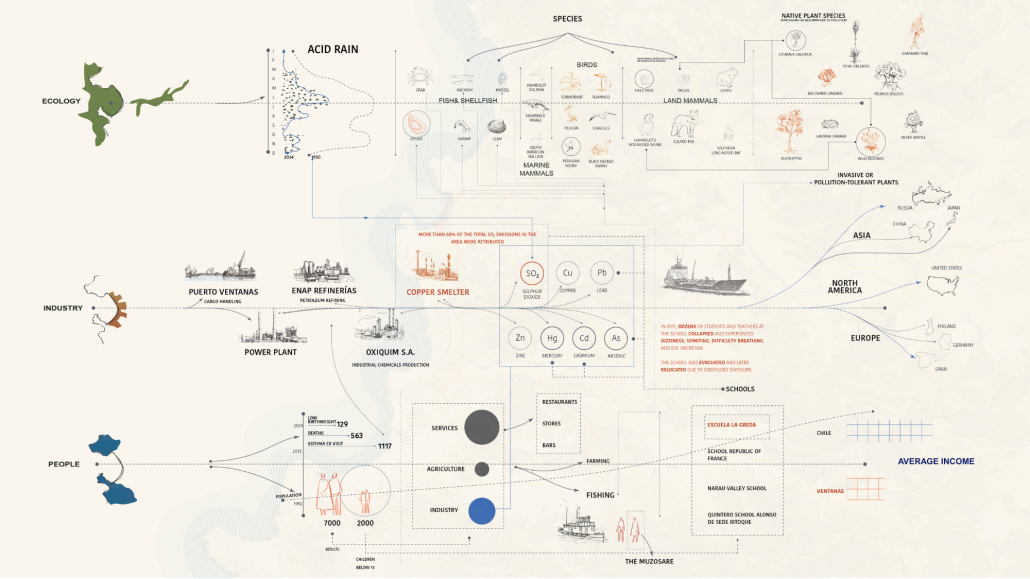
Quintero Bay, once a thriving coastal ecosystem in Chile, has become one of the country’s most heavily polluted sacrifice zones. Years of industrial activity have contaminated the air, land, and sea, deeply impacting the health and livelihoods of its residents. The region powers 7% of Chile’s energy, yet the communities living here have received only environmental harm in return.

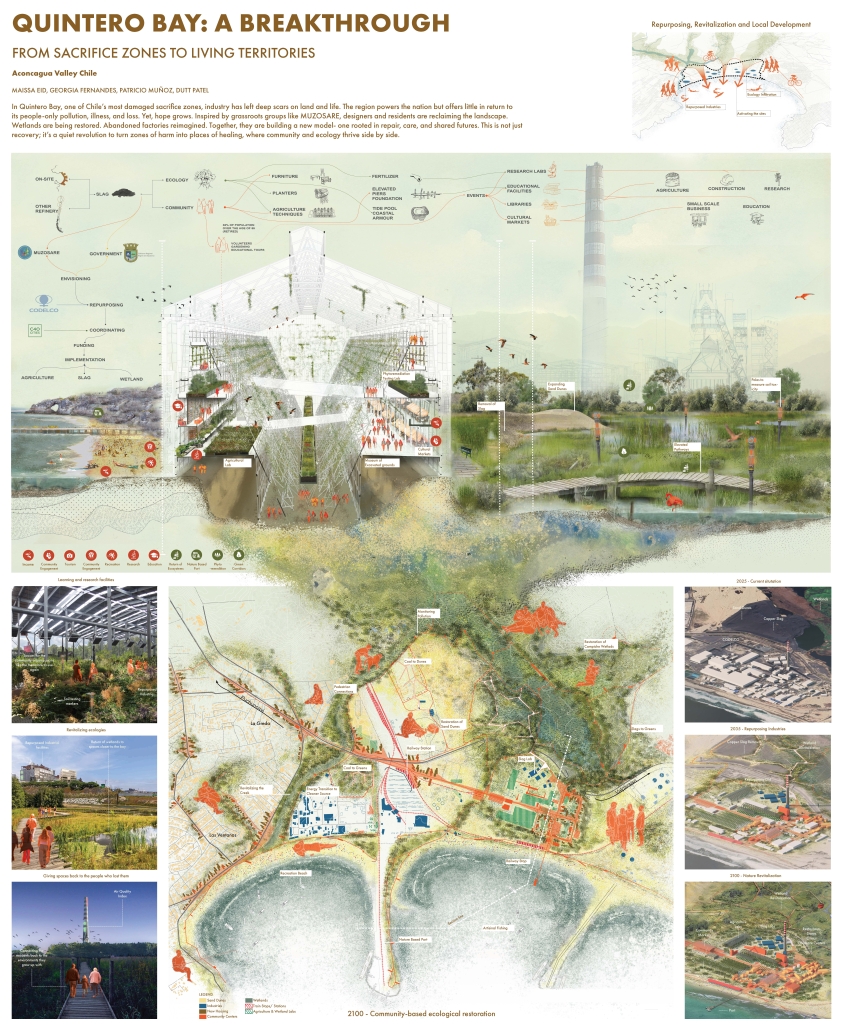
Our project, inspired by the work of local feminist collective MUZOSARE, envisions a future rooted in healing and co-existence. Rather than erase the industrial past, we aim to repurpose it. The phased closure of the Codelco copper smelter offers a unique opportunity to restore wetlands, uncover buried sand dunes, and adapt former factories into community hubs for housing, research, culture, and ecological stewardship.

Guided by the principles of revitalizing, repurposing, and community development, the design introduces green corridors, nature-based ports, and SLAG LABS to transform industrial waste into public infrastructure. Residents can participate in restoration through income or social credit-based programs, reactivating the local economy while building environmental resilience.

This is not just a vision for Quintero Bay—it’s a model for all sacrifice zones. By integrating policy, ecology, and community leadership, the project offers a blueprint for transforming places of harm into living territories of shared futures.

This project won the Lucille Smyser Lownfish Memorial Prize.

Instagram: @g__fernandes, @misssoouuuu, @pamb.070, @duttpatel108, @mehtageeta999, @sdelpino_arq, @gabrielvergarag, @lucascoelhonetto, @eadmassu

Rhythmic Ribbons by Tadhg McDonald, M.Arch ’25
Lawrence Technological University | Advisor: Masataka Yoshikawa

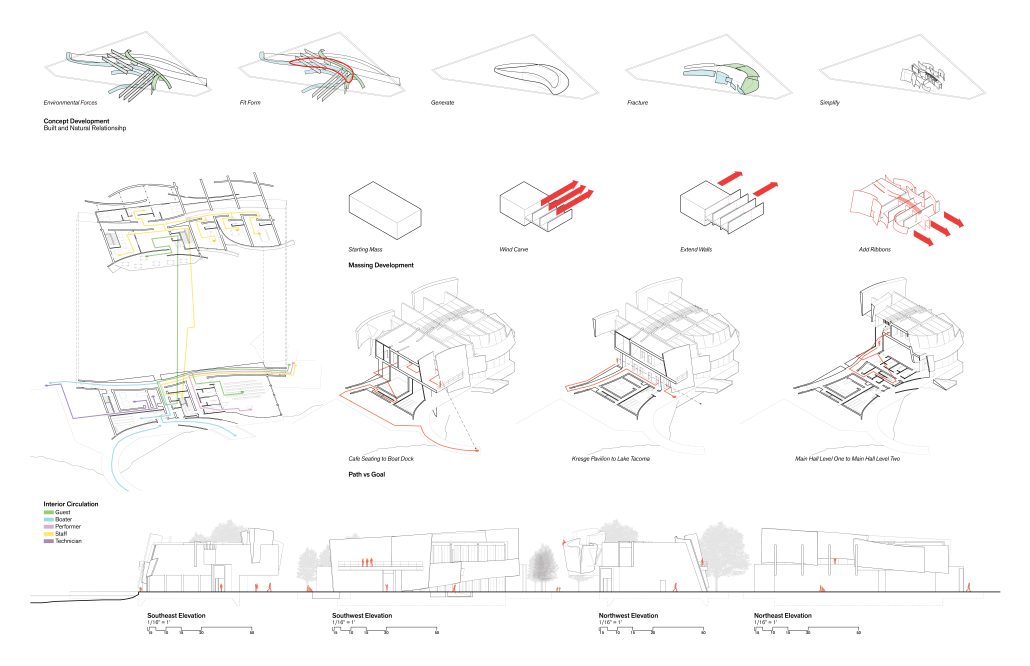
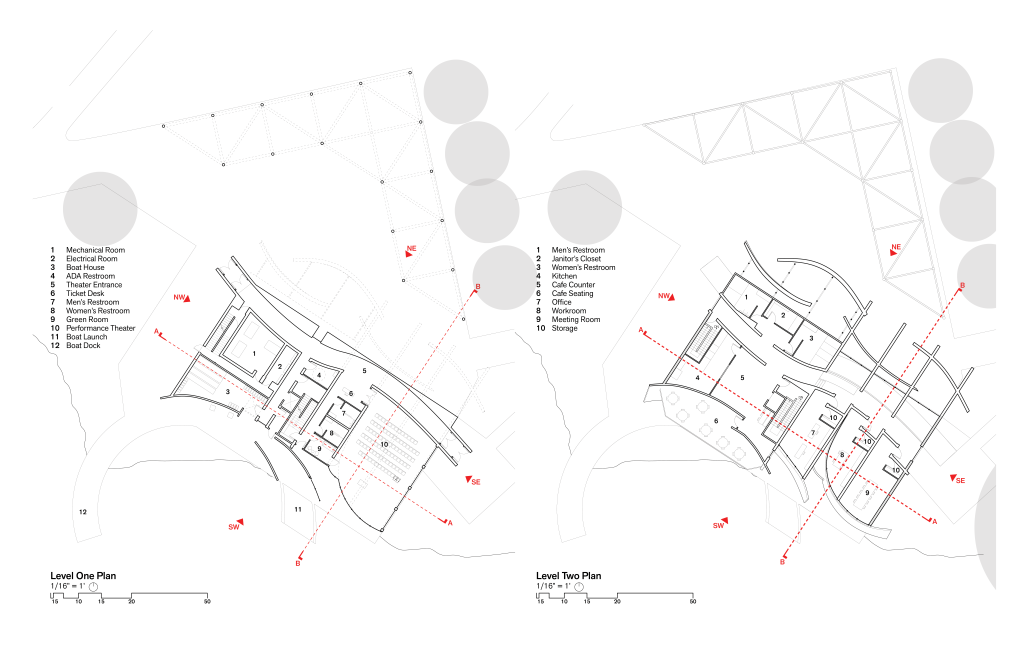
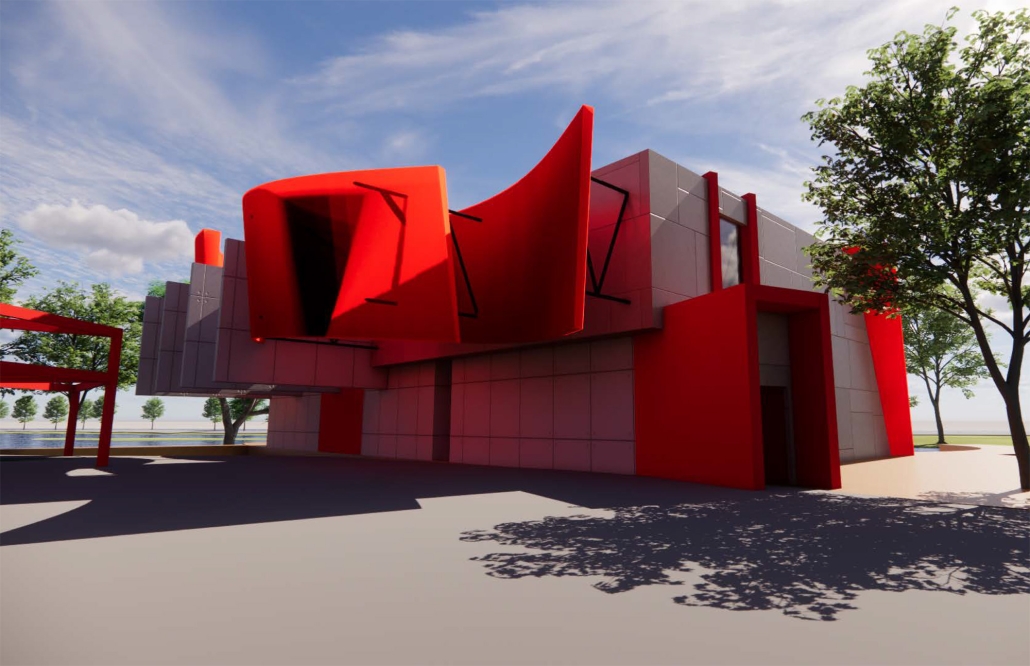
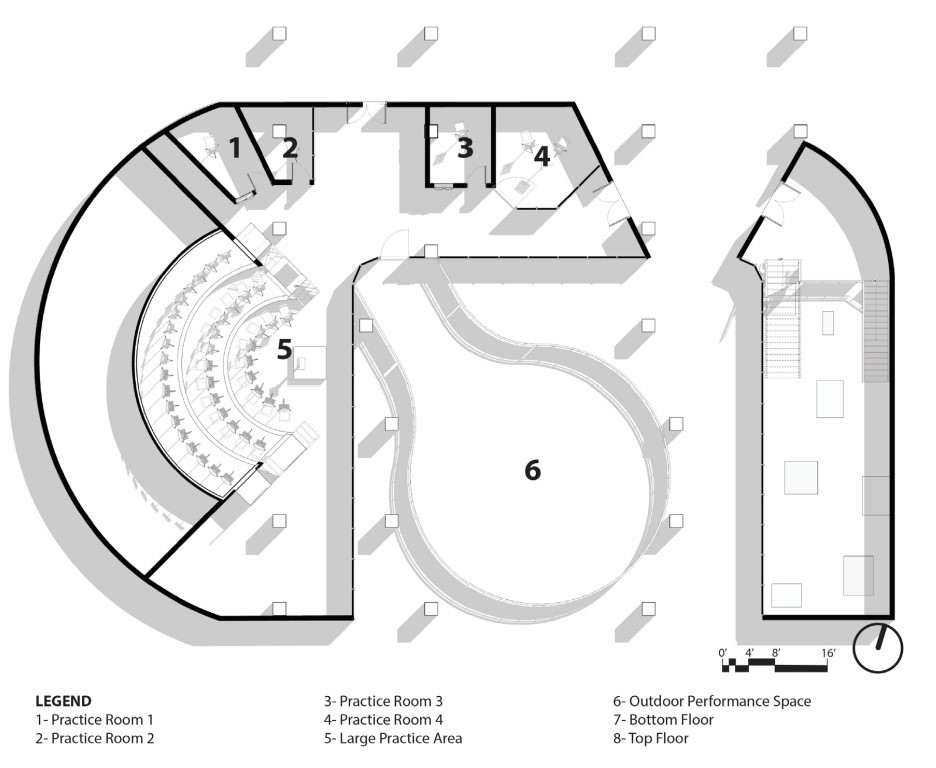
The goal of this design was to highlight the site’s seclusion from the rest of Belle Isle and how it is reinforced by the relationship between the existing built and natural environments. This relationship influenced the formal design elements through the utilization of both orthogonal and curved walls. The orthogonal walls represent the built environment, while the curved walls represent the natural [environment.] The main generator for the site’s seclusion was the journey that any site visitors have to travel in order to reach the secluded core of the site. From the parking lot, the visitor can partially see all of the stunning views of the site, but they do not get the full experience until they have passed through the lines of trees and the Kresge Pavilion. This idea of Path vs. Goal was heavily influential for the interior design of this new construction. Overall, the site’s inherent seclusion, journey, and built and natural confines create a uniquely private experience for all visitors.

Instagram: @ta.dhg, @masataka.yoshikawa

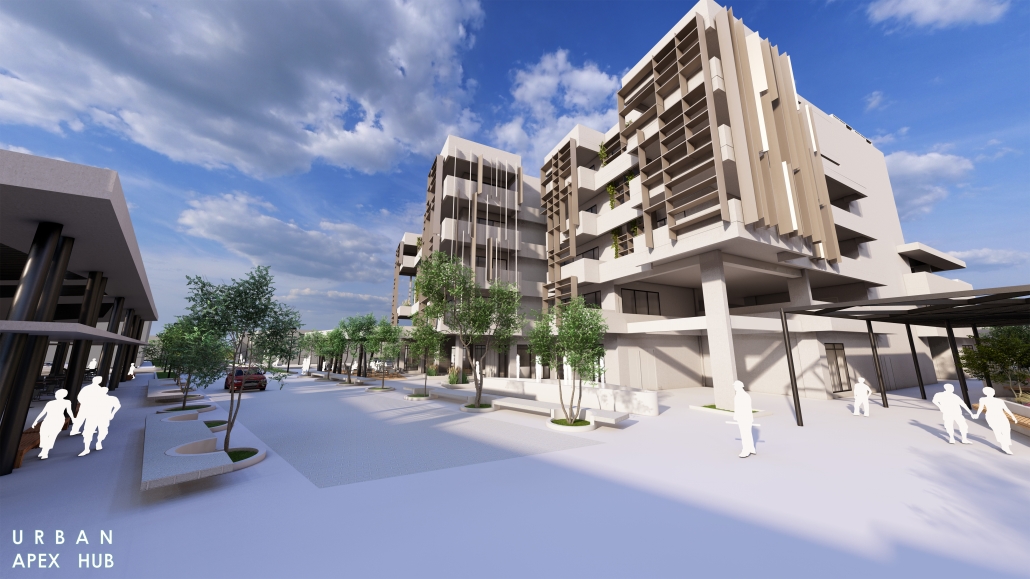
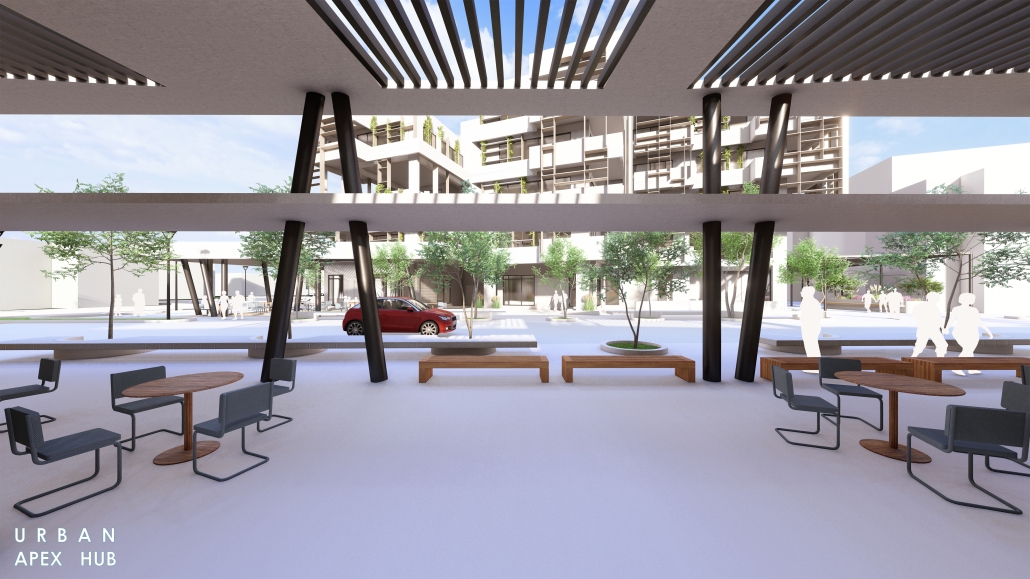
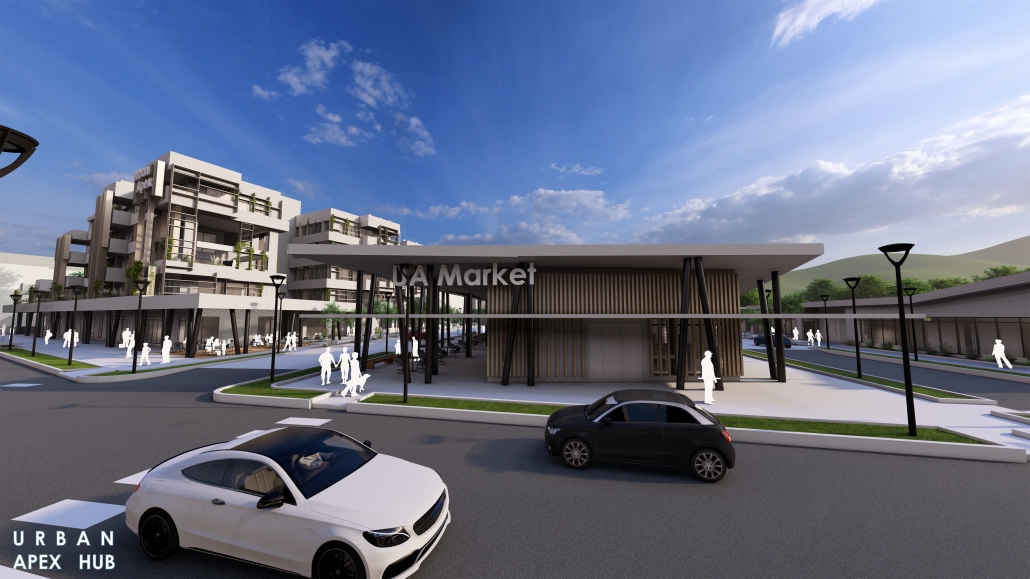
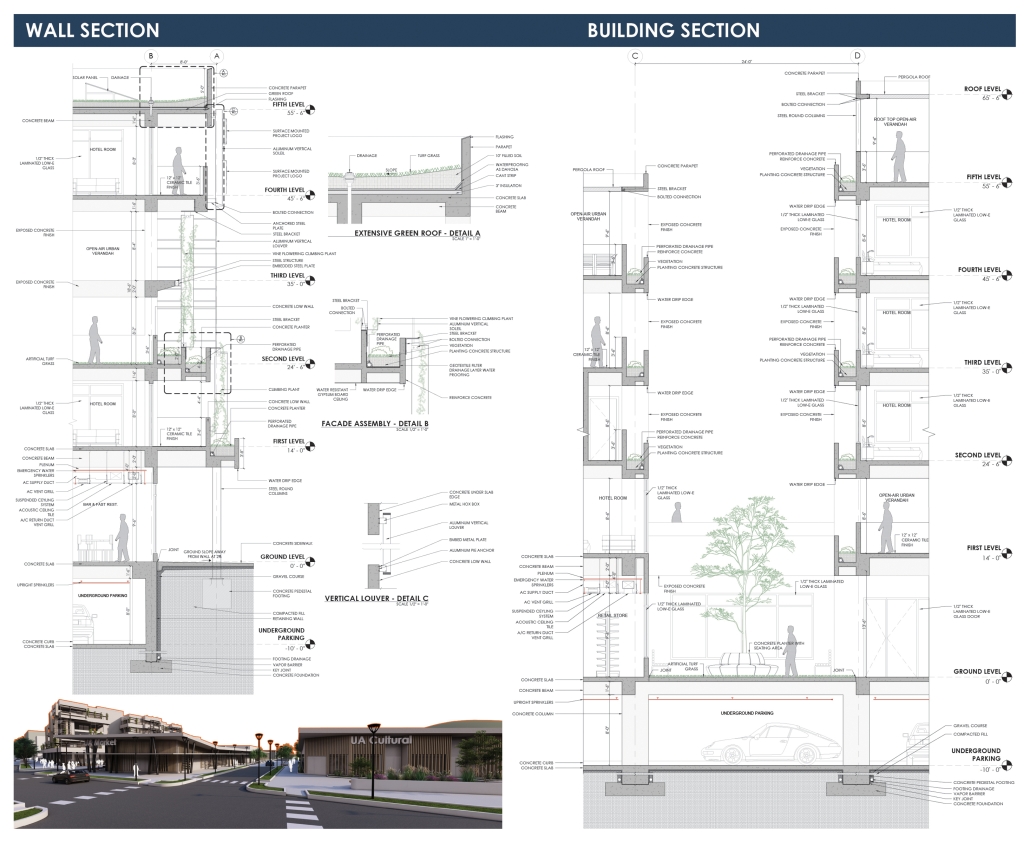
Urban Apex Hub – Sustainable Tourism: A Path to the Reconstruction of Urban Spaces by Louis Y. Sepúlveda-Homs, B.Arch ’25
Pontifical Catholica University of Puerto Rico | Advisors: Jesús O. García-Beauchamp, Pilarín Ferrer-Viscasillas & Pedro A. Rosario-Torres

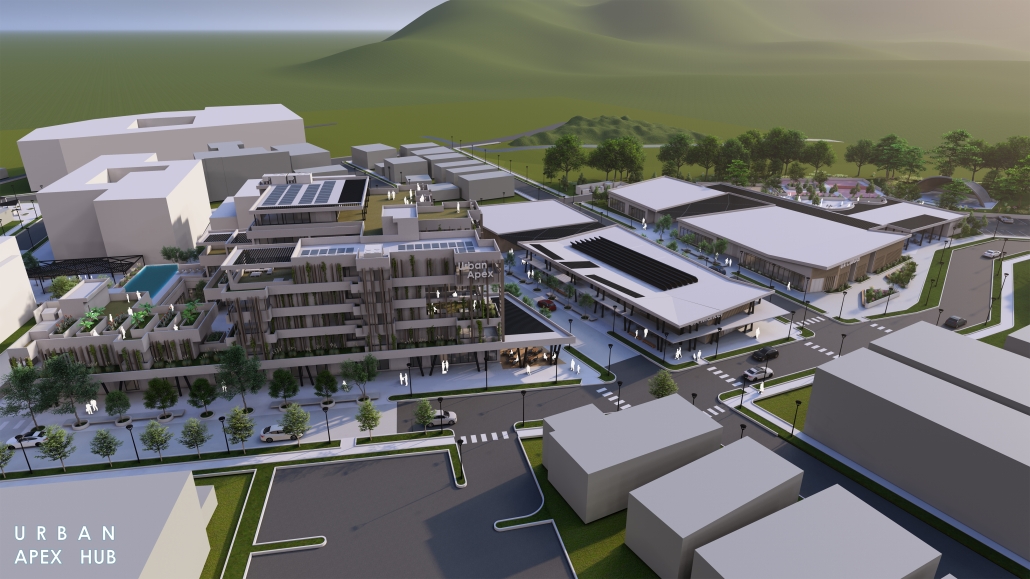
Urban decay is a persistent condition in many contemporary cities, leading to the deterioration of physical infrastructure, the disappearance of cultural identity, and the disconnection between communities and their environments. This capstone investigates the potential of sustainable tourism as a catalyst for the reconstruction of such spaces, proposing an architectural and urban intervention that integrates ecological, cultural, and economic dimensions. Titled “Urban Apex Hub – Sustainable Tourism: A Path to the Reconstruction of Urban Spaces,” the project is located in the deteriorated historic center of Río Grande, Puerto Rico, a site marked by abandonment, weak pedestrian infrastructure, and lack of public activation.

This research explores the intersection between landscape urbanism, urban obsolescence, and ecotourism as strategic tools to regenerate neglected urban cores. Drawing from the theories of Charles Waldheim on landscape as a framework for urbanization, Kevin Lynch’s concept of urban obsolescence, and Richard Butler’s tourism area lifecycle model, the proposal envisions a hybrid public space that merges architecture and nature. The program includes an eco-conscious hotel, a cultural center for local expression and education, and a public market that supports local entrepreneurship and food sustainability.

The methodology combines site analysis, ecological mapping, and community engagement to develop a masterplan focused on walkability, stormwater management, cultural preservation, and green infrastructure. Key spatial strategies include the use of interior gardens, green roofs, permeable surfaces, and open-air courtyards that enhance microclimates and support social interaction. The project also addresses tourism from a critical lens, proposing a model that attracts ecotourists to under-visited urban areas while empowering local communities.

Urban Apex Hub reimagines tourism as more than a temporary activity; it becomes a long-term drive for environmental stewardship, cultural resilience, and economic regeneration. By rooting the architectural proposal in the specific ecological and social context of Río Grande, the project demonstrates how sustainable tourism can actively participate in reconfiguring urban identity and restoring meaning to forgotten spaces. Ultimately, this research advocates for an architecture that is not only responsive to climate and place, but also capable of reshaping the narrative of urban decline into one of collective renewal.

Click here to learn more.

Instagram: @arch.louis_yarell

Ecologies of Extraction: Reclaiming Industrial Landscapes for Ecological and Social Renewal by Anna MacDonald, B.Arch ’25
Wentworth Institute of Technology | Advisor: Lauren McQuistion

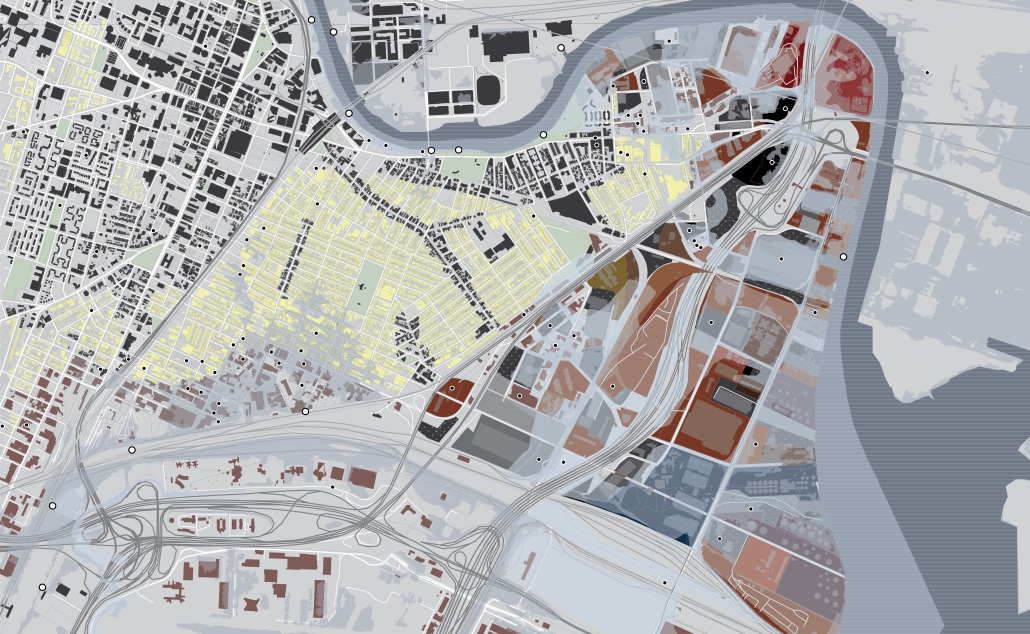
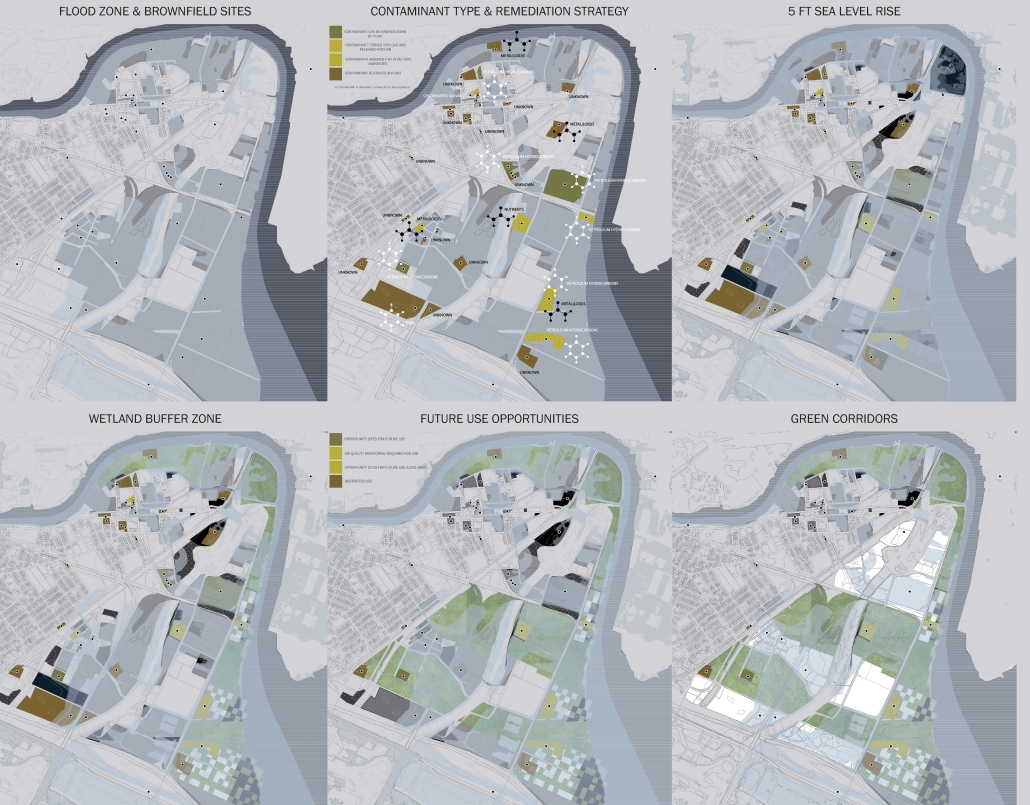
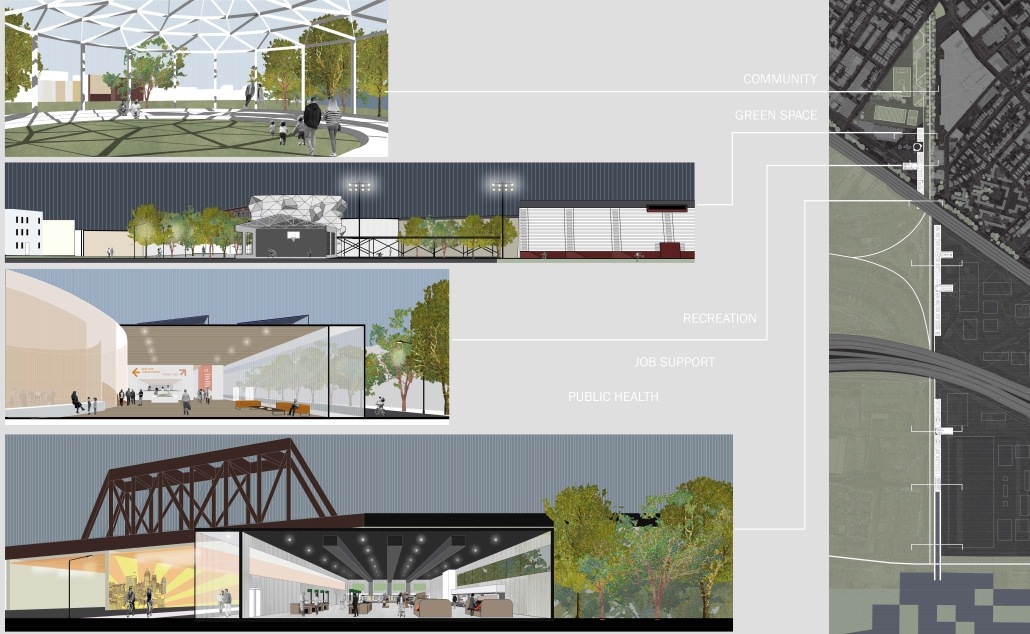
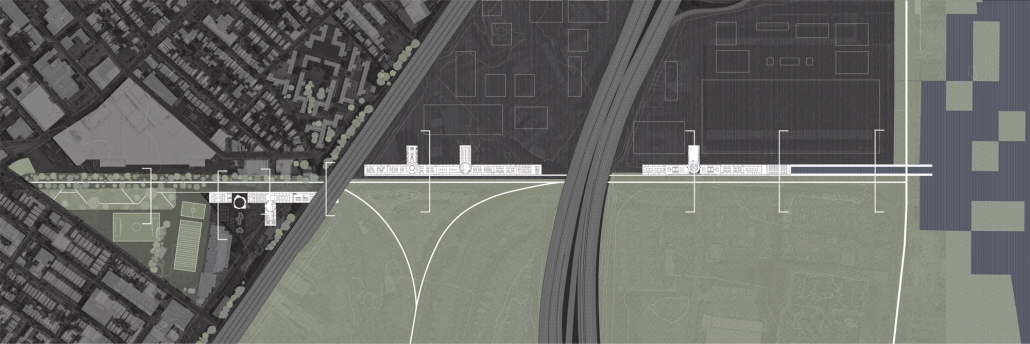
The remediation of declining industrial landscapes in cities can serve as a catalyst for reimagining the urban fabric through the establishment of resilient infrastructure and renewed community connections. Newark’s industrial zone exemplifies the tensions and possibilities of this transformation, revealing how design, policy, and environmental strategies can converge to reshape industrial spaces. Industrial landscapes have long been shaped by economic shifts, ecological negligence, and urban expansion. As industries shrink or relocate, their physical remnants—factories, warehouses, rail lines, and contaminated land—present both challenges and opportunities for urban and ecological transformation. 

The transition to sustainable, post-industrial cities requires strategies that integrate environmental remediation, adaptive reuse, and equitable redevelopment. Newark, NJ, serves as just one extreme example of the contaminated, underutilized industrial landscapes that permeate U.S. cities, and regulatory agencies must implement a framework for transforming modern industrial zones through sustainable infrastructure, ecological restoration, and social equity. Strategic interventions explored in this study establish a model for cities to move beyond extractive histories toward climate-conscious and socially inclusive futures, demonstrating how industrial spaces can evolve into regenerative landscapes.

This project won the ARCC King Award, Wentworth School of Architecture and Design: Design Excellence Award.

Instagram:@annarmacdonald, @mc.quistion

WHEN THE LEVEES BROKE by Madisyn Hunter, M.Arch ’25
Florida A&M University | Advisors: George Epolito, Andrew Chin & Ronald B. Lumpkin

WHEN THE LEVEES BROKE: THE IMPACT OF HURRICANE KATRINA ON THE CREATIVE PROCESS OF MUSICIANS AND THE EVALUATION OF ARCHITECTURAL LANDSCAPES

This thesis examines the intersection of architectural innovation and cultural resilience in the wake of Hurricane Katrina, focusing specifically on its impact on the creative processes of young musicians in New Orleans. The project investigates how architectural design can serve as both a physical and emotional safeguard against future natural disasters, while simultaneously nurturing cultural expression and healing.

Following Katrina’s devastation, rebuilding efforts largely favored traditional architecture over progressive design solutions—often reinforcing systemic inequities and overlooking the creative lifeblood of the city’s youth. Yet, in the face of limited resources and widespread destruction, many musicians returned to their craft, channeling trauma into vibrant, transformative art. This thesis argues that their resilience and creativity were not merely responses to adversity but vital threads in New Orleans’ cultural recovery.

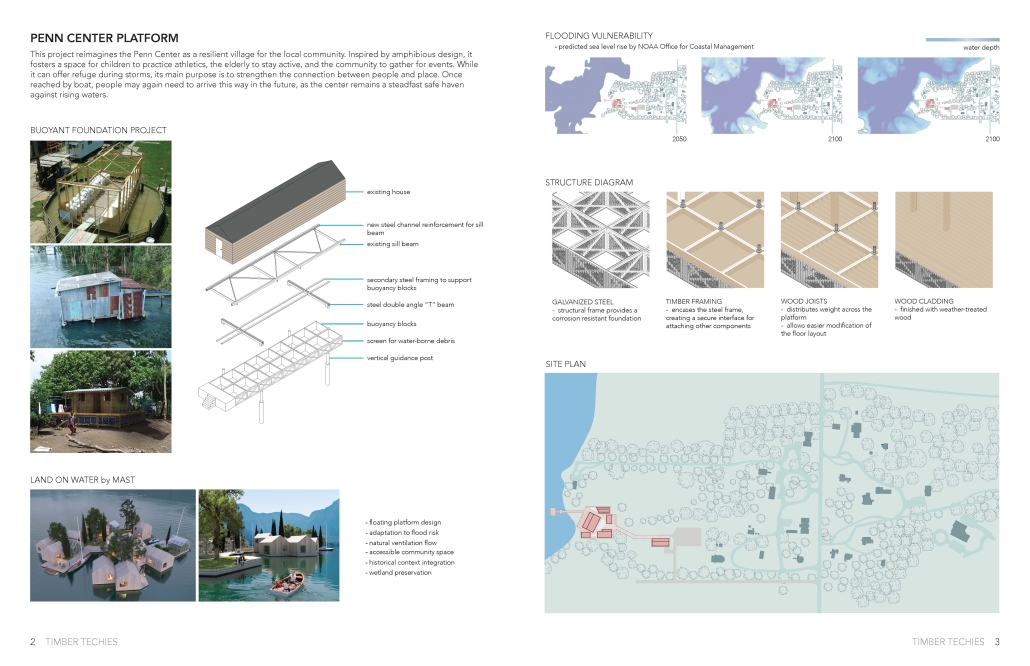
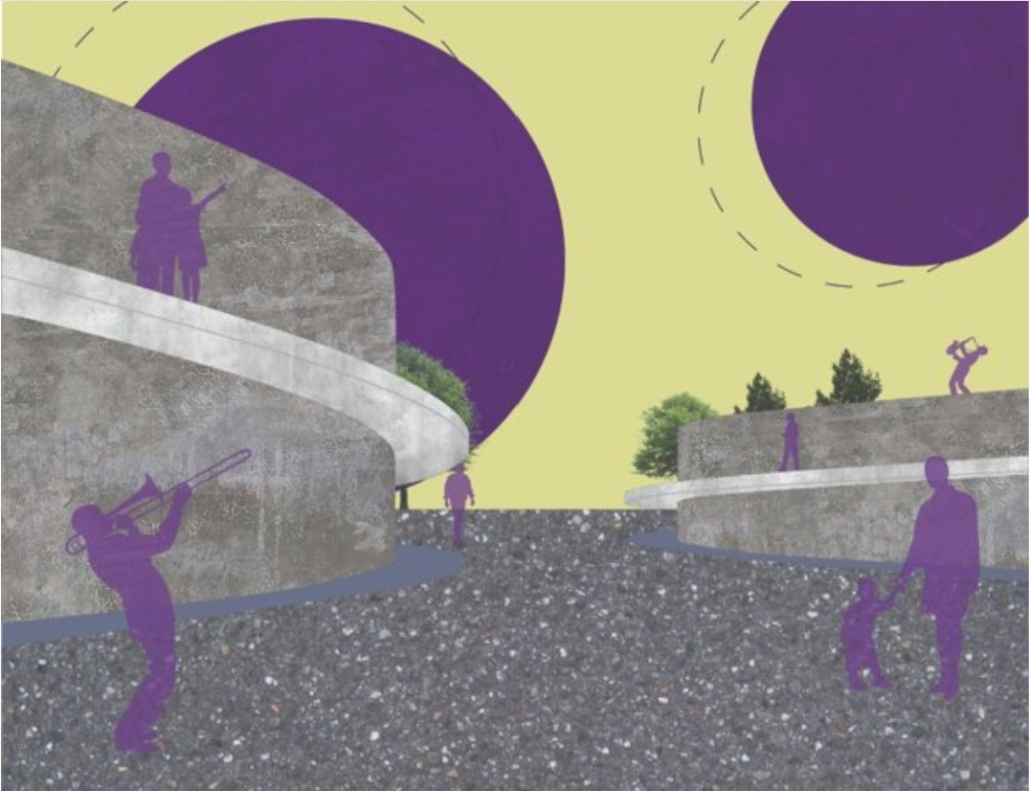
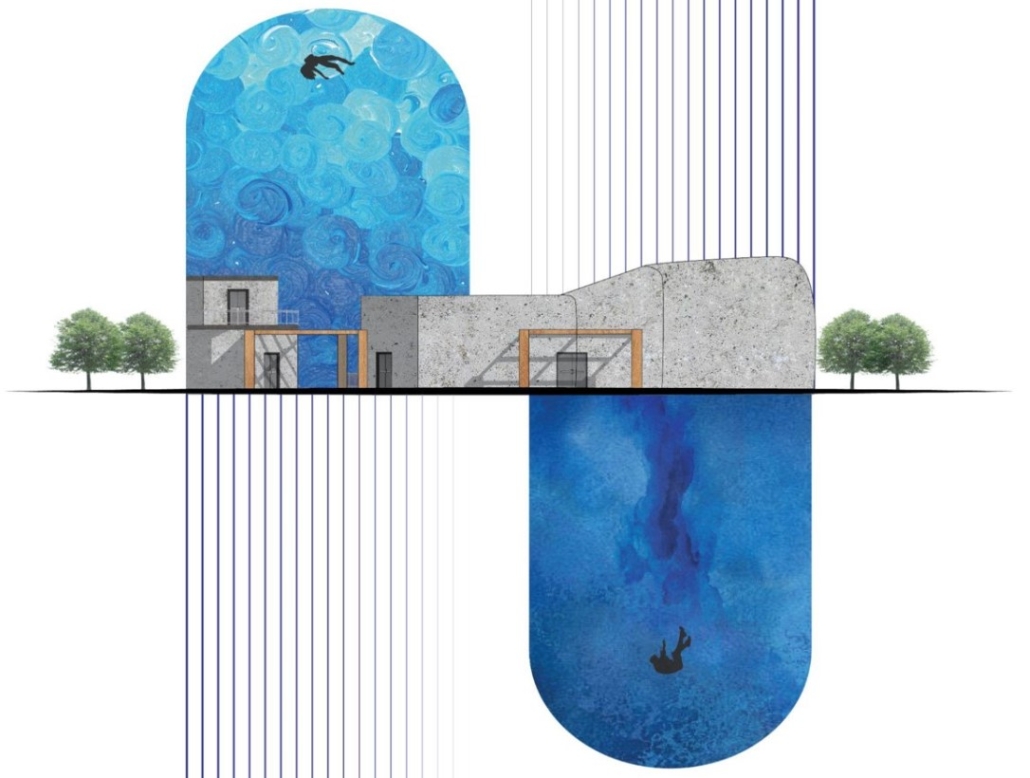
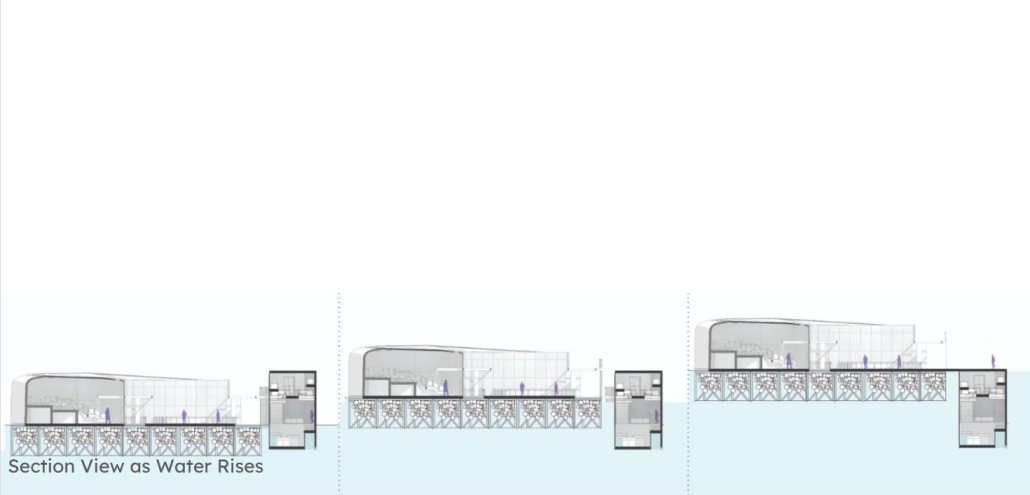
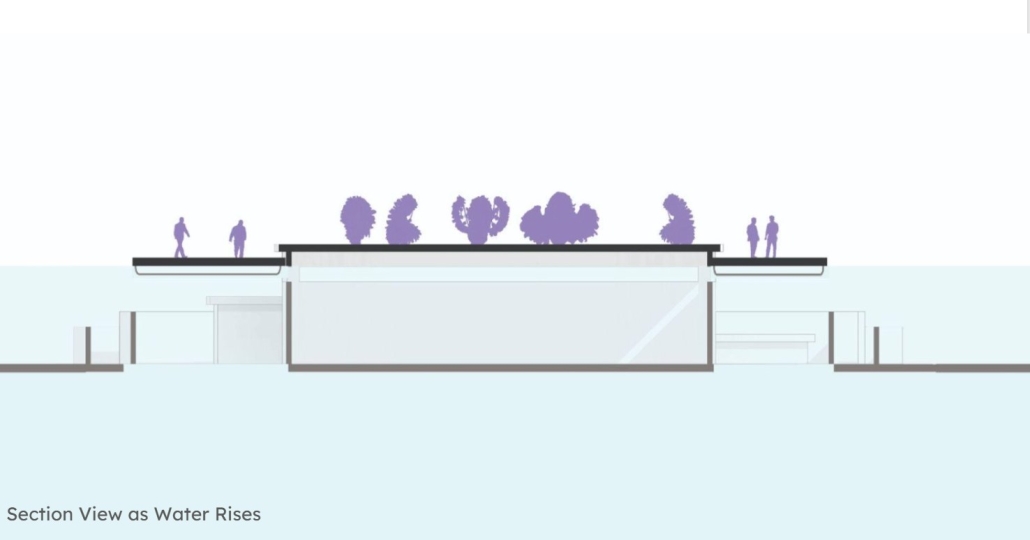
The research combines case studies, archival data, and design analysis to explore how architecture can support post-disaster recovery by integrating cultural spaces within resilient infrastructure. The proposed design envisions floating structures that act as creative havens—spaces for performance, collaboration, and remembrance. These architectural interventions respond not only to storm surge patterns and environmental threats but also to the need for safe, inclusive places that honor the city’s musical heritage and provide psychological support.

Ultimately, “When the Levees Broke” presents a vision for architecture that does more than mitigate disaster—it becomes a catalyst for cultural preservation, artistic growth, and long-term community healing. The thesis underscores that in a city where music is a lifeline, architecture must rise to meet both environmental and emotional needs with equal care.

Instagram: @famusaet, @famu_masterofarch
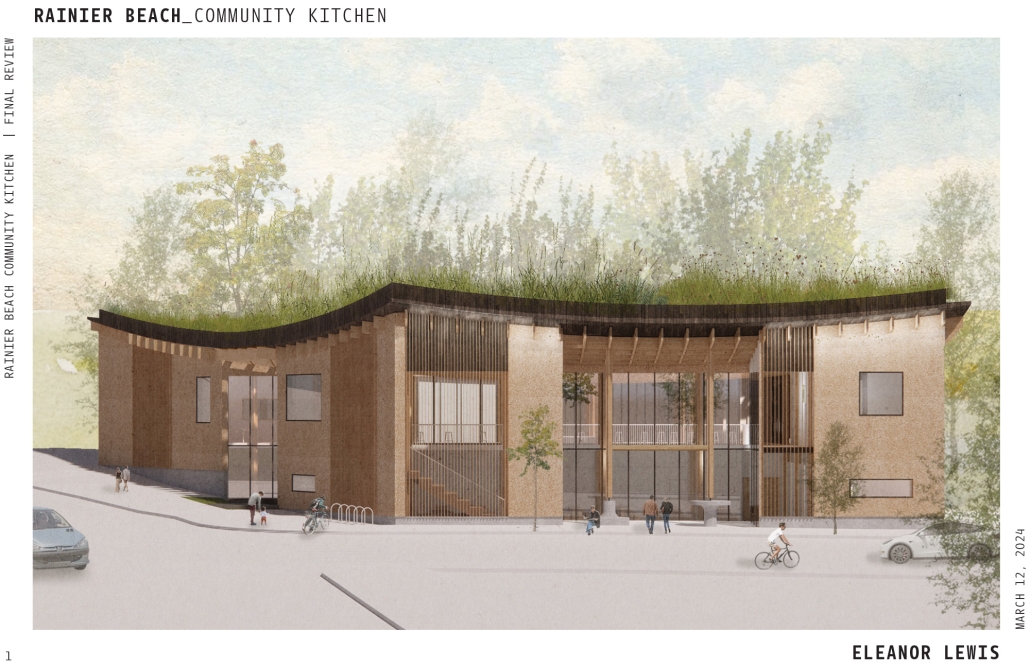
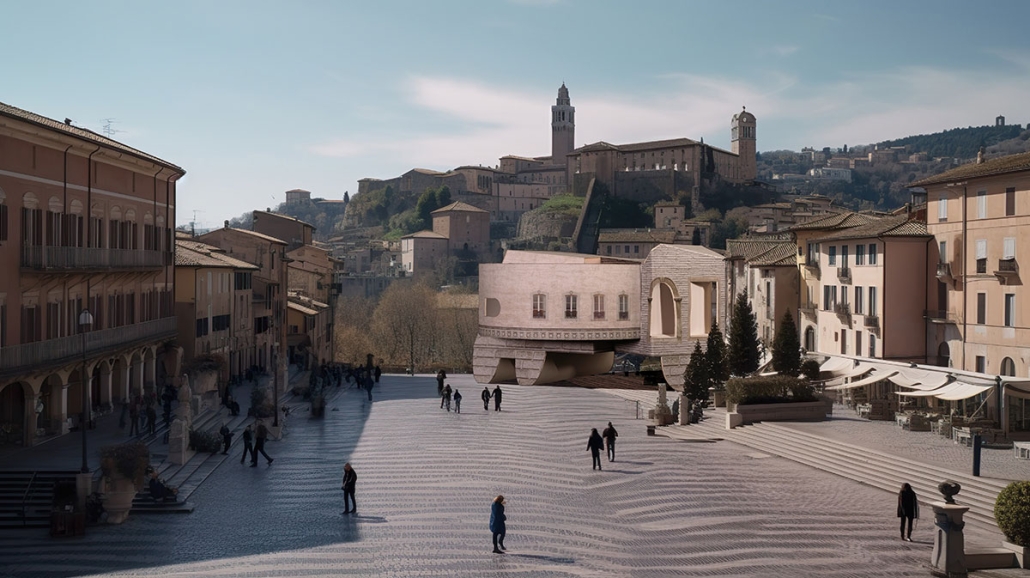
Lazo by Rafael Martínez Marín, B.Arch ’25
Tecnológico de Monterrey | Advisor: Claudia Berenice Muciño García

The abandonment of Puebla’s Historic Center stems from urban, economic, and social transformations that, since the city’s founding, have triggered segregation and displacement, altering its residential character. In the 20th century, urban sprawl and the creation of new housing zones pushed residents out of the center. This trend was deepened by economic crises, weak public policy, and a lack of housing incentives, leaving many buildings in disrepair and community life fractured.

In recent decades, the city’s designation as a World Heritage Site and the growth of tourism have transformed the center into a commercial hub, further reinforcing residential abandonment and neglecting the development of its original neighborhoods.

This study focuses on the Analco neighborhood, a place deeply affected by these dynamics. It now faces advanced deterioration and insecurity. Through documentary research, interviews, comparative analysis, and analogous case studies, the project identifies patterns, challenges, and opportunities that have shaped Analco’s transformation.

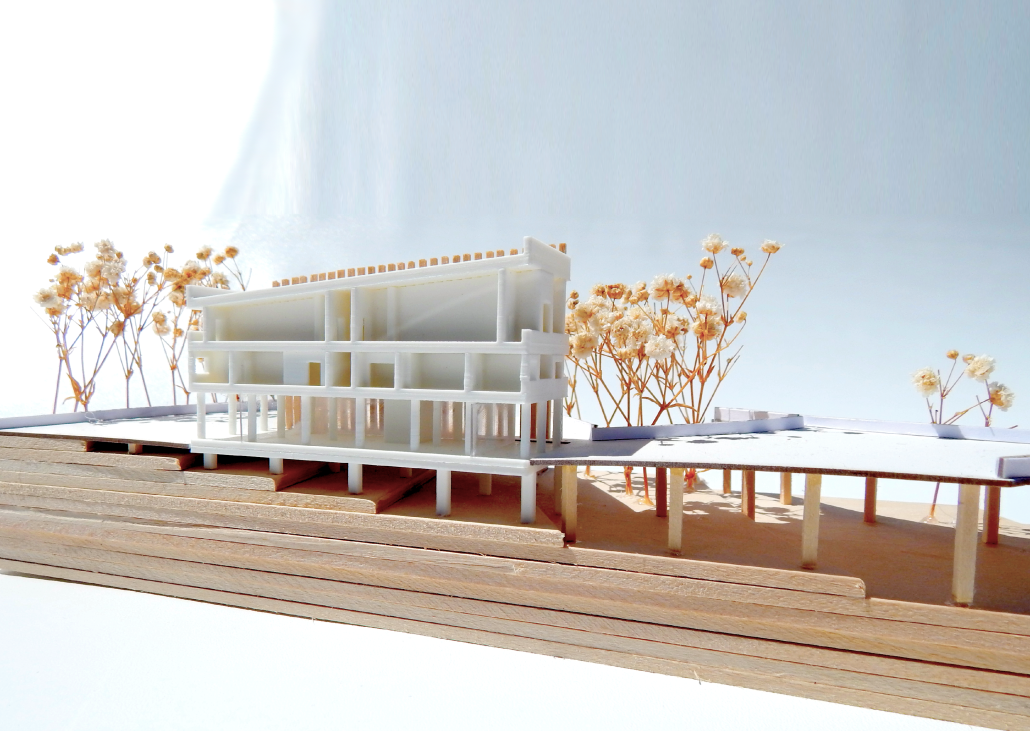
As a response, the architectural project “Lazo” proposes a strategy to reconnect the neighborhood with its people. Situated on two plots separated by a street, the design links them through a habitable bridge that becomes both a symbolic and functional connector. This elevated structure hosts cultural, educational, and social programs that strengthen community bonds.

More than a finished object, the project is conceived as an open and adaptable system, shaped through community involvement. Public space is the core of the proposal, with plazas, open workshops, and shared courtyards designed to encourage interaction and daily use. The program includes classrooms, artisan workshops, a communal kitchen, and exhibition areas—spaces that promote learning, creativity, and the transmission of local knowledge.

The bridge redefines the street not as a boundary but as a space of encounter, promoting pedestrian movement and intergenerational exchange. “Lazo” becomes not just a building, but an infrastructure of care, identity, and continuity—an active agent in the regeneration of one of Puebla’s most historic yet neglected neighborhoods.

The capstone was recognized as Best Generation Project by Tecnológico de Monterrey.

Instagram: @rafamtz._, @arq.pue.tec

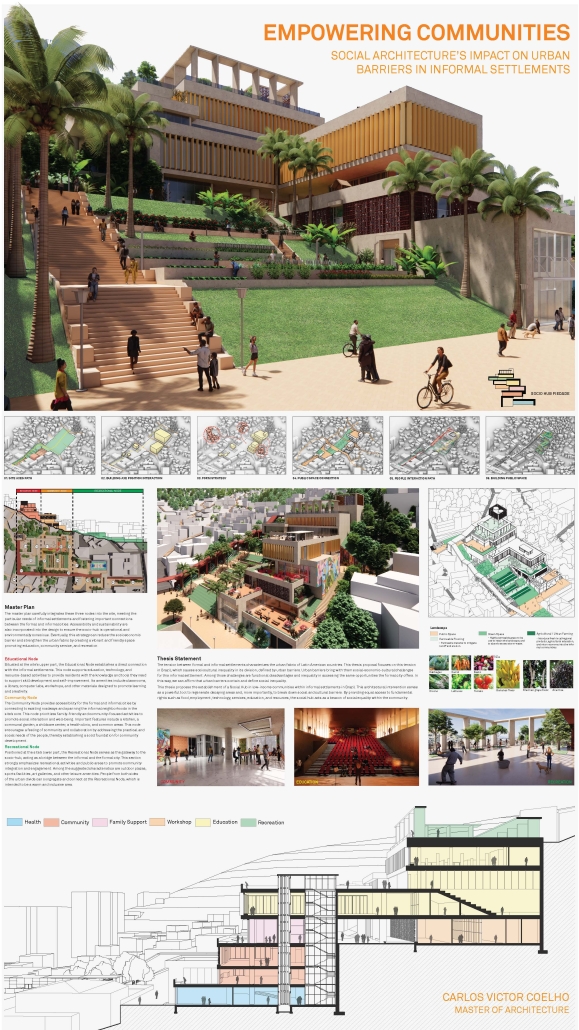
Empowering Communities by Carlos Victor Coelho, M.Arch ’25
Boston Architectural College | Advisors: Ralph Jackson & Ian F. Taberner

SOCIAL ARCHITECTURE’S IMPACT ON URBAN BARRIERS IN INFORMAL SETTLEMENTS

This thesis proposal focuses on the tension between formal and informal settlements in Latin American countries, particularly in Brazil, where urban barriers contribute to sociocultural inequality. These barriers, including spatial, economic, and political exclusions, create challenges for informal settlements, such as infrastructure disadvantages and limited access to opportunities. By asking the following questions, this proposal suggests establishing a social hub in a low-income community within informal settlements, emphasizing the importance of considering its unique conditions and challenges in planning urban interventions. 

The Social Hub aims to break down social and cultural barriers through social architectural intervention. This intervention will act as a powerful tool to provide equal access to essential resources and services, such as food and water. The initiative also aims to promote social equality and inclusion. This proposal suggests establishing the social hub in an informal settlement in Vitoria, ES, Brazil. To achieve its goal, the proposed site, approximately 1.8 acres, is situated in a sloped informal neighborhood within the heart of the city and the Historical center, rich in cultural and historical relevance.

Methods of Inquiry:

– How can social architecture in informal settlements increase the quality of life and social equality?

– What challenges and barriers do urban barriers within low-income communities bring to them?

– How can deconstructing urban barriers through architecture help guarantee needy community residents’ right to the city and ensure integration and equality?

Term of Criticism:

– Does the proposal project help overcome challenges such as the urban barrier within the community?

– Does the proposal present a structure that fulfills the community’s significant needs, such as food access, education, and public space?

– Does the project offer a structure that encourages the community’s involvement and inspires pride and opportunities

This project received Commends for Thesis.

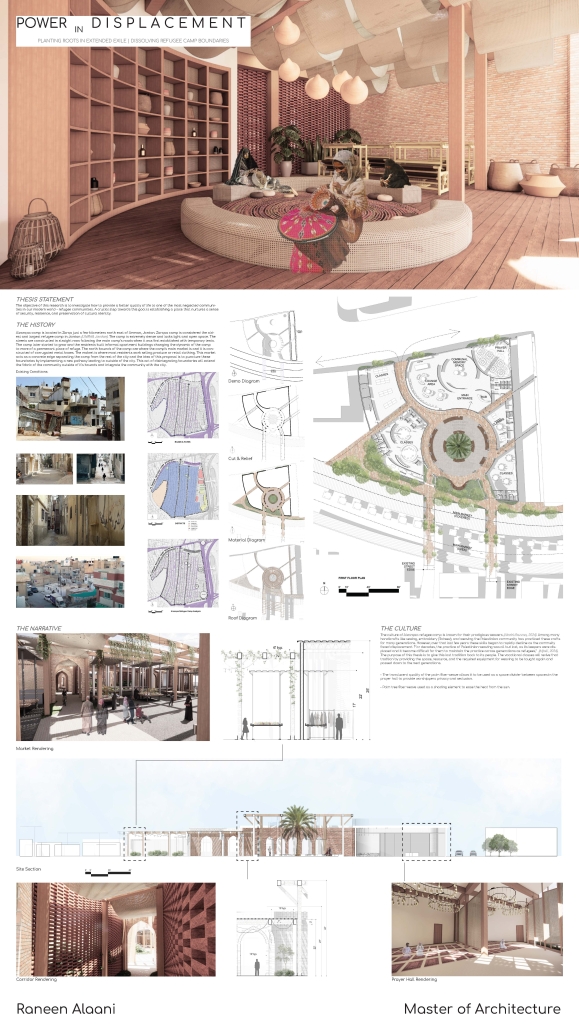
Power In Displacement by Raneen Alaani, M.Arch ’25
Boston Architectural College | Advisors: Lorraine Kung & Ian F. Taberner

Planting roots in extended exile – Disintegrating refugee camp boundaries.

This research investigates establishing a sense of security, resilience, and preservation of cultural identity for Palestinian refugee communities in the Middle East. These communities have been struggling with instability and feeling that they have been uprooted from their homes for many decades. The political status of most of these refugees complicates the issue even further. Palestinian refugees in many Middle Eastern countries fall under the status of “stateless”. This dilemma is not only affecting their social and economic lives, but it is detrimental to their psychological and emotional wellbeing as they continue to feel imprisoned within the intangible boundaries of their refugee camps.

  • Creation of a safe haven to exhibit communal memory that reminisces the homeland
  • A place of attachment that empowers the culture, religion and heritage
  • The use of natural light to invoke healing – peace – tranquility

Methods of Inquiry:

  • Sense of security and stability is restored
  • Refugee community’s youth have aspirations for their future
  • Self-esteem and self worth is restored

Terms of Criticism:

Alzarqaa refugee camp is only a few kilometers outside of Amman, Jordan. It is one of the oldest refugee camps in the region (UNRWA Jordan). Alzarqaa camp struggles with density and lack of job opportunities in addition to water scarcity, lack of resources, and lack of natural light. This thesis proposes a resilience center of approximately 9000 SF just outside the bounds of the camp that acts as a continuation of the community extending just beyond the boundaries of the camp.”

This project received Commends for Thesis.

Stay tuned for Part XII!
2025 Study Architecture Student Showcase - Part X

Architecture tells a story. The capstones and theses highlighted in Part X of the 2025 Study Architecture Student Showcase use texture, material, and spatial configuration as visual narratives. From short films to renderings, each project uses a unique medium of storytelling. The displayed work ranges from memorials inspired by speculative fiction and design interventions using augmented reality to exhibitions on womanhood and visualizations of poetry.
Scroll down for a closer look!
Thread by Thread by Emily Dross, B.Arch ’25
Ball State University | Advisor: James F. Kerestes

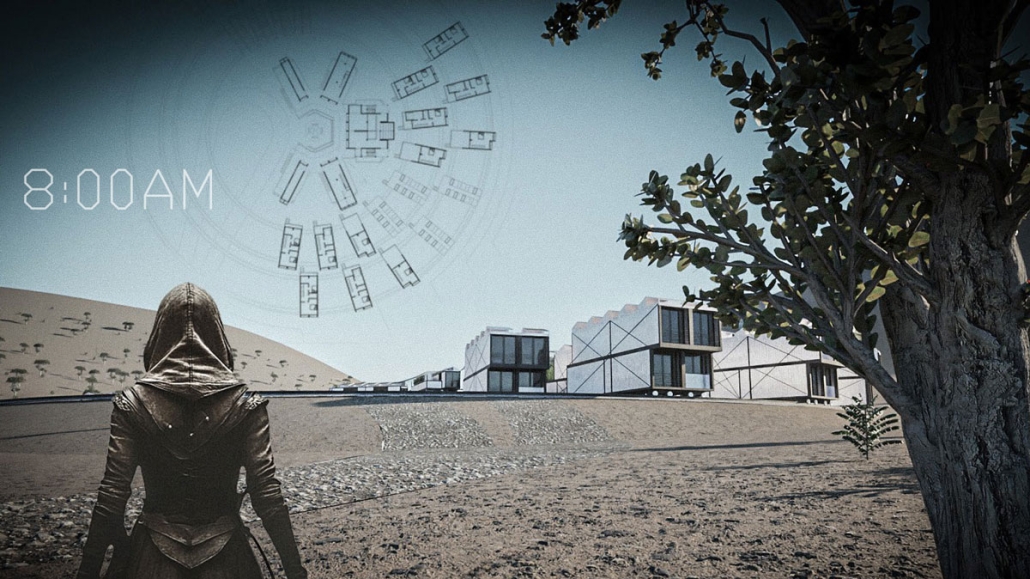
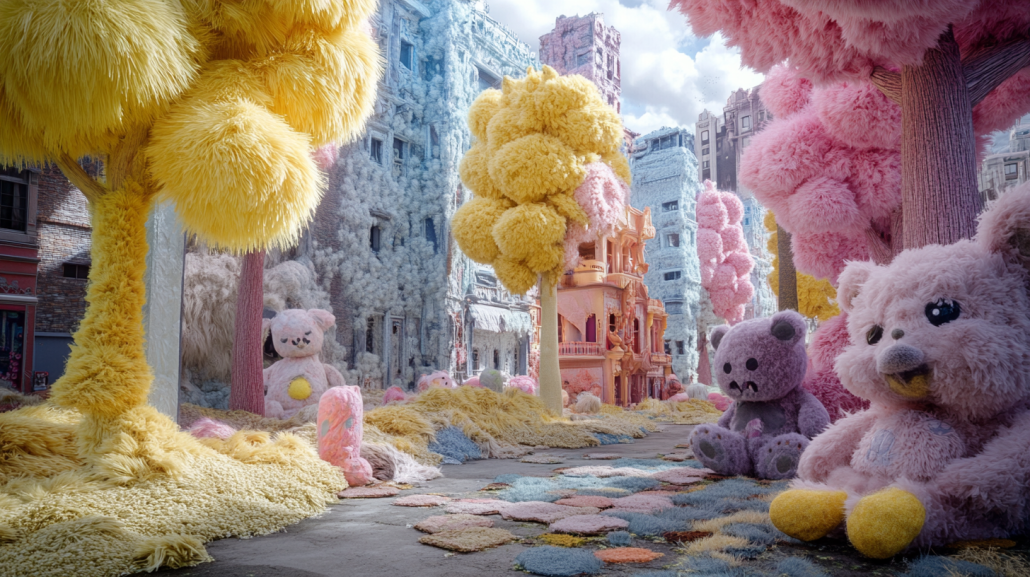
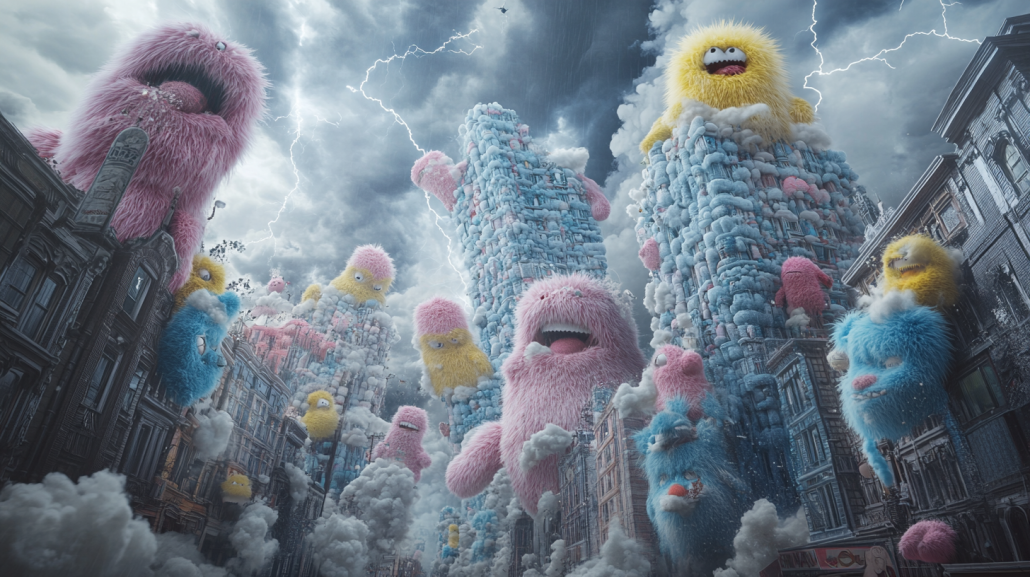
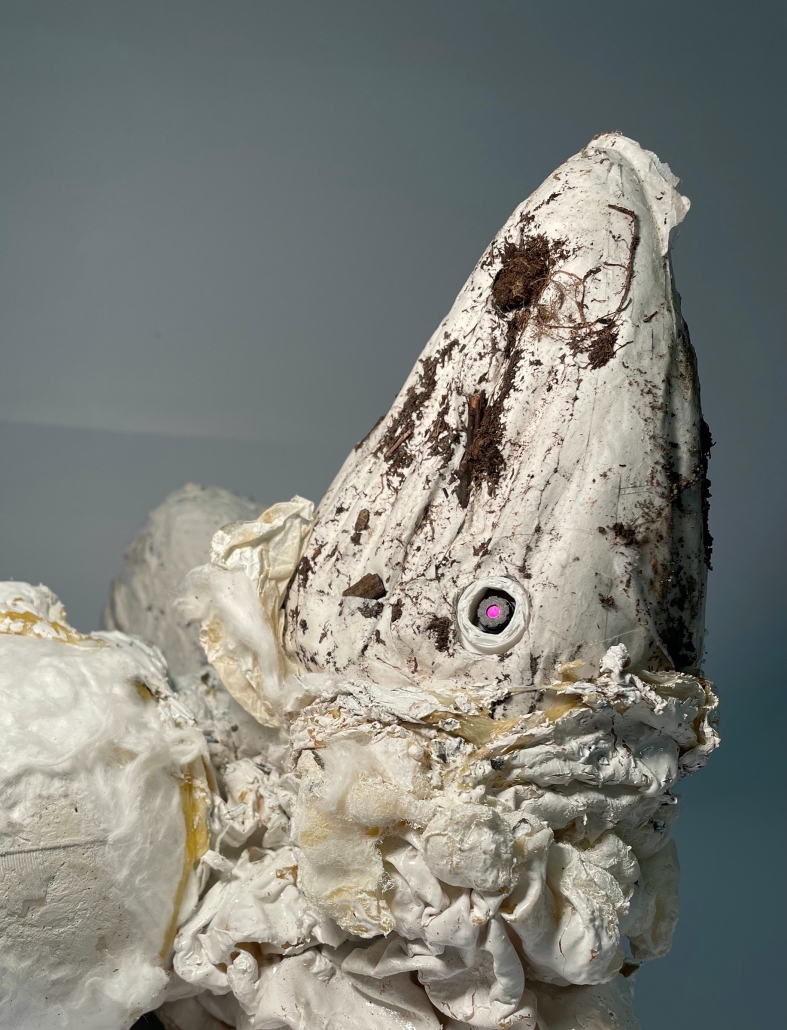
“Thread by Thread” is a short film, created as part of the course Cinematic Environments: Uncanny AI, explores hybridized architectural conditions through a speculative and surreal lens. Set in a richly imagined built environment, the narrative unfolds through the movements and interactions of fluffy, stuffed animal-like creatures—anthropomorphic figures that serve as both inhabitants and interpreters of the space. These soft-bodied protagonists navigate a world that oscillates between the familiar and the uncanny, offering a playful yet critical reflection on contemporary architectural and environmental issues.

The project operates within the “fuzzy space” between realism and speculation, where exaggerated materials, textures, and spatial configurations provoke questions about the future of the built environment. By merging whimsical imagery with architectural inquiry, the film engages themes of technological transformation and post-Anthropocene speculation. The soft, plush inhabitants stand in stark contrast to the often rigid, industrial aesthetic of traditional architectural spaces—suggesting alternative, more empathetic ways of occupying and designing environments.

Through visual storytelling, “Thread by Thread” reflects a critical position on how architecture might respond to pressing global concerns while embracing unconventional narratives and mediums. Ultimately, the film is a provocative gesture—one that reimagines the role of architecture in shaping not only physical space but also cultural and emotional landscapes. It invites viewers to question the boundaries of architectural representation and consider the value of softness, fantasy, and hybridity in the discourse of design.

Instagram: @em.dross, @jameskerestes

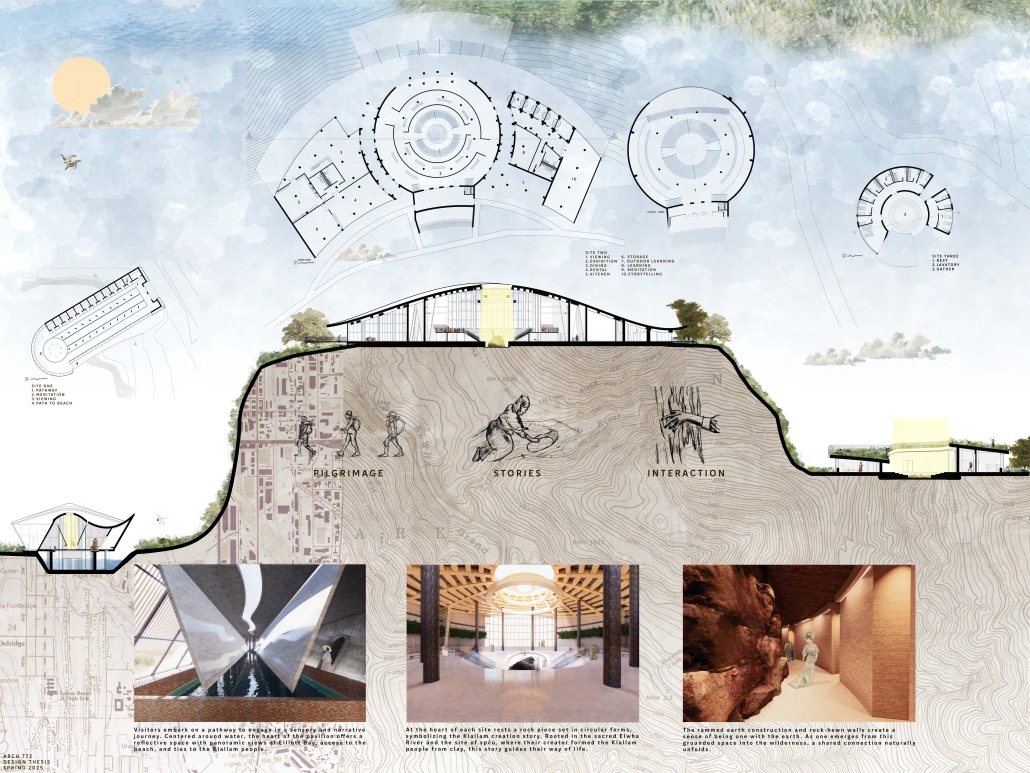
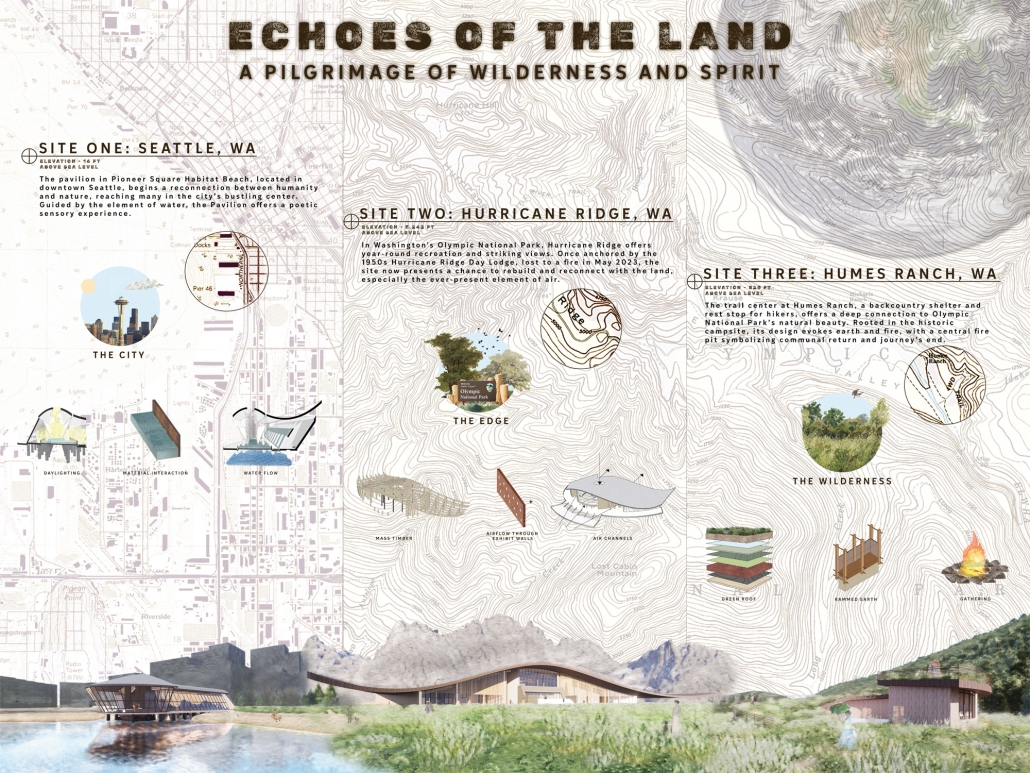
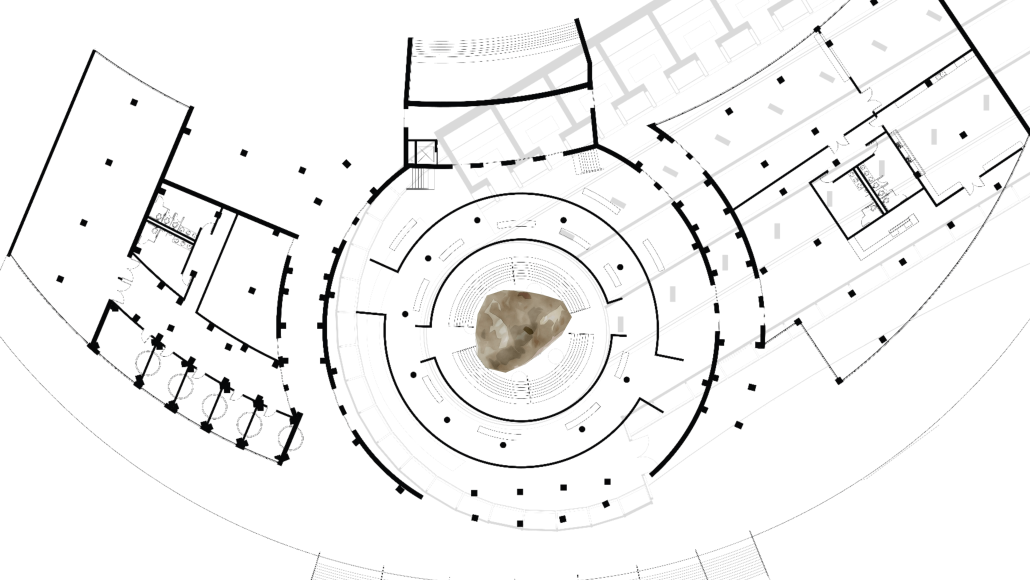
Echoes of the Land: A Pilgrimage of Wilderness and Spirit by Andrea Frank, M.Arch ‘25
North Dakota State University | Advisor: Stephen Wischer

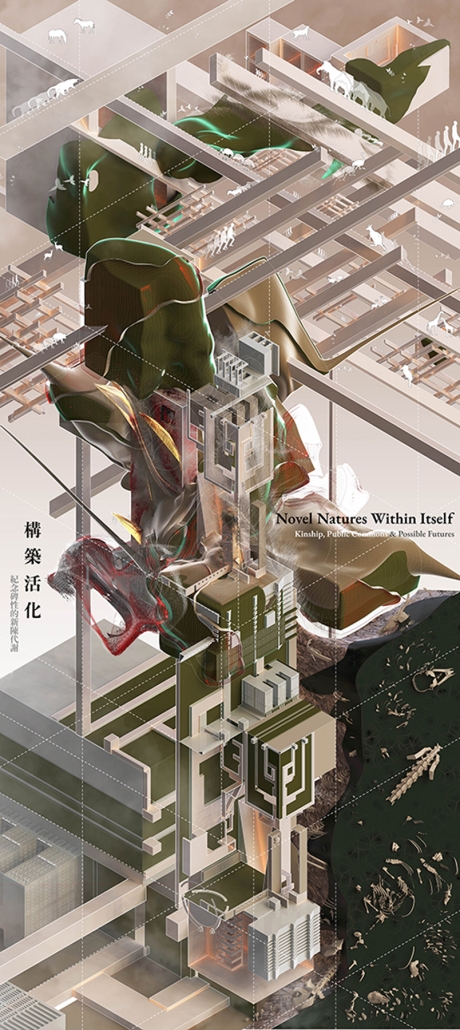
This thesis explores how architecture can bridge humanity and the natural world, restoring a connection eroded by technology, overconsumption, and distraction. While cities offer curated encounters with nature, they cannot replace the deep peace found in wilderness. This connection is essential to humanity’s survival. If humanity fails to understand its relationship with the environment and engage with it responsibly, it jeopardizes the ecological balance of the world and humanity’s own existence.

Architecture, once in dialogue with nature, now often serves function, spectacle, or profit. This work reimagines architecture as a mediator that fosters kinship with the earth through a threefold approach: a pilgrimage across city, edge, and wilderness; poetic uncovering of ancient site stories; and sensory engagement with the four classical elements. In doing so, architecture becomes a vessel for atmosphere, memory, and meaning, guiding individuals to a deeper awareness of themselves and their world.

This project received an AIA Medal for Academic Excellence.

Instagram: @andrea.frank10

A Place for Pilgrimage by Andy Packwood, B.S. in Architecture ’25
University of Virginia | Advisor: Peter Waldman

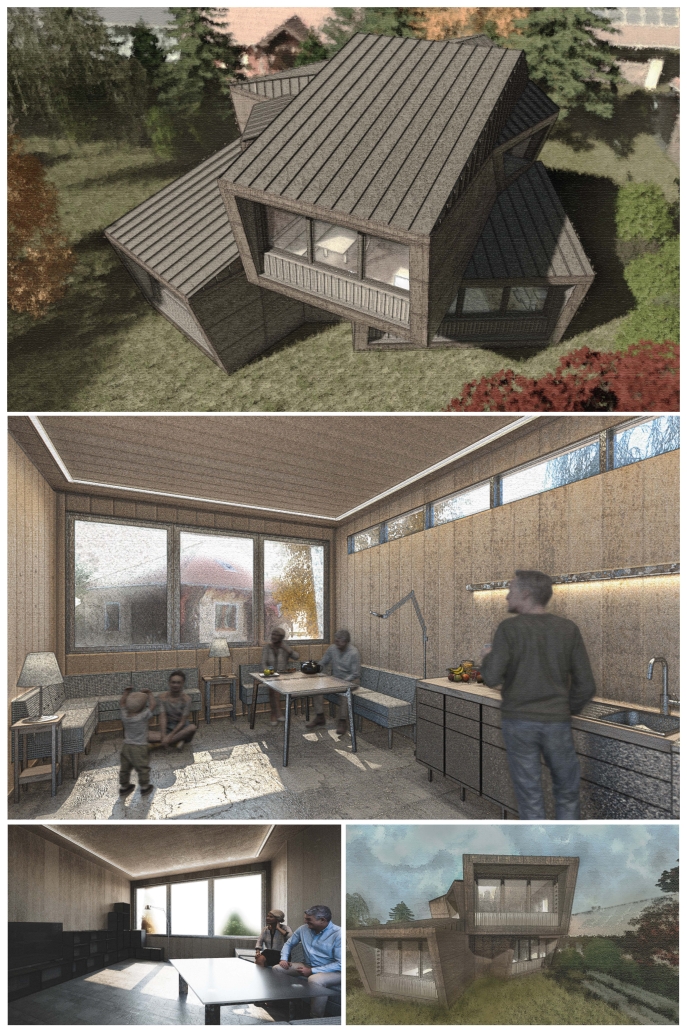
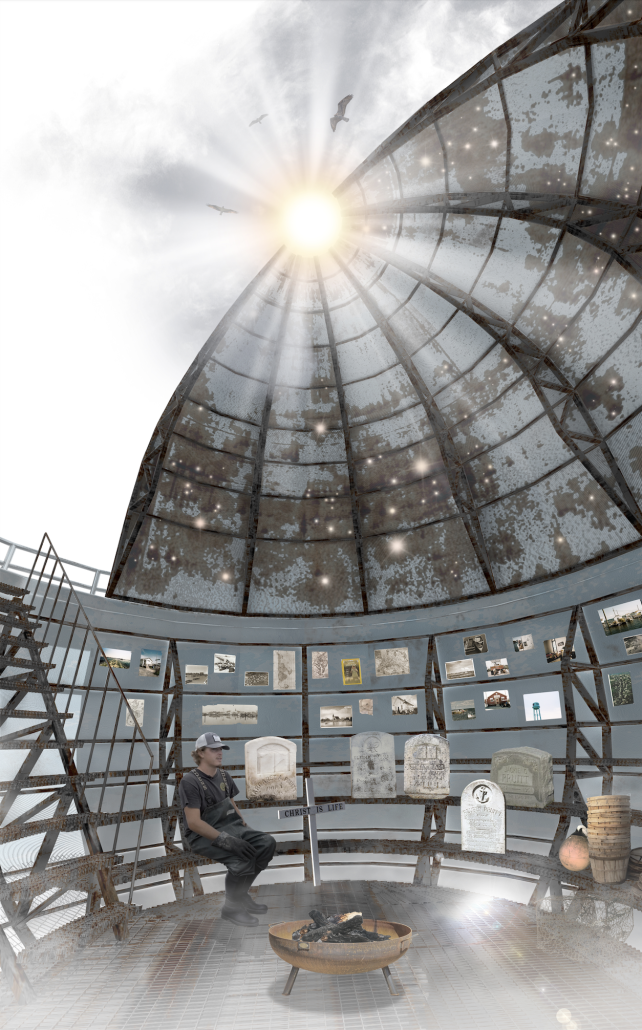
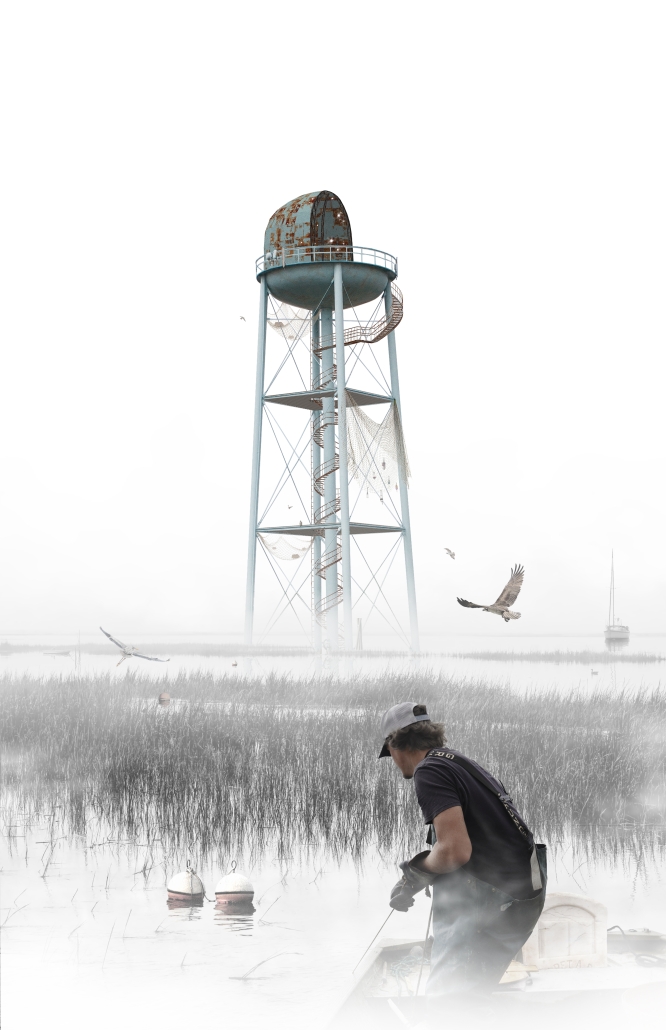
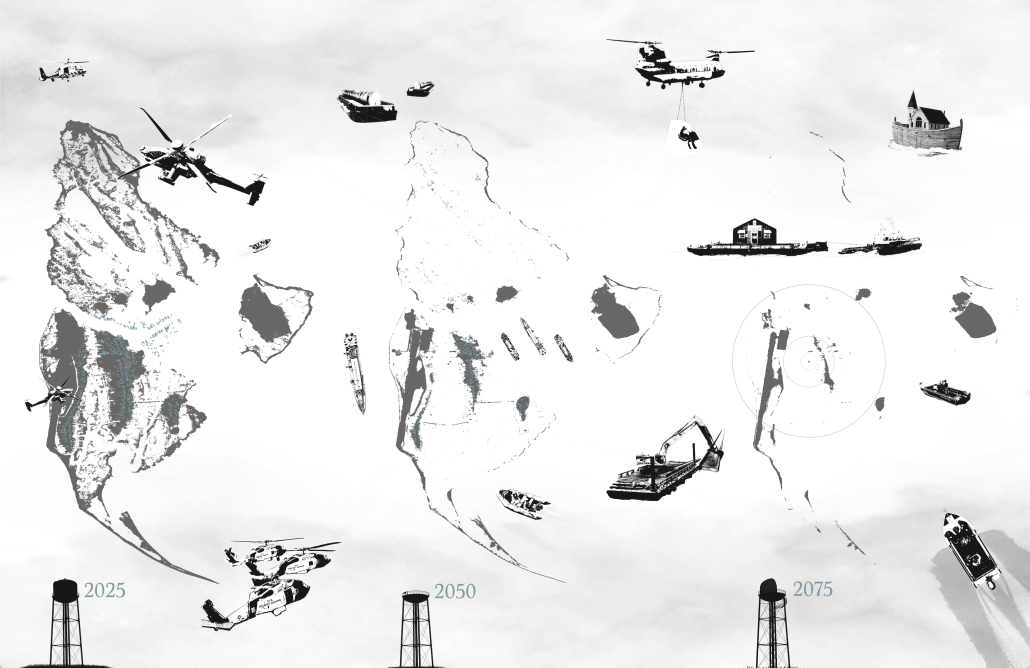
The project synthesizes two years of fascination for and research into the climate-threatened coastal community of Tangier, speculating as to what will ultimately happen to rural, low-income American communities in the wake of inevitable sea level rise. My interest lay not in the proposal of any sort of savior infrastructural solution, not in the proposal of a managed retreat plan, nor in the design of a mainland relocation for displaced refugee residents. I chose to develop a memorialized destination that could still exist on the island long after its ridges have turned to marsh, its homes have been barged away, and normally perceived connotations of inhabitability have all but vanished. I chose to create “A Place for Pilgrimage”, inspired by my own pilgrimage of El Camino de Santiago this past March.

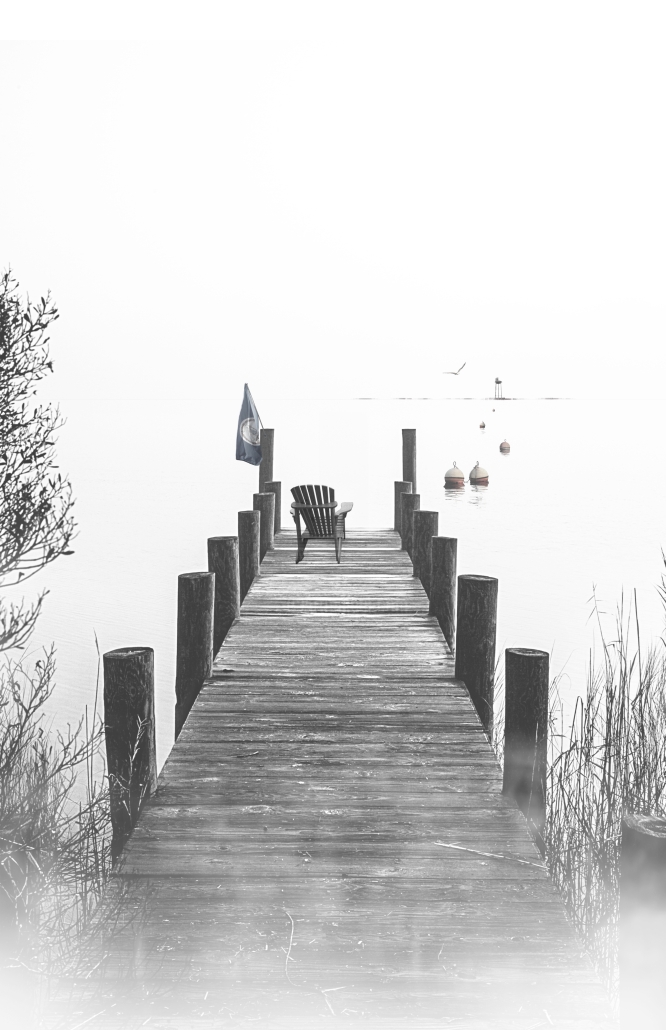
Simply put, the proposal is an adaptive reuse of the tallest structure on Tangier: its water tower. Adding a spiraling staircase and pushing the structure fifty years into the unknown, the design creates a single space in the sky through the removal of half of the tower’s upper dome. The approach is incredibly important; much of the final pin-up focused on rendering this pilgrimage step by step. Starting from the dock of the mainland resettlement, looking out into the Chesapeake Bay, a line of buoys trails towards the horizon. A bird soars toward the tower in the distance, the vestiges of marsh poking out of the water. Cameron Evans, current vice mayor and young watermen of the Island, embarks as this future pilgrim by skiff. He carries with him a gravestone; many cemeteries on the Island are often inundated by tidal flooding, and residents must move these tombs to higher ground, again and again.

What I have proposed is a final resting place, safe from the heights of sea level rise. A place for generations to visit, to bring tokens of remembrance, to occupy overnight, or to even continue their trade as watermen. Up within the dome of the water tower is a cenotaph for the people, memories, culture, history, and beauty of Tangier. We will need one.

This project was awarded High Honors for Thesis.

Ephemeral Spaces — Presence and Absence by Robin Xiao, B.S. in Architecture ’25
University of Virginia | Advisor: Peter Waldman

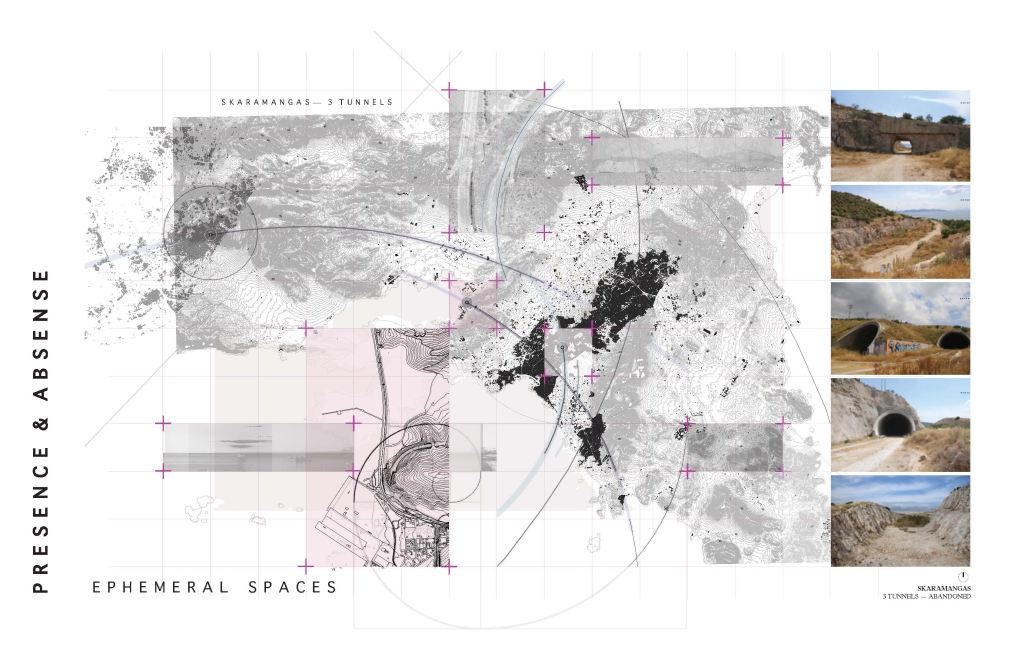
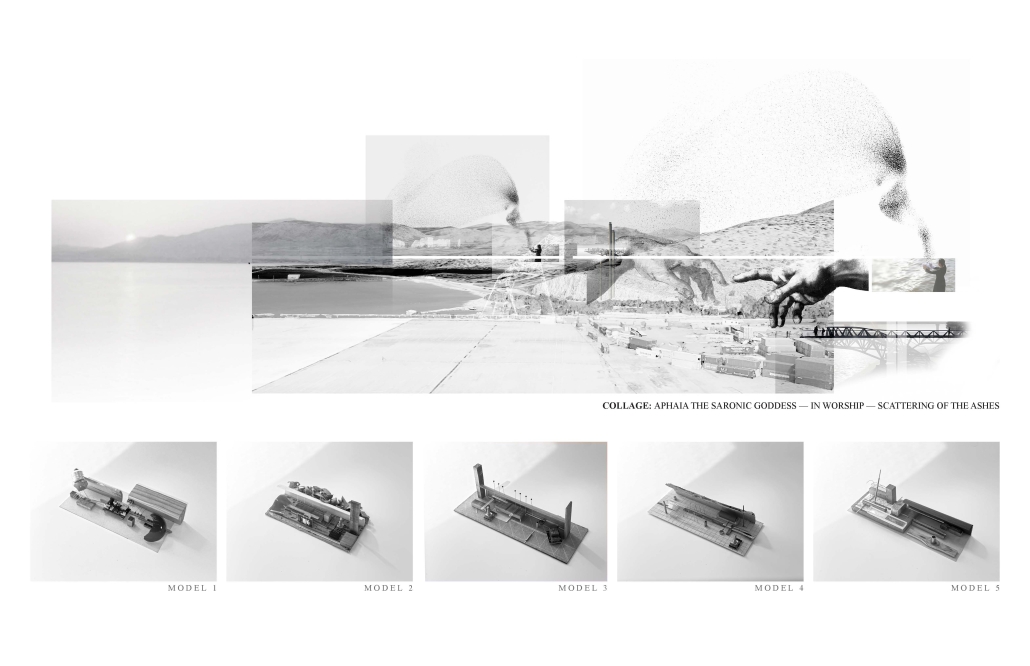
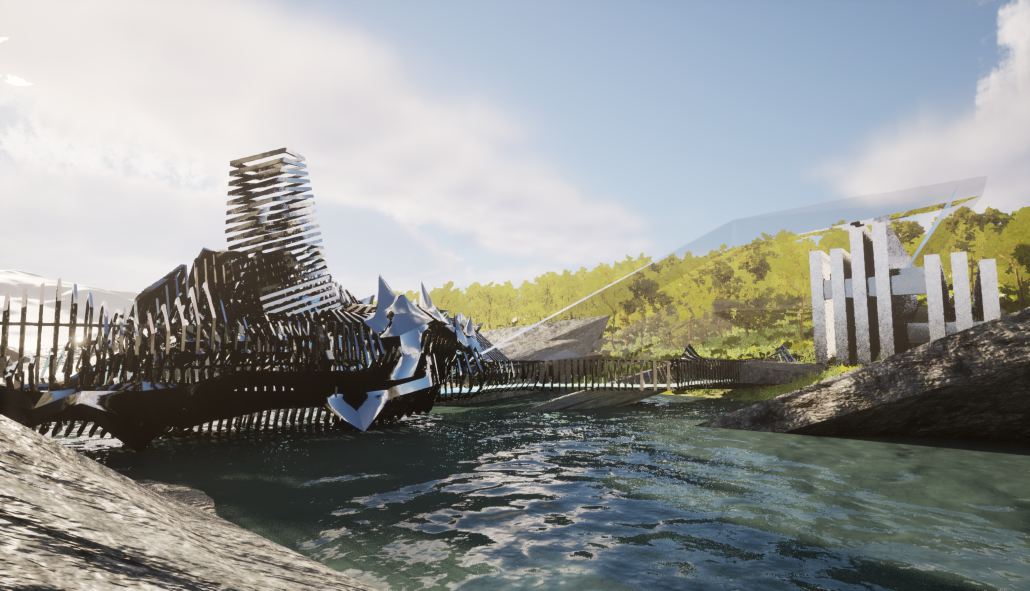
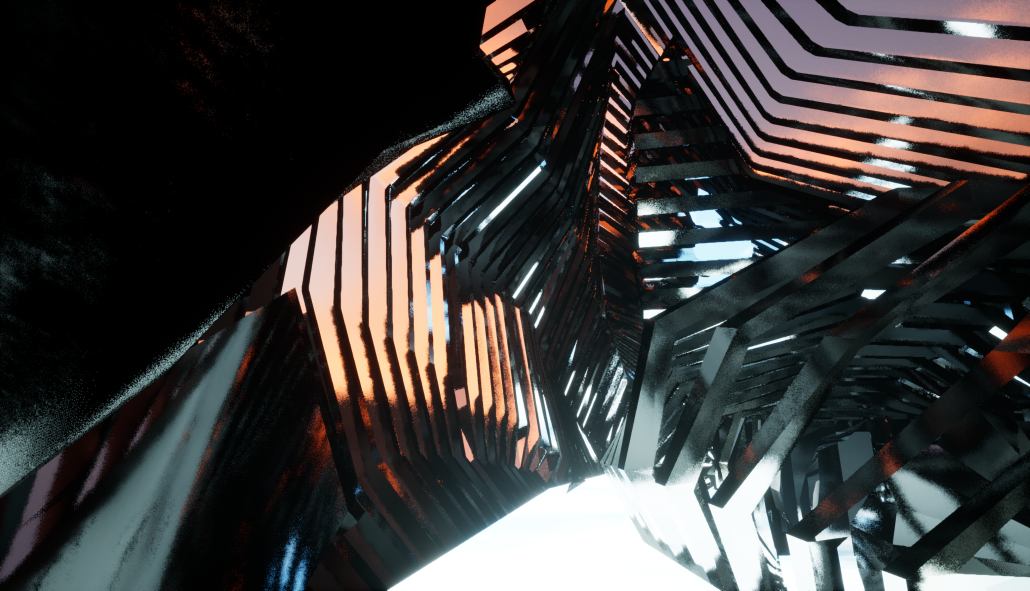
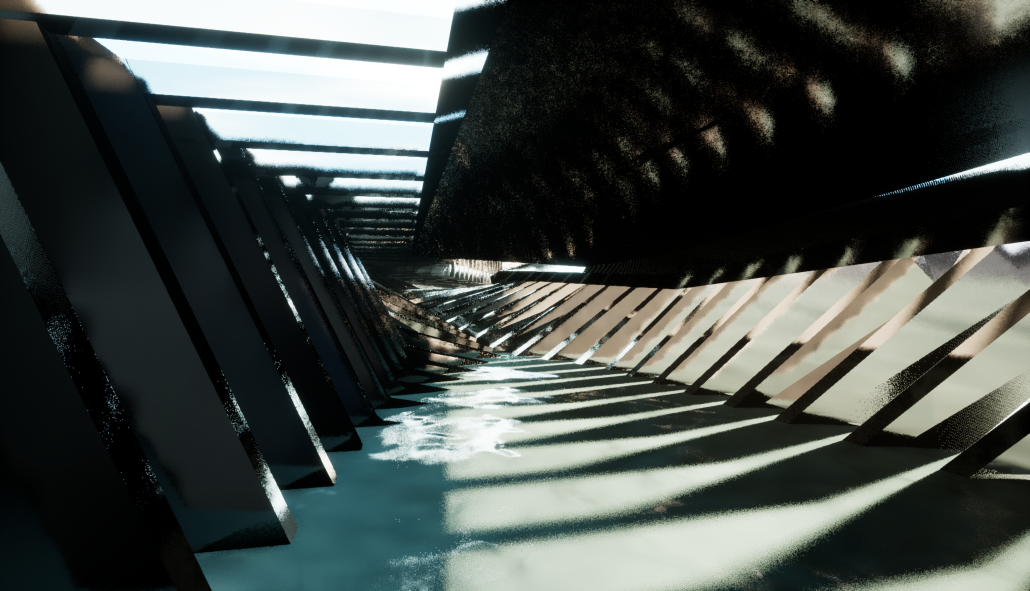
This thesis explores how architecture can emerge from the debris of the everyday to construct a space of ritual and transition—between life and death, presence and absence, memory and forgetting. 

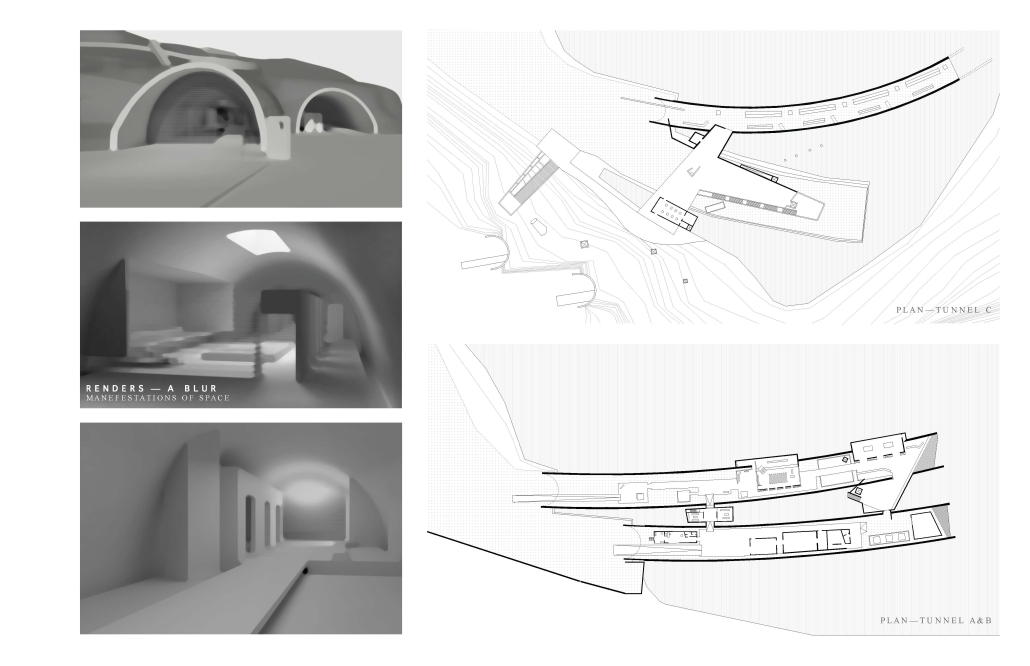
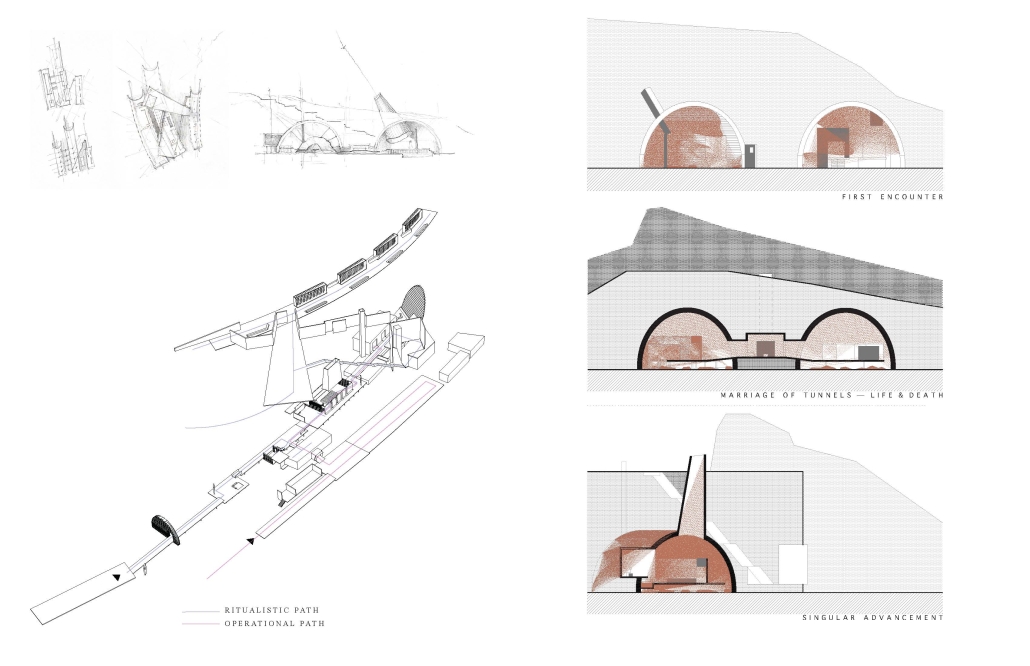
Situated in the post-industrial landscape of Skaramangas, Athens, the project transforms three abandoned military interchange tunnels into a procession of ephemeral architecture: a crematorium, a columbarium, and spaces for reflection, and spaces of pause/entry/exit. 

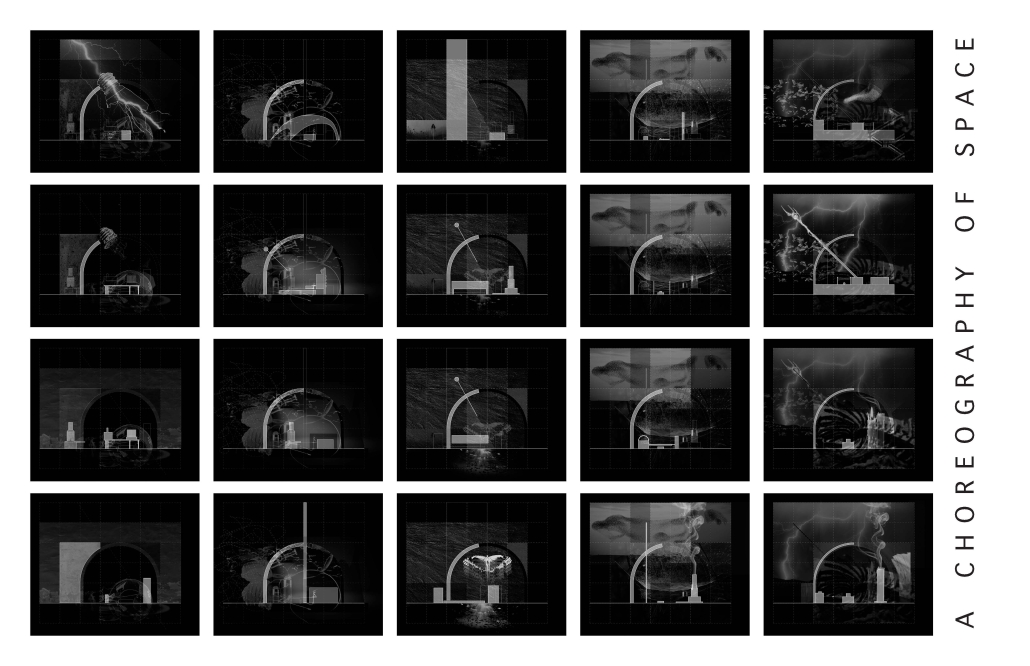
Through a series of five conceptual models, material fragments—broken light bulbs, candles, metal tubing, computer chips, wood scraps—become instruments of spatial inquiry, offering alternative ways to think about temporality, transformation, and the sacred. Each model gives rise to a set of sectional drawings, collaged with elemental forces—earth, fire, air, water—revealing a layered architecture of transition. 

The resulting proposal is not a fixed structure, but a choreography of spaces that invite the living to move with the dead, through tunnels repurposed as thresholds. This work situates ephemerality not as loss, but as an architectural condition of becoming—an act of spatial murmuration shaped by light, material residue, and memory in motion.

This project received High Honors for Undergraduate Thesis.

Instagram: @robinxiaostudio

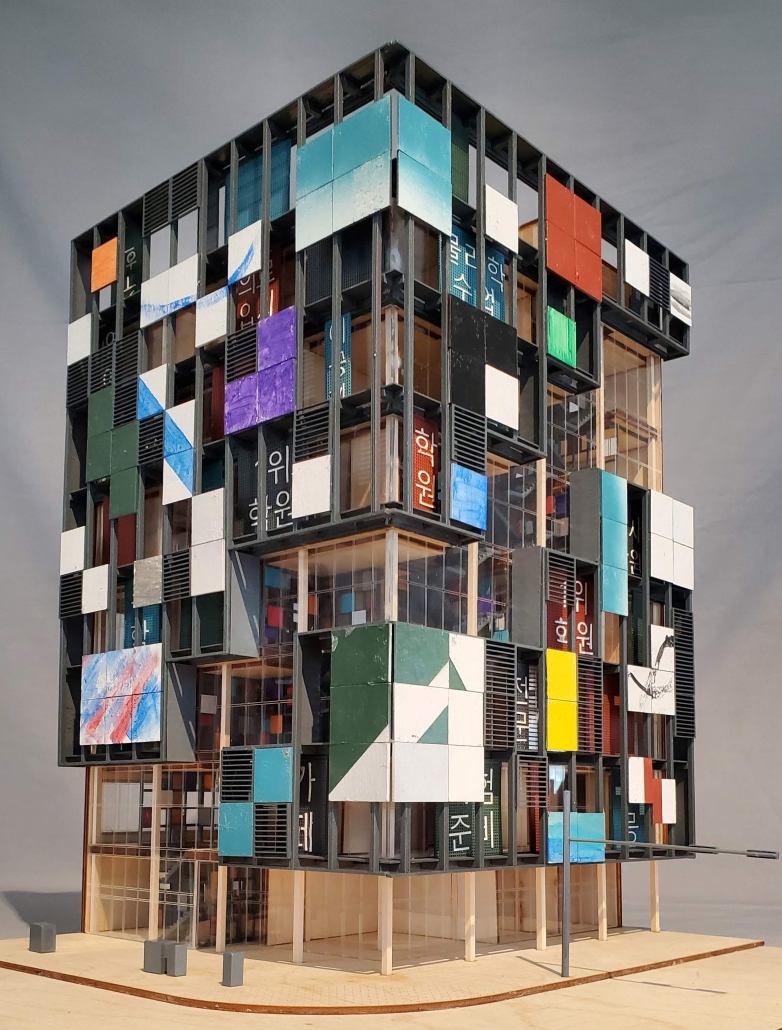
MOVING FUTURES VERTICAL SCHOOL by Alex Hoover & Zach Izzo, M.Arch ’25
University at Buffalo | Advisor: Jin Young Song

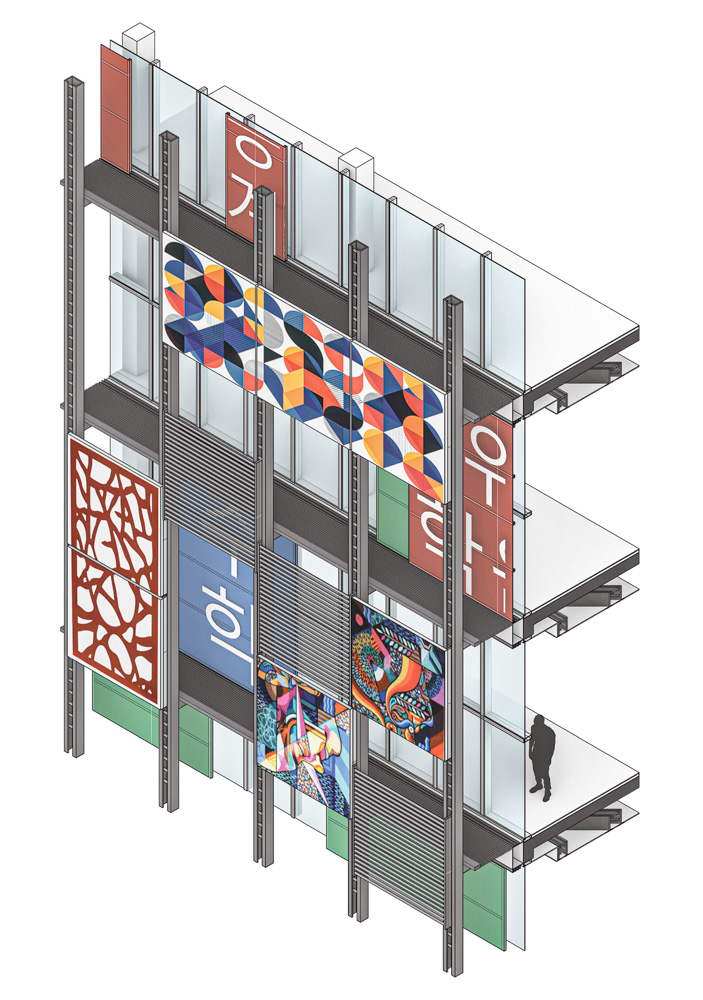
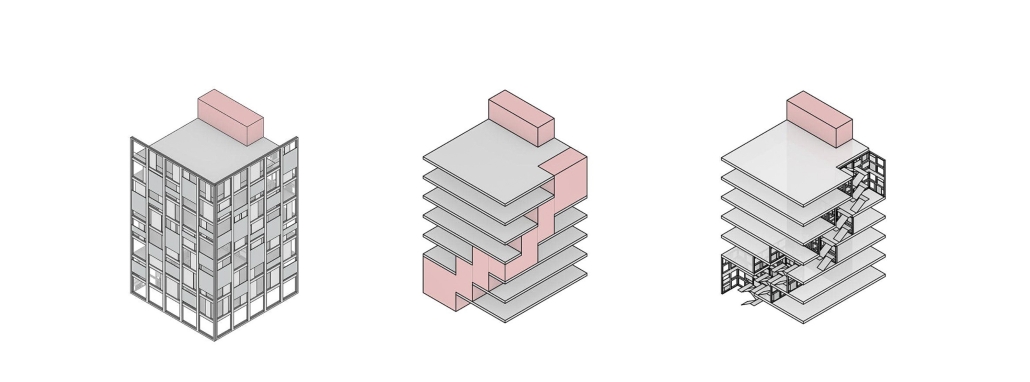
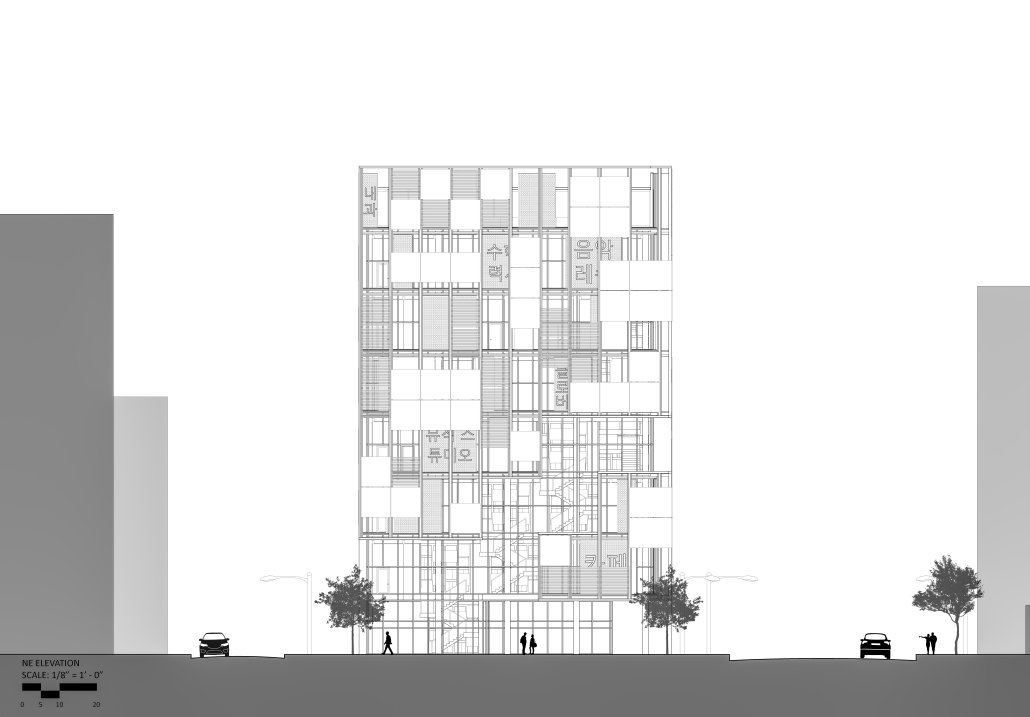
Located in Songdo, Seoul, our project reimagines the typical Korean private educational institutions, known as Hagwon, by prioritizing spatial flexibility and community engagement. Traditional Hagwons often feature cramped, efficiency-driven classrooms. However, research shows that children learn better in environments with diverse spatial qualities—high ceilings, minimal partitions, vibrant colors, and flexible layouts. To address this, we designed a highly adaptable building with movable interior and exterior components. Each main floor features partition walls on ceiling-mounted tracks, allowing spaces to transform easily—from small study rooms to large lecture halls or art galleries. This system ensures both spatial diversity for students and long-term adaptability for future tenants or programs. 

The facade similarly emphasizes flexibility, offering a reinterpretation of Korea’s dense, intrusive urban signage. The three-layer facade system integrates architecture, community identity, and student expression. The outer layer consists of LED media panels and sun-shading devices, configurable to display student artwork or community visuals, establishing the building as a neighborhood landmark. The second layer features sliding perforated metal signage panels, subtly blending information with the architecture rather than overwhelming it. The innermost layer wraps the social stair, visible from both adjacent streets, inviting public interaction and showcasing movement within the building. Smaller panels provide localized signage, such as floor numbers and bulletin boards. Together, the dynamic facade and transformable interior create a learning environment that fosters both community visibility and spatial flexibility, promoting a more engaging, human-centered educational experience.

The project was selected for the Cram Urbanism and Vertical Learning Space International symposium

Instagram: @_alex_hoover, @jinyoung___song  

The Market of Joy by Shefa Quazi, M.ArchD ’25
Oxford Brookes University | Advisors: Toby Smith, Alexandra Lacatusu, Toby Shew, Charles Parrack

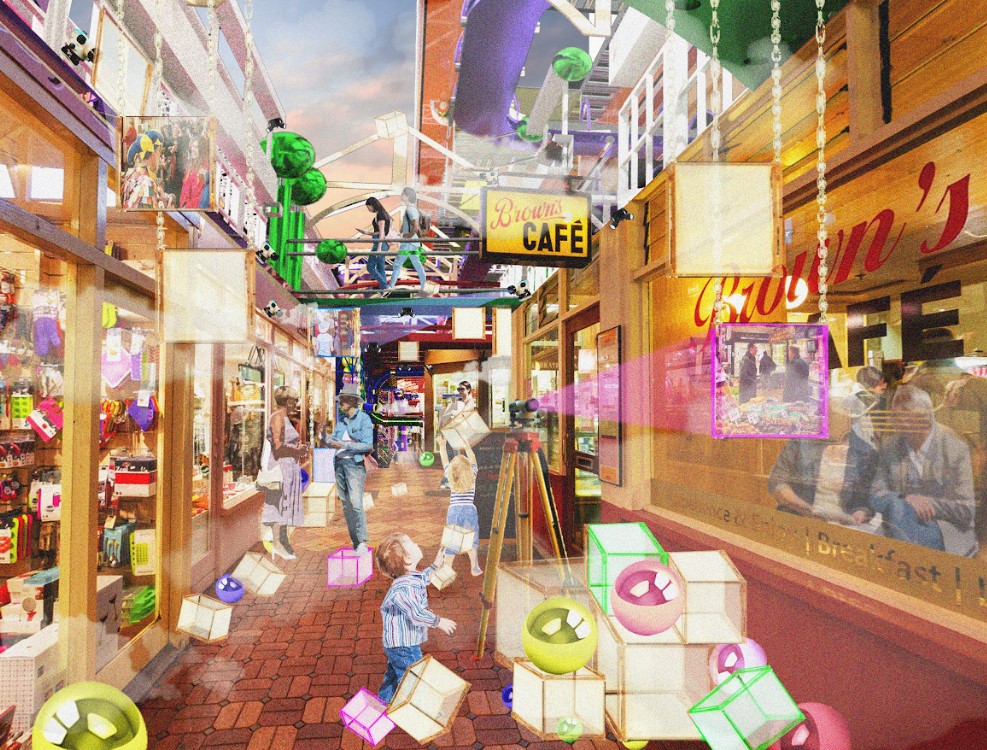
In a world dominated by seamless digital consumption, where screens dictate desires and algorithms predict movement, The Covered Market in Oxford becomes a site of rebellion—a place where reality is glitched, distorted, and reclaimed from commercial control. Instead of a polished, hyper-commercial spectacle designed to guide users into predictable behaviors, the proposed series of interventions hijack the mechanics of digital consumerism and turns them against themselves to exaggerate them into a physical, pseudo-reality. Attempting to readminister the loss currency of joy.

The market transforms into a disruptive, anti-brand arcade—a physical and augmented experience that interrupts, unsettles, and reawakens users to the absurdity of algorithm-driven life. Augmented Reality, typically a tool for corporate control (filters, tracking, gamified shopping), is instead repurposed to create moments of détournement, where the commercial is undermined, and participation leads not to consumption, but to adding weight to reality and human interaction. Overall revaluing the High Street as a whole. 

Instead of guiding users toward consumption, the market becomes a disobedient space, forcing engagement away from passive scrolling and toward critical awareness of spectacle itself. The interactions don’t feed an algorithm—they break it. The market is no longer a relic of pre-digital commerce but a living, evolving site of resistance against digital saturation and corporate control.

This project received the Oxford Brookes University Reginald W. Cave Award.

Instagram: @sheevz_q, @oxarch

The Inner Mechanism by Jared Roberts, M.Arch ’25
Lawrence Technological University | Advisor: Masataka Yoshikawa

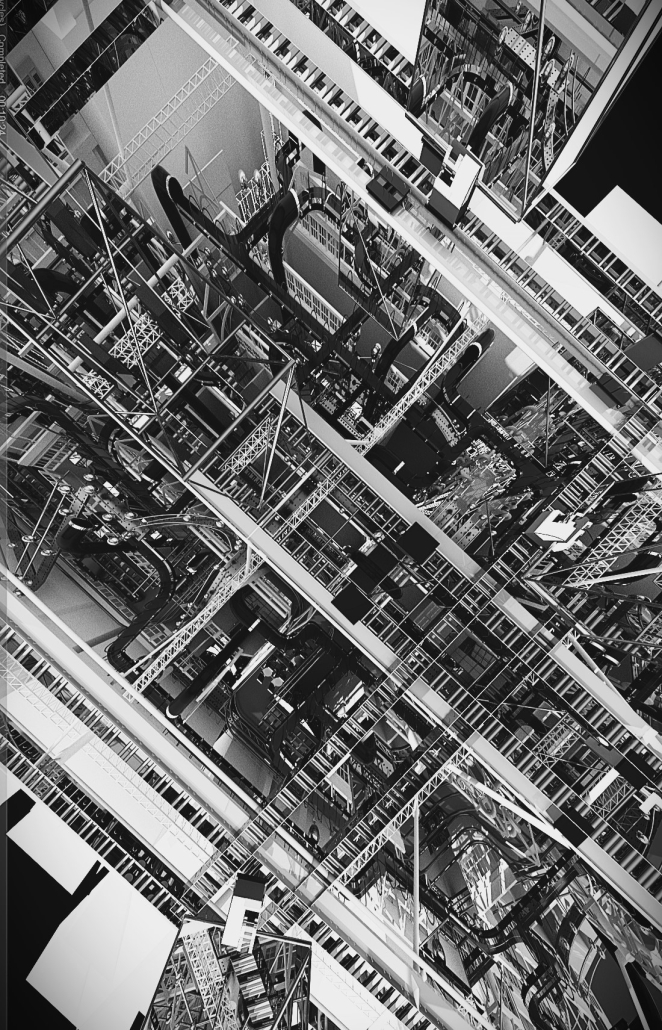
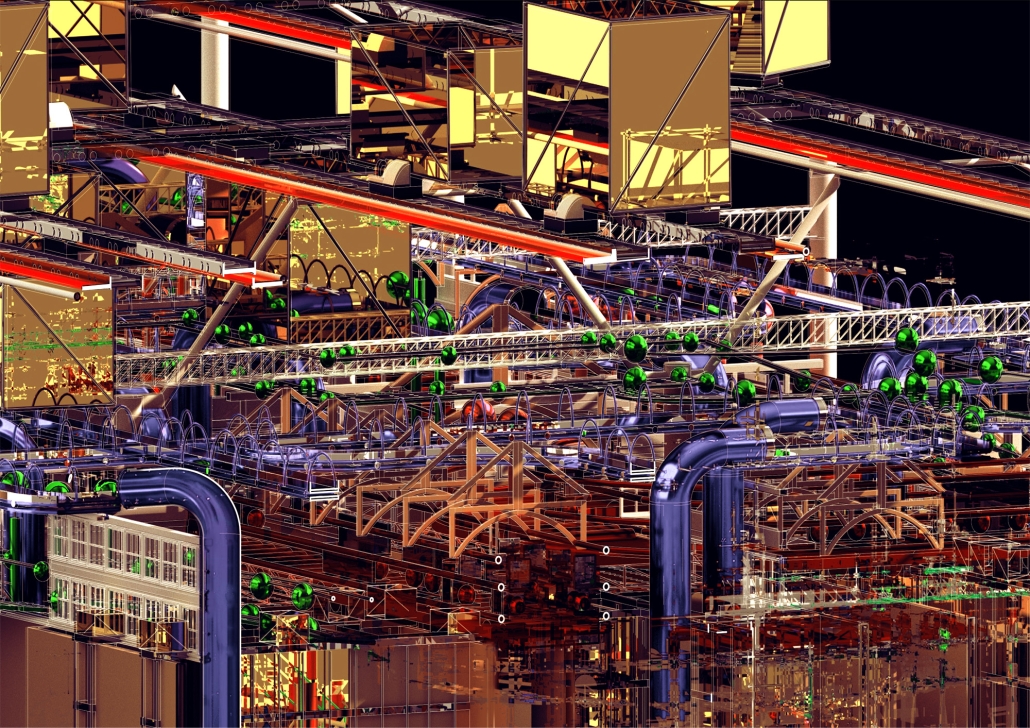
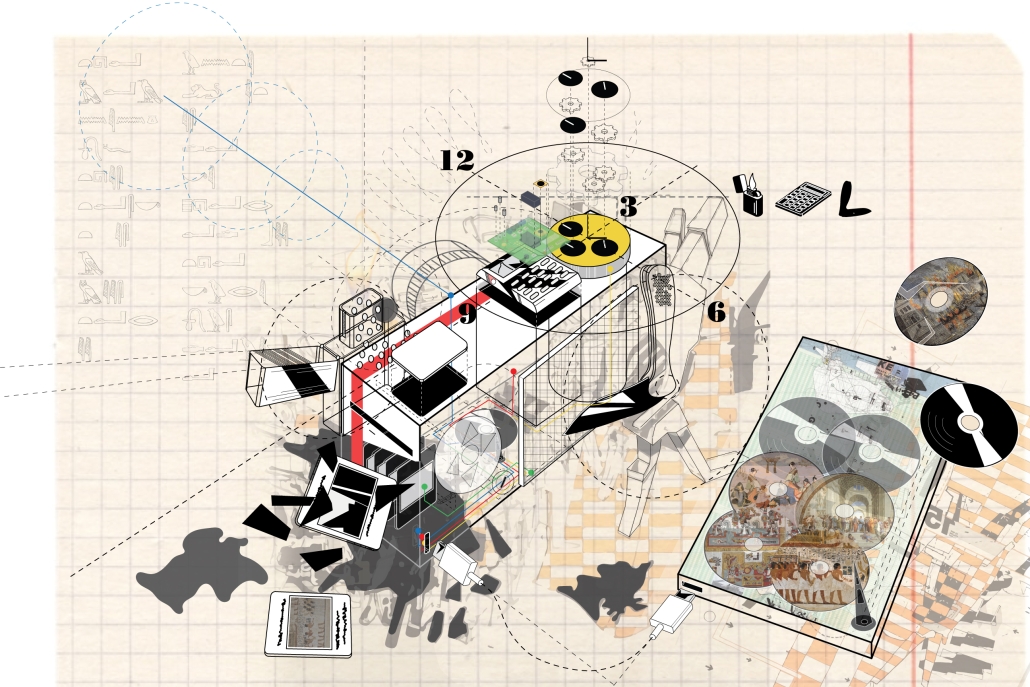
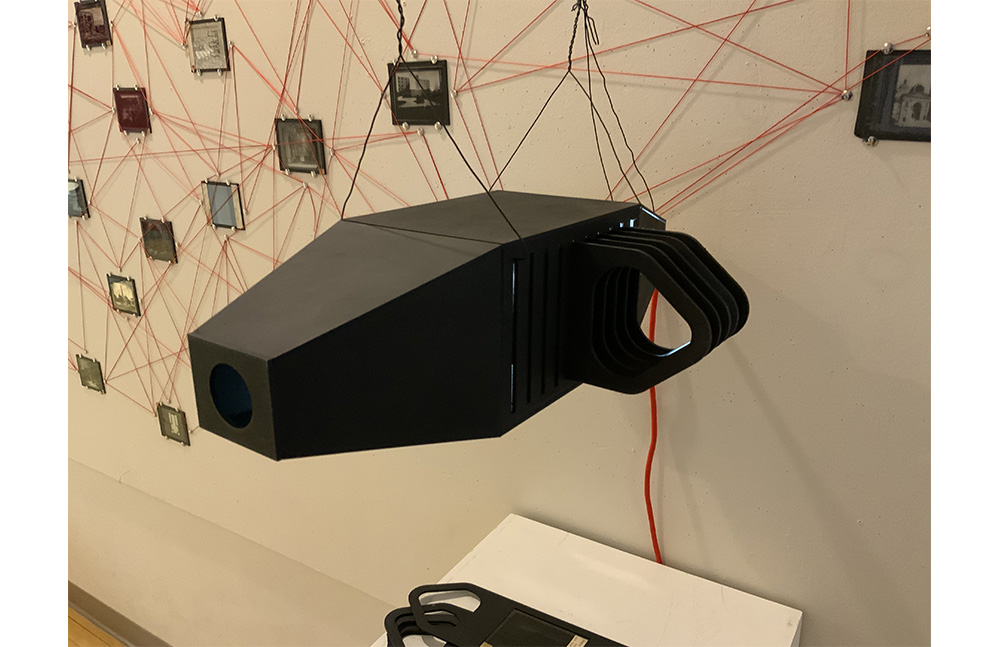
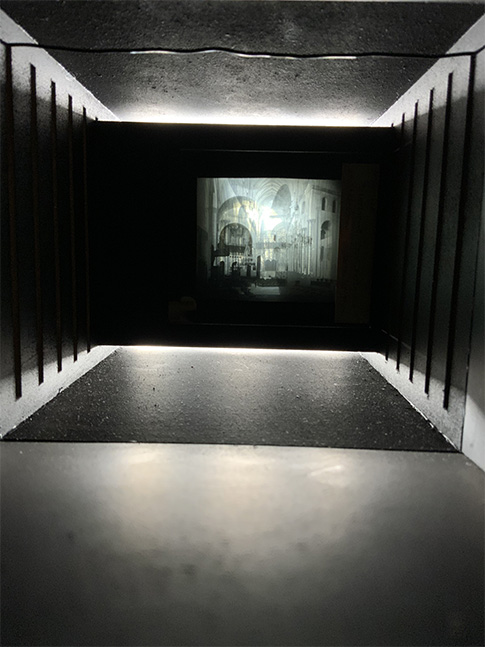
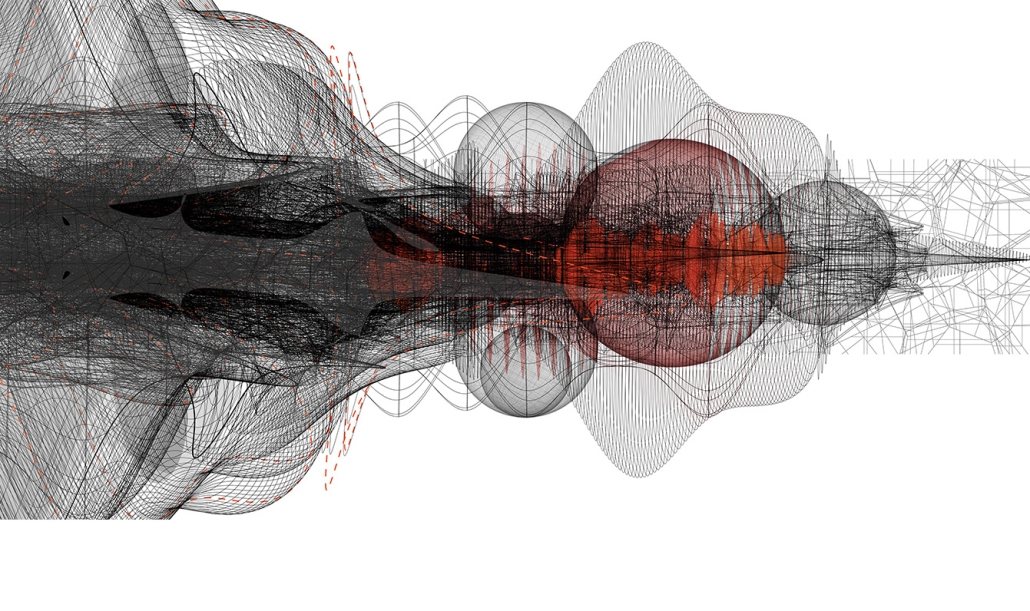
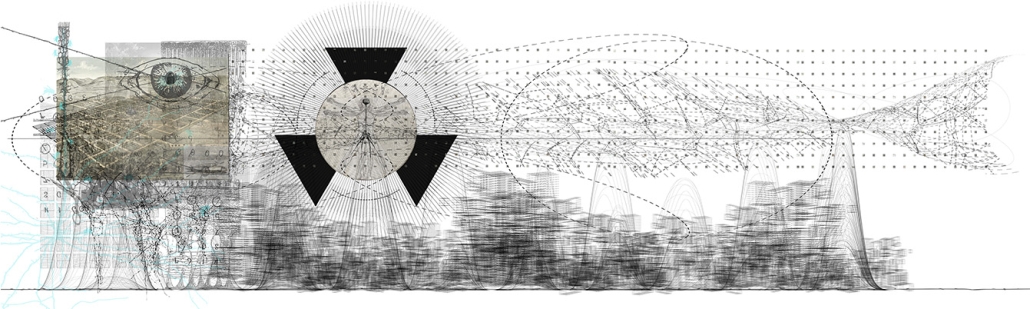
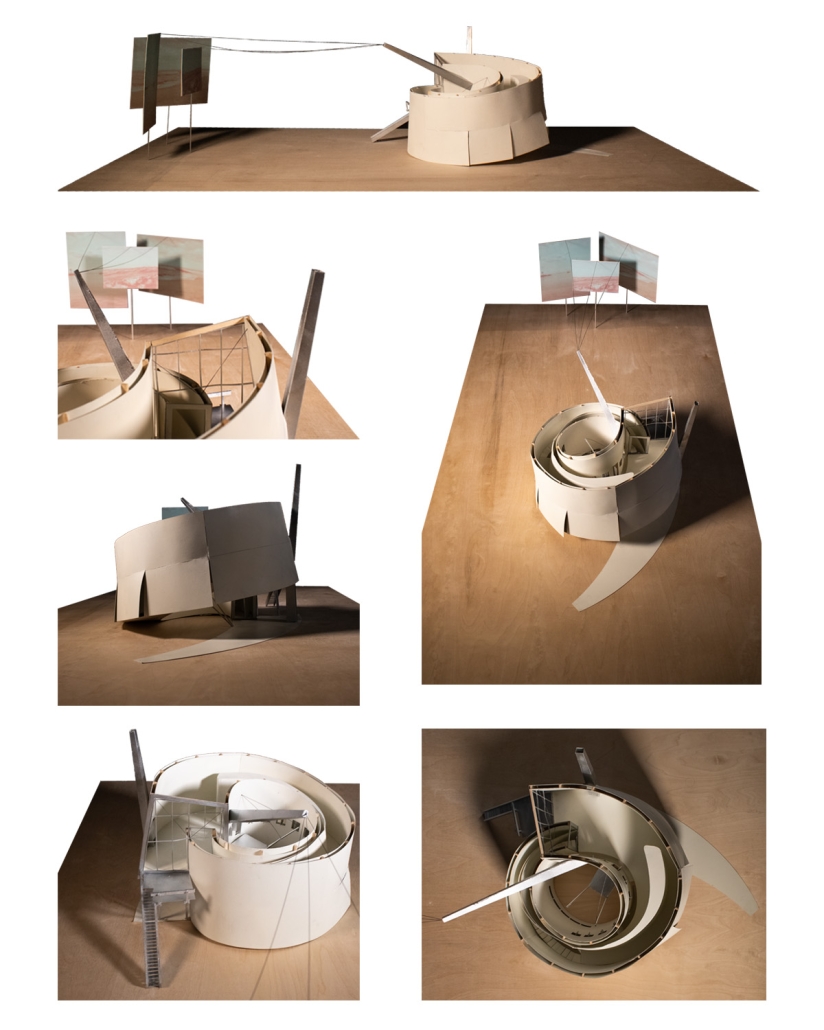
This project sees the physical model and 2D illustration of the hypothetical device abstracted to create architectural forms and spaces. The form derives itself from the concepts dealt with in the inner mechanisms and particularly information storage. The “nested” nature of digital information storage (i.e., nested file folders on a computer) translates to nested architectural forms that sometimes exist within or even overlap other parts of the model. Another concept was that of information’s changes and persistence over time. The form is constructed like a timeline that exists in all three dimensions, inspired by the flow map of Napoleon’s invasion of Russia, which charts various different variables including location, population, time, events and more about Napoleon’s Russian campaign. In the same way, the timeline is a two-dimensional visual representation of information gathered about events in history; this model is a three-dimensional representation of the information gathered and stored by the hypothetical device. 

Instagram: @masataka.yoshikawa

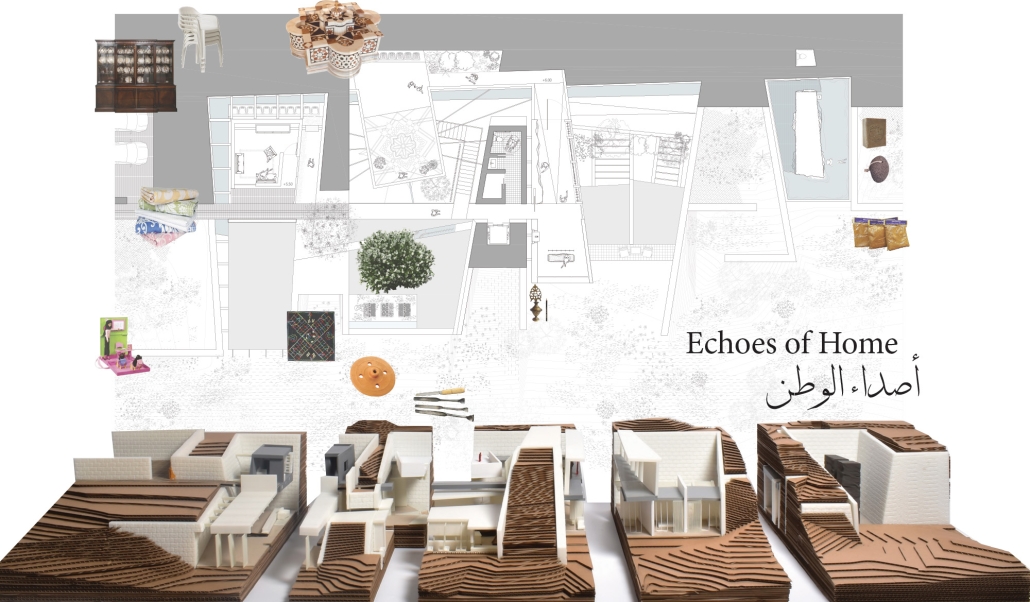
Echoes of Home by Zuha Arab Sabbagh & Rana Abdelhadi, B.Arch ’25
American University of Sharjah | Advisor: Gregory Thomas Spaw

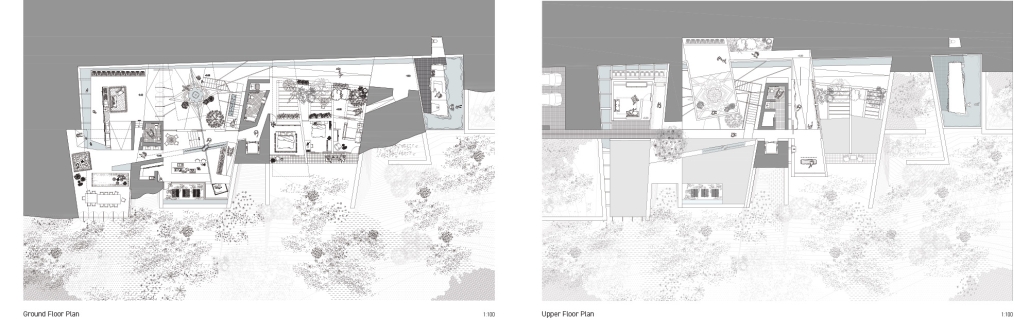
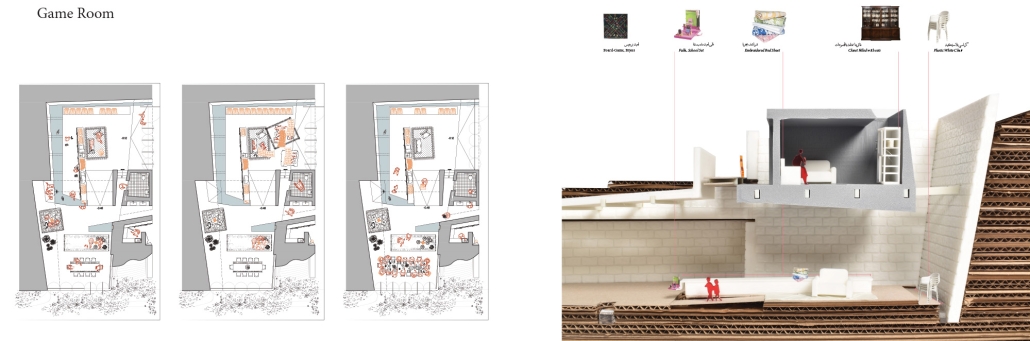
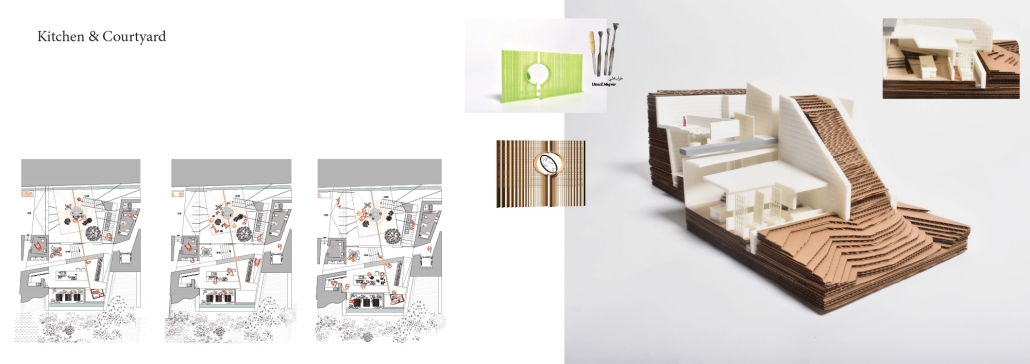
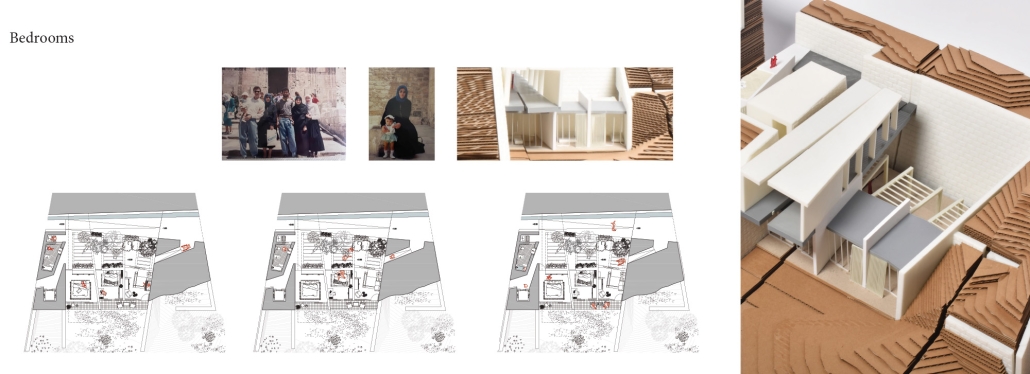
‘Echoes of Home’ responds broadly to displacement in our globalised world. Specifically, on the generational displacement of Syrians. Centralised on the intimate and underappreciated labour of homemaking, the project acts as a recognition and celebration of Womanhood as a discipline. It is designed to mark the story of displacement – building and rebuilding – into an inconstant world. The project tentatively approaches the need to capture the complicated ephemerality in our modern understanding of what ‘home’ is.

In designing a secondary residence-exhibition, the studio deployed the renaissance phenomenon of the cabinet of curiosities to challenge us to create spatially charged architecture focused on the exhibition of artifacts. We selected fictitious clients, curated a selection of curiosities to display, picked a suitable site, and decided the extent of distinction between the residence and the exhibition.

Designing a residence required an examination of the notion of ‘home’. Historically, ‘home’ has been explored as a vehicle for living and, with the rise of modernism, critiqued as performative. The programs selected recognise the labour of homemaking and extend to capture the performance of hosting and the pleasure of gathering. ‘Home’ has consistently been placed in women’s domain. The practice of homemaking falls under the discipline of Womanhood. The project adheres to the practice and rejects criticism, accommodating for it spatially. The kitchen, game room, bathing space, bedrooms, bathrooms, and guest room all double as exhibition spaces. The integrated spaces create opportunities for gathering and hakawayti (storytelling). Homes tell a story of past, present and future, and the project acts as a natural extension.

Encouraged to design spaces from the inside out, the client and narrative guided design decisions. The Characters: a mother, daughter and grandmother, based on Syrian women in our vicinity, emphasise the generational distinctions in modes of displacement: immigrant, diaspora and refugee. The clients’ stories resemble those of many diasporas. 

Instagram: @gregoryspaw

An Anchor in Time: A Dwelling Reflecting the Interplay of Time and Space by Salma Hani Mubarak Ali, B.Arch ’25
American University of Sharjah | Advisor: Gregory Thomas Spaw

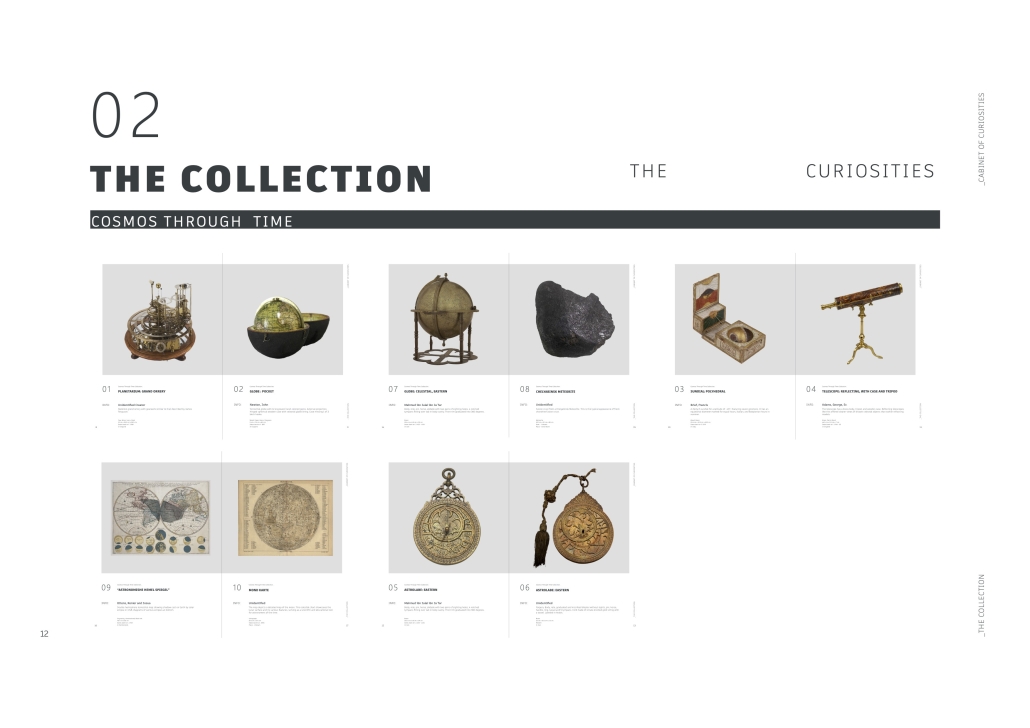
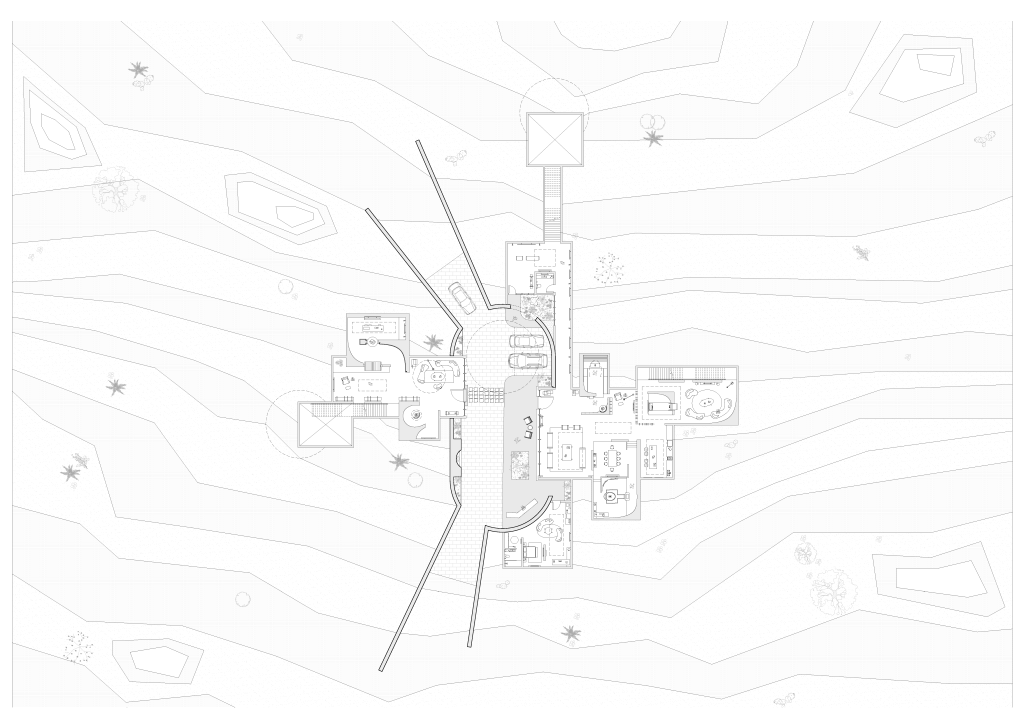
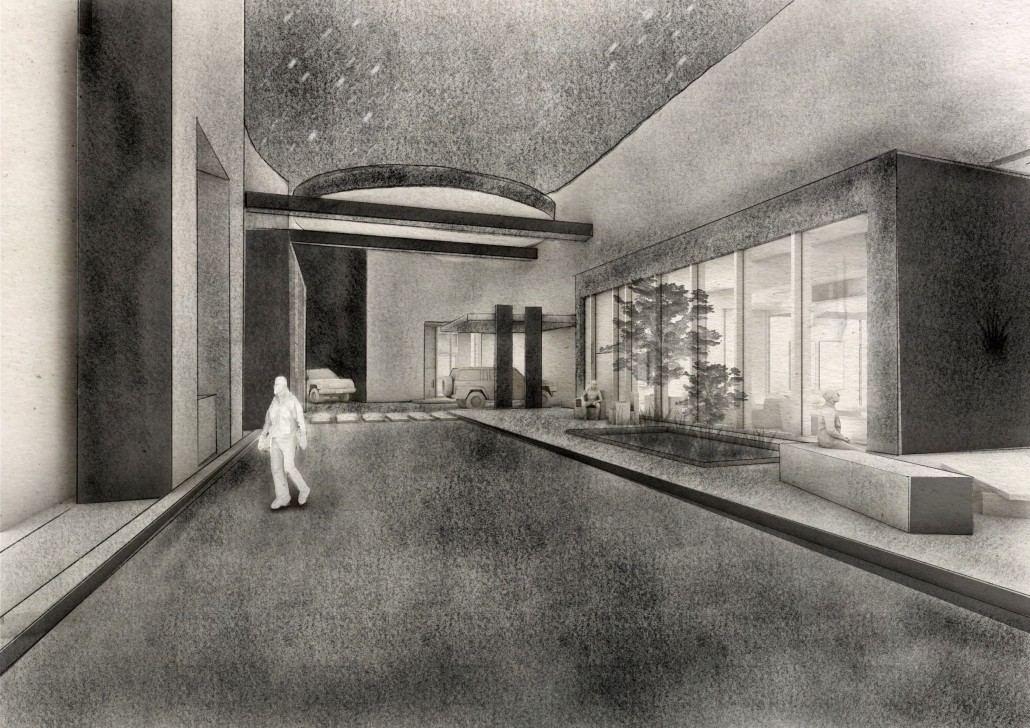
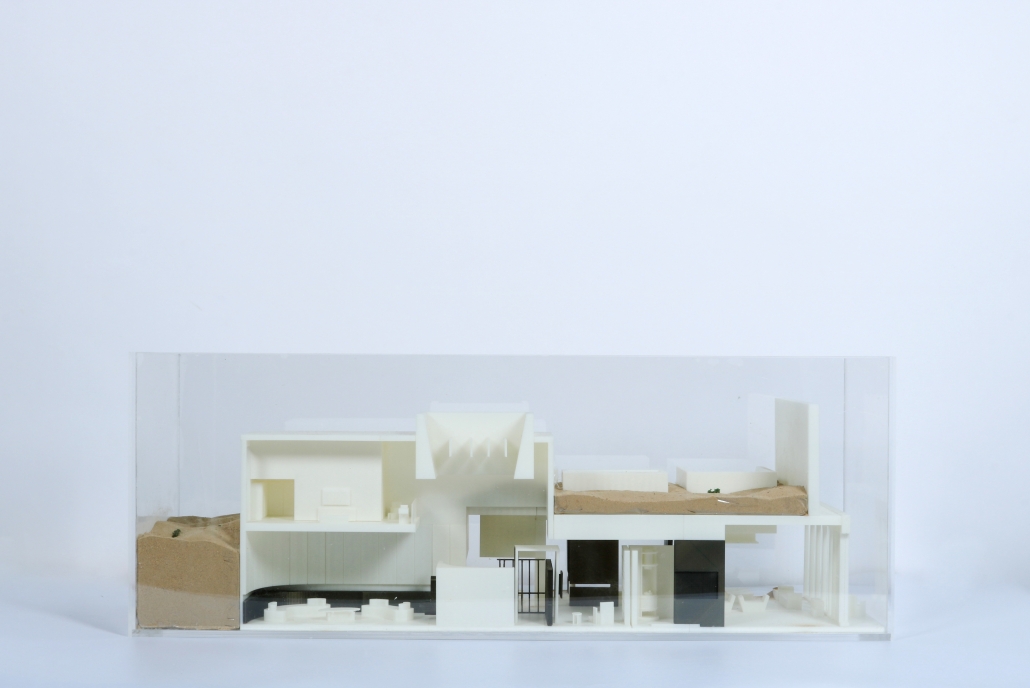
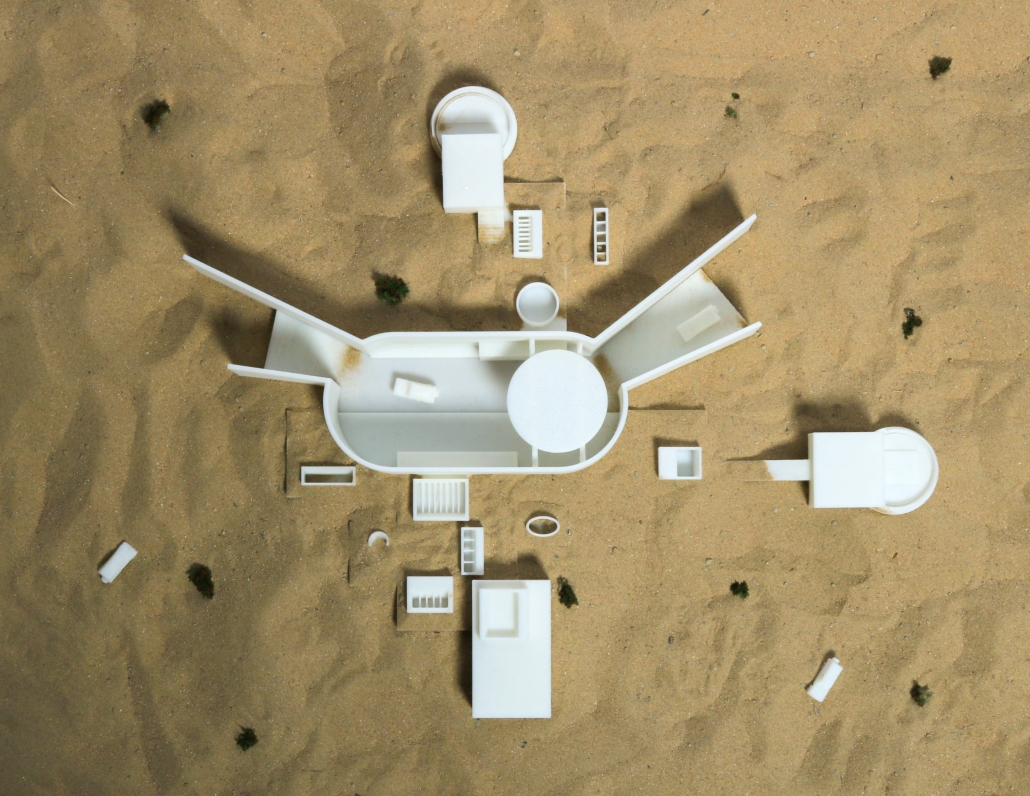
In the vast stillness of the desert, this residence becomes a compass of time—a place where shifting sands echo the dance of the stars, grounding life within the endless drift of the cosmos. The design emerges from the client’s collection of astrological instruments, shaping spatial arrangements that enhance functionality and interaction. Objects inform the layout, with dedicated areas that invite exploration and observation. Strategic openings frame views of the night sky and desert, enriching the experience of celestial observation. This residence serves as both a home and an observatory, fostering a profound connection to the cosmos while celebrating the beauty of time and change. (Text: Salma Hani Mubarak Ali)

Cabinet of Curiosities: Exploring the Ensemble (aka, house of the collector) is an option studio utilizing the 16th-century-18th-century phenomenon of the Cabinet of Curiosities or Wunderkammers (wonder-rooms) as a point of departure to explore the exhibition of ensembles of artifacts with the goal of creating spatially charged architecture.

Working as individuals or in pairs, students had the opportunity to curate their own collection of curiosities and develop a novel architectural language to facilitate the display of the exquisite objects. Associated with the collection was a real or imagined client that served to further drive a generated domestic program. With the scale of the overall proposals being purposely manageable, students had the opportunity to focus on developing architectural assemblies that directly engage with issues of materiality, connections, and details. As such, physical and digital models were heavily employed as tools to study the interplay of elements at a series of scales

This project won the RIBA Gulf: Future Architects 2024 Overall Best Model Award.

Click here to learn more.

 Instagram: @salma.hani.ali, @gregoryspaw

Evermore: A Cemetery For The City by Mo Karnes, B.Arch ’25
Mississippi State University | Advisors: Jassen Callender, David Buege, Aaron White, Mark Vaughan & David Perkes

My uncle died less than two years before I was born. I never met him, but his death is only an obstacle in my ability to know him. Chris was an artist and poet who left behind many things for me to know him by, including a poem entitled Evermore, written during his struggle with AIDS. The meditation is: 

I will walk unlonely,

Holding me up

As I begin to fall,

You Lead the way

And sometimes follow.

Our passage now is

Evermore.

(To be repeated, Unending).

To be ‘unlonely’ is a profound response to the impending, seeming loneliness that is death. Loneliness for those dying and those left behind. Chris’s poem is not just a meditation for himself, but for those struggling with loss. As a dying man, Chris places himself shoulder to shoulder with the reader; their journey is one and the same.

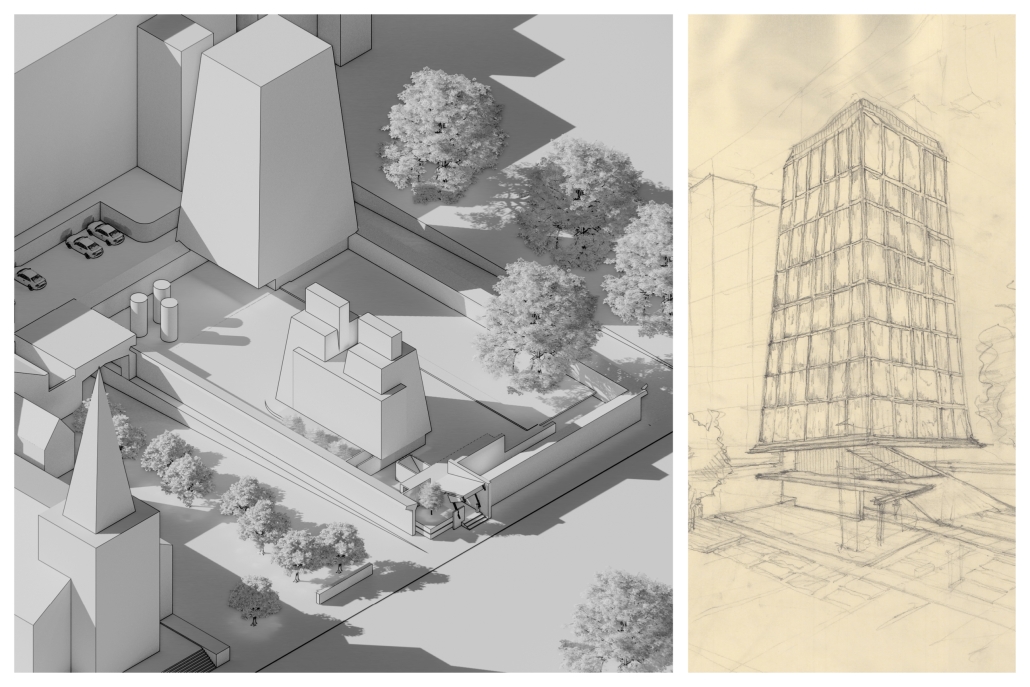
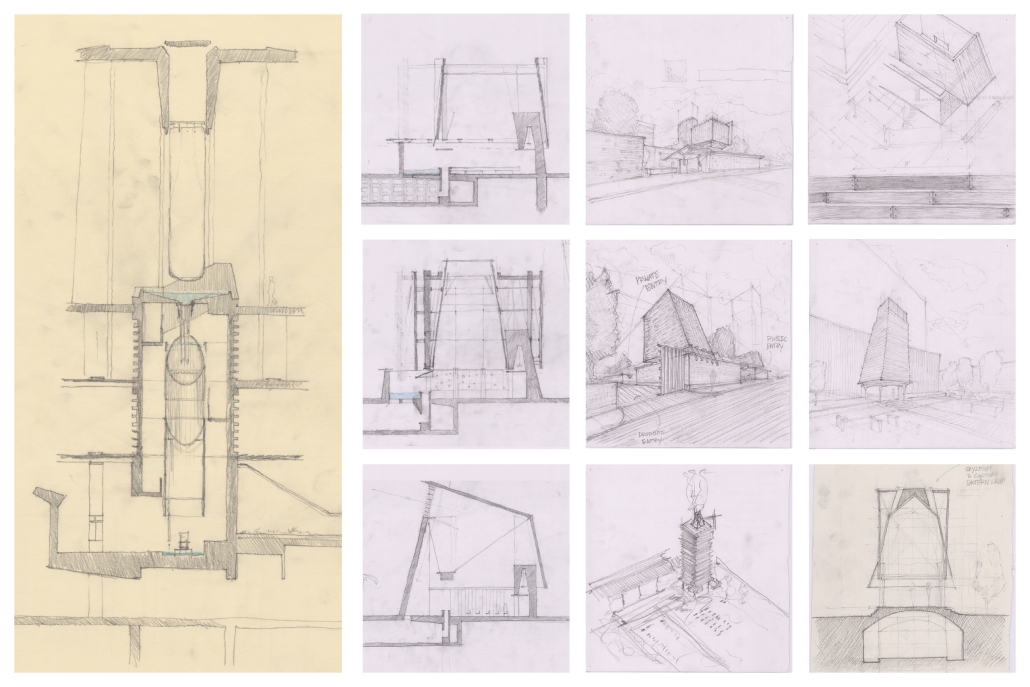
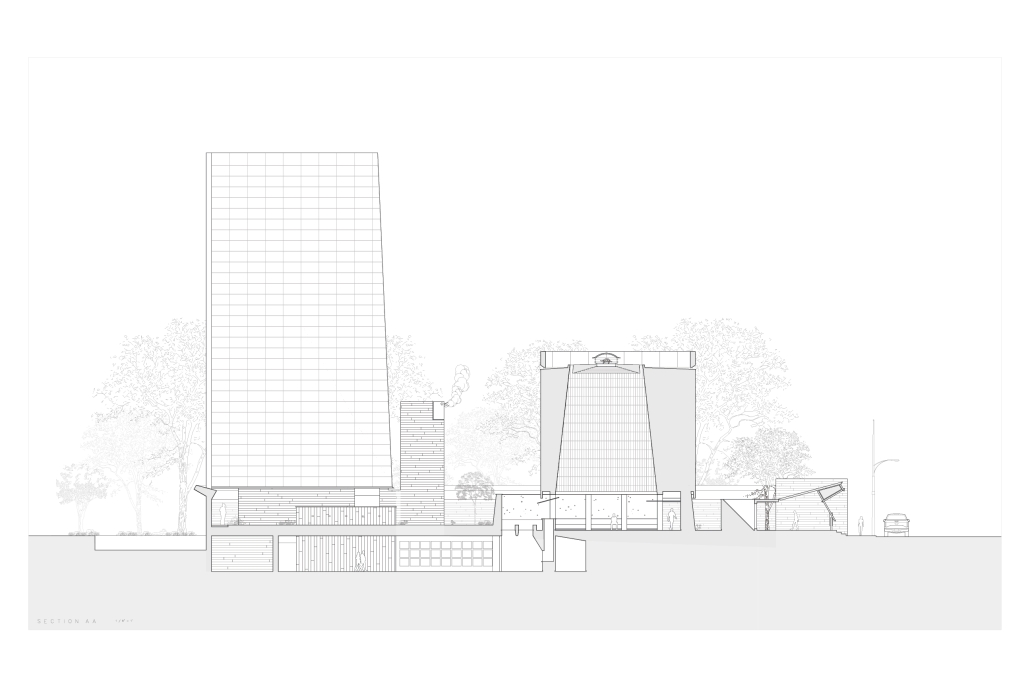
“Evermore: A Cemetery For The City” is a small cemetery complex adjacent to the Cathedral of St. Peter the Apostle in Downtown Jackson, Mississippi. The complex comprises a crematorium, vertical columbarium, and chapel. The site is rectangular, bound on all sides by concrete walls with only one threshold for entry. Two masses seemingly float behind the concrete boundary walls that veil them, the smaller chapel and the larger columbarium. Both stoic in form, they disguise the intricacies hidden in the interiors of their masses.  

The ambition of this project is to integrate the awareness of mortality into the city, while supplying architectural means to confront it. This awareness is not a means of oppression, but an attempt to convey the gift that is life. This cemetery is intended to be a public space where inhabitants can experience the city with citizens who came before them, inducing a relationship with the past, generating an appreciation of those who came before, and propelling the city forward with the intent to befriend and mentor the future.  

This project received the CDFL Capstone Studio Travel Award. 

Instagram: @mo.karnes, @jassencallender

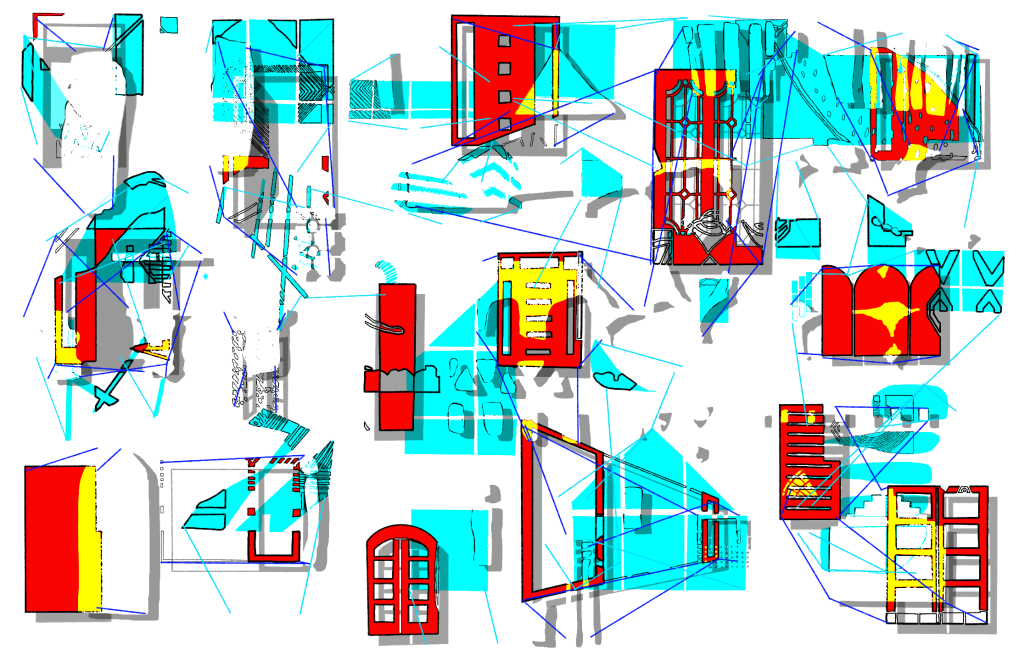
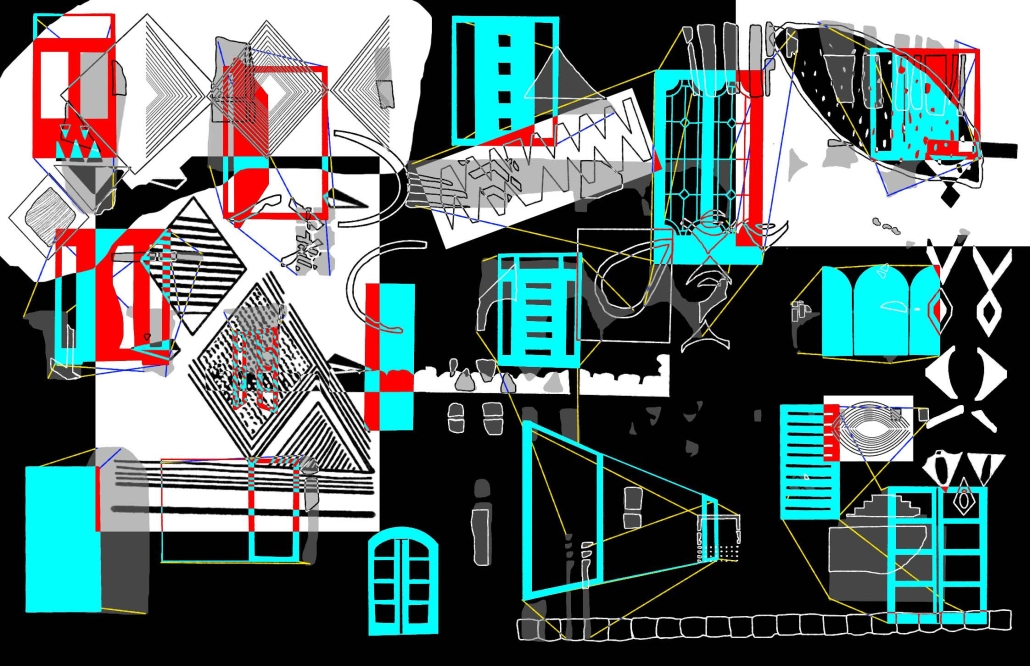
IMAGINATIVE REALITY: INVENTION OF SYNERGISTIC NARRATIVES by Chey Isiguzo, M.Arch ’25
Toronto Metropolitan University | Advisor: Lisa Landrum

Imagination is both an act and a familiar, safe space, evoking nostalgic feelings rooted in our reality. 

This space can become unfamiliar when cultural expressions changes, leading to multifaceted identities and undeveloped narratives. This dynamic contributes to cultural conflict and highlights the juxtaposition of traditional and contemporary African architectural narratives. As a space, imagination can generate narrative 

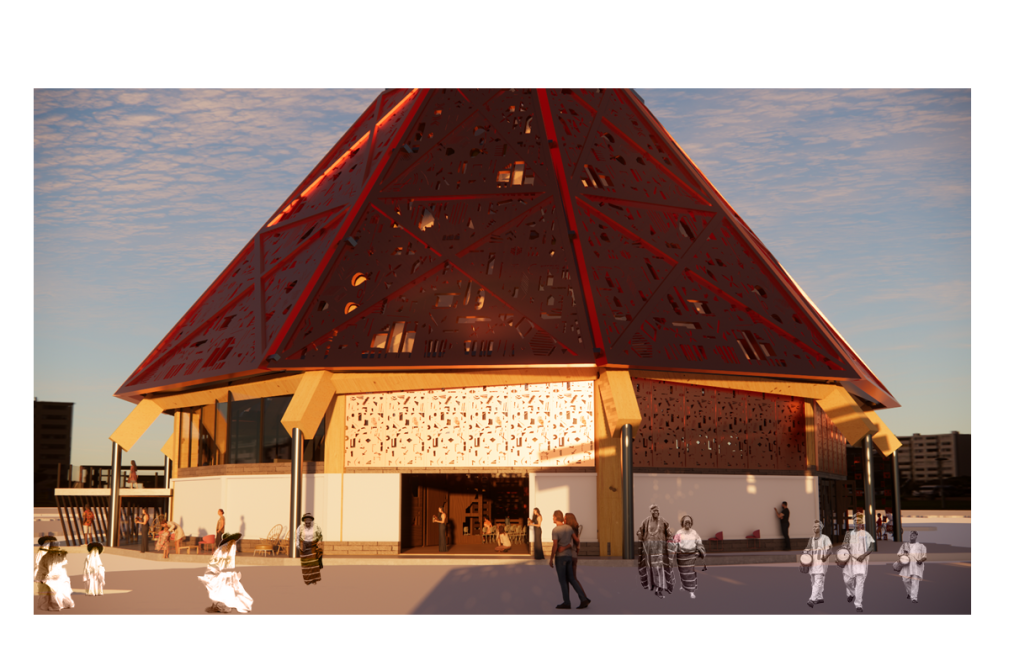
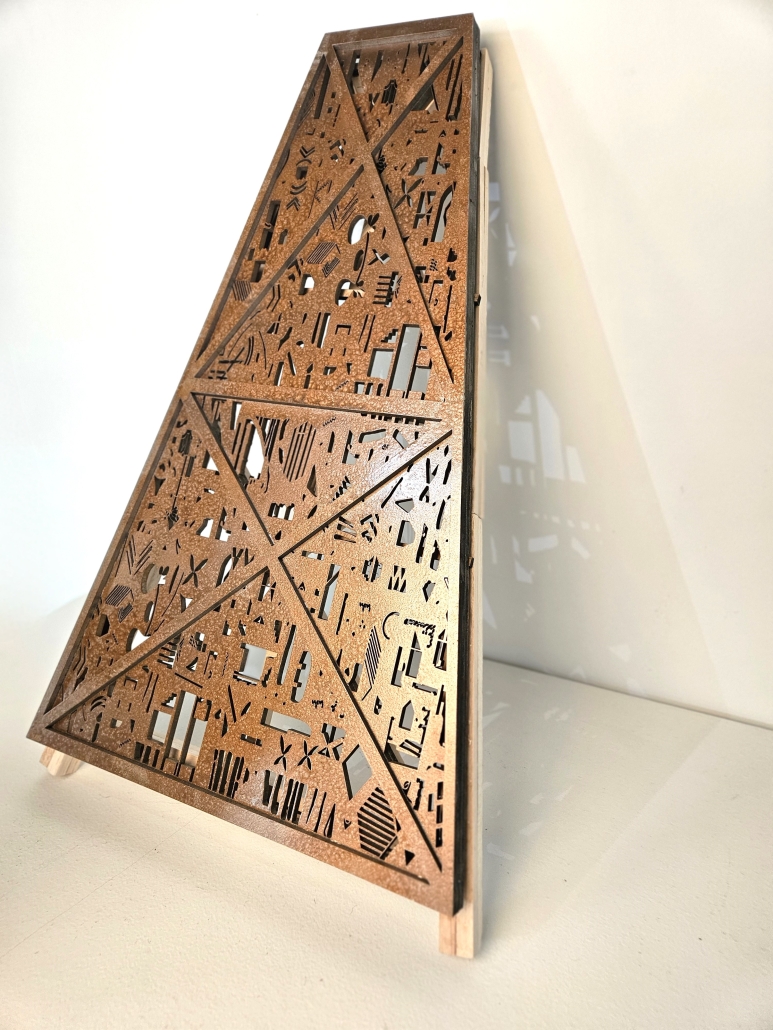
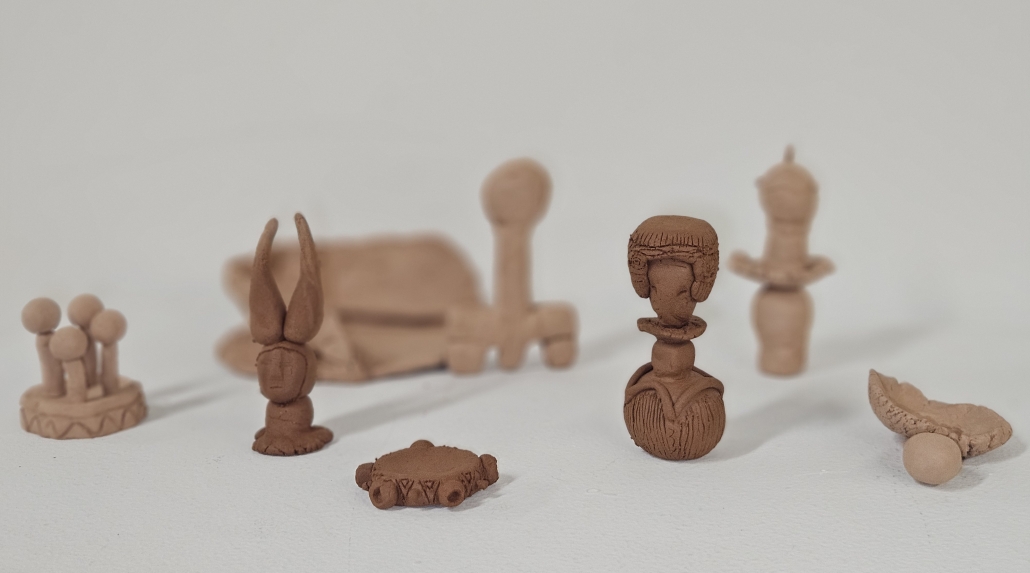
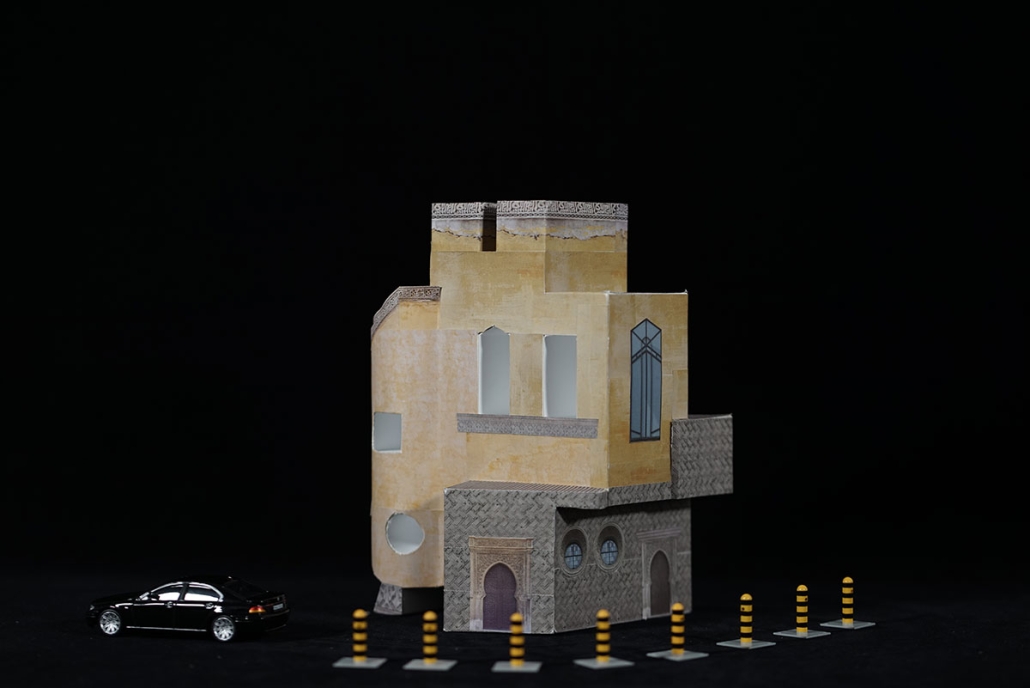
characters and elements by creating synergistic stories that incorporate traditional craftsmanship into contemporary African architecture. The imaginative process consists of three components. Imagining while thinking is an act that uses mental images from memories, dreams, fantasies, or visions to create one’s reality. Imagining while making is the act of craftsmanship used to speculate the distinction between traditional and contemporary architectural narratives through the lens of cultural expressions. Imagining while drawing is an act of translation by utilizing narrative characters—building elements like windows and doors—to dissect fragments of both traditional and contemporary architecture to find new narratives. 

These narrative characters work alongside structural elements, such as walls, roofs, layouts, courtyards, and compounds, to convey new stories that showcase materials and design techniques rooted in Igbo craftsmanship. To develop synergistic narratives, one can explore the evolution of traditional African craftsmanship, particularly within Igbo culture, across ancestral, post-colonial, and contemporary contexts. This exploration reveals how the architectural narratives of traditional and contemporary styles are increasingly distinct. Consequently, this imaginative space becomes a reality that examines the relationship between what is real and what is envisioned through architectural craftsmanship.

Instagram: @sumisi000, @ucisi_studios, @tmu_archgrad

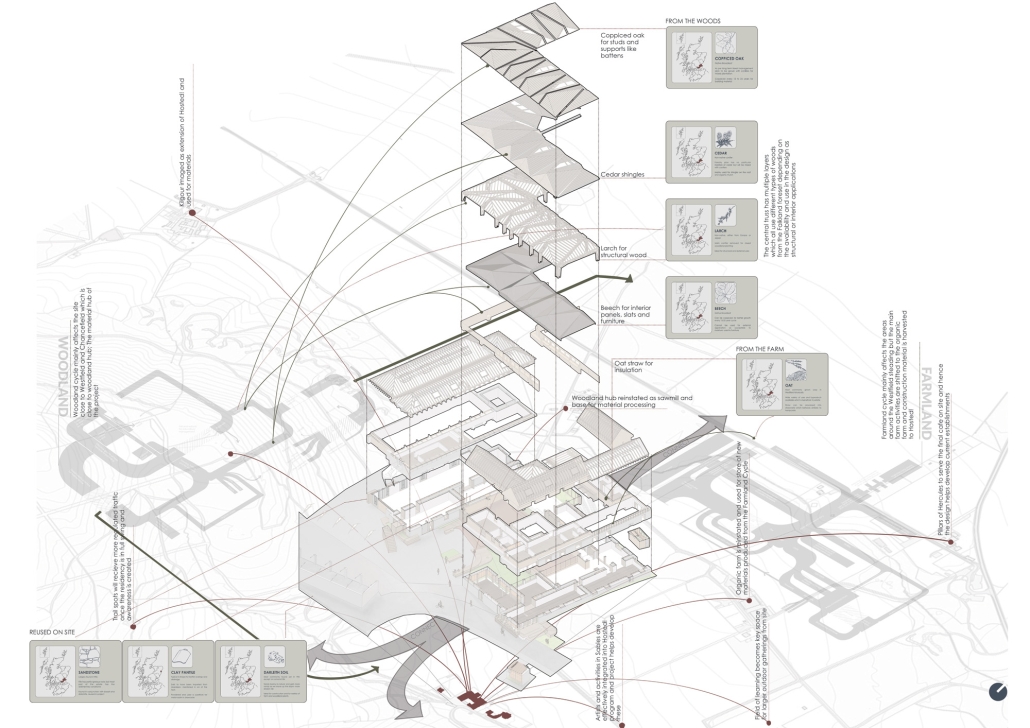
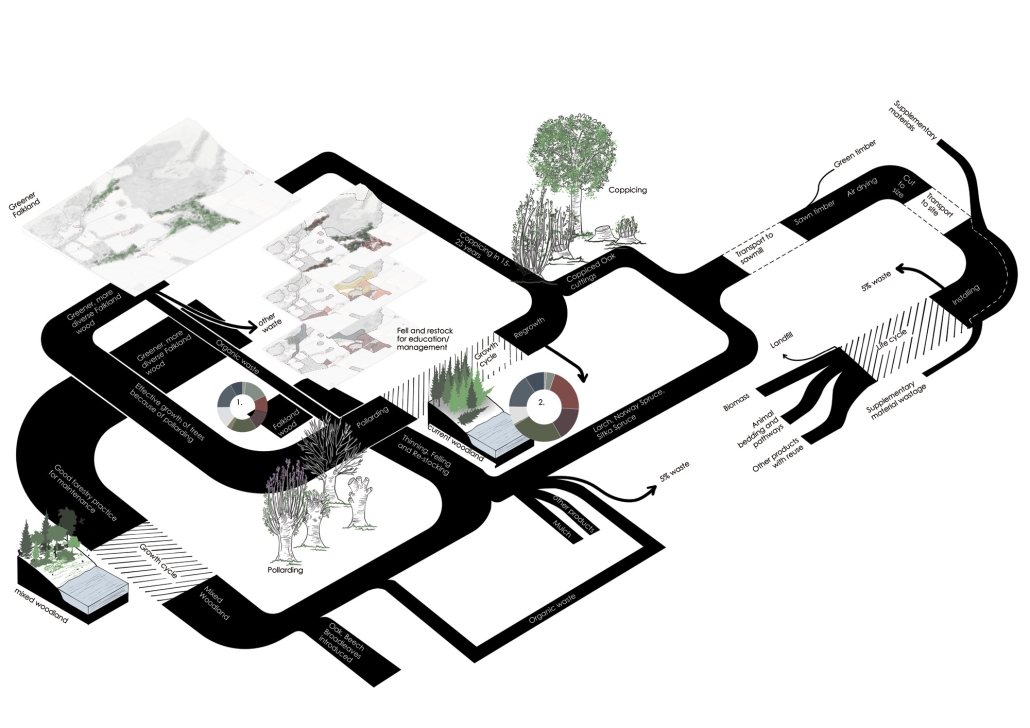
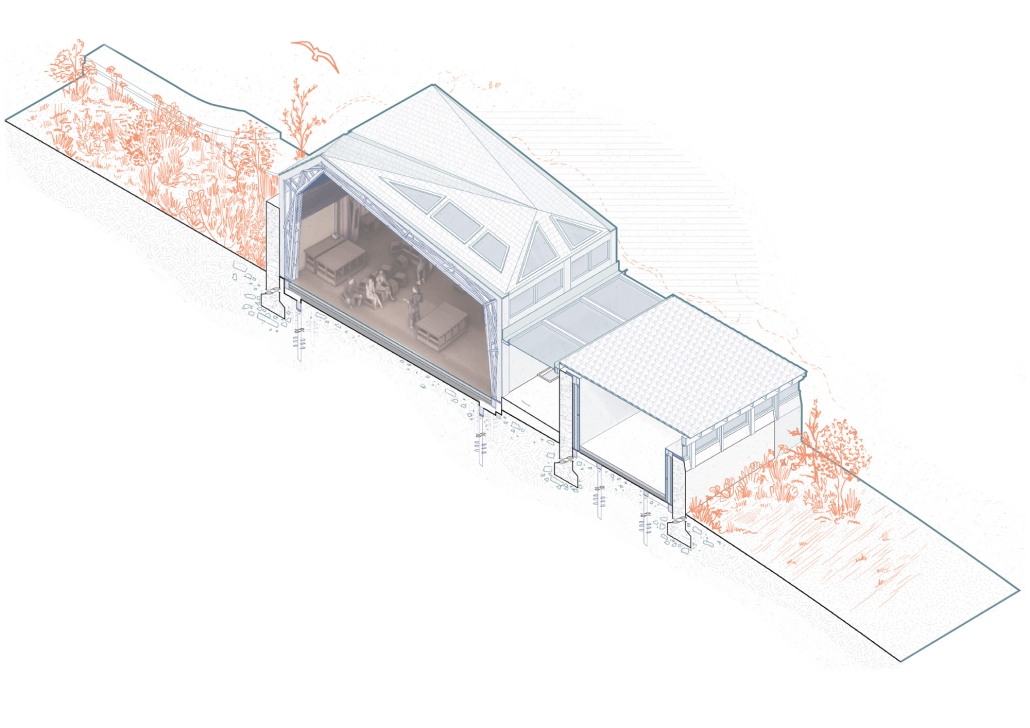
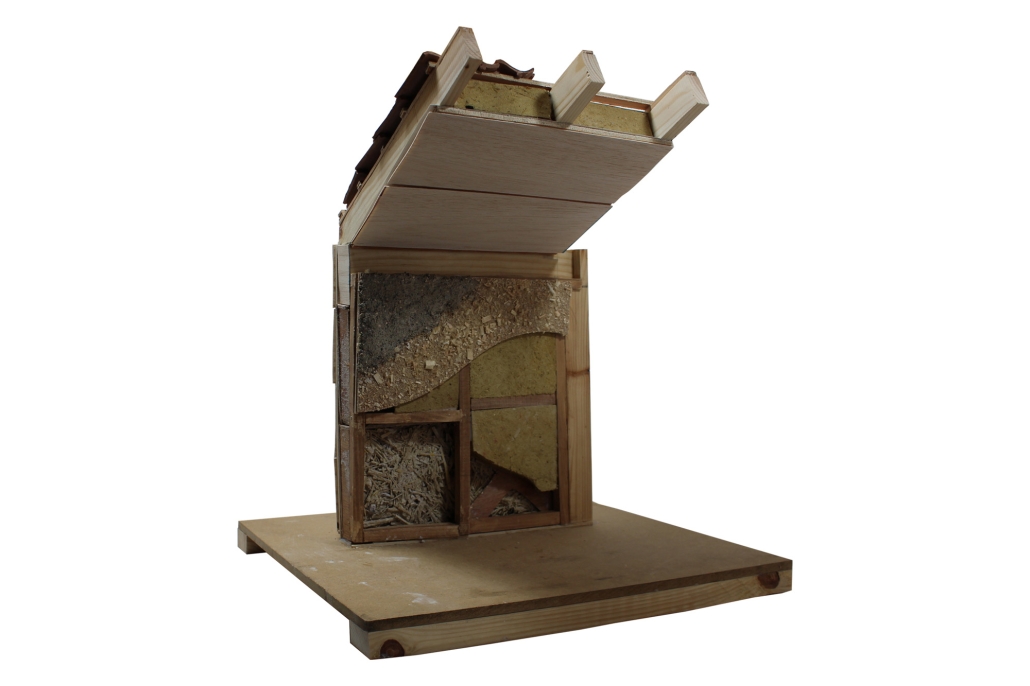
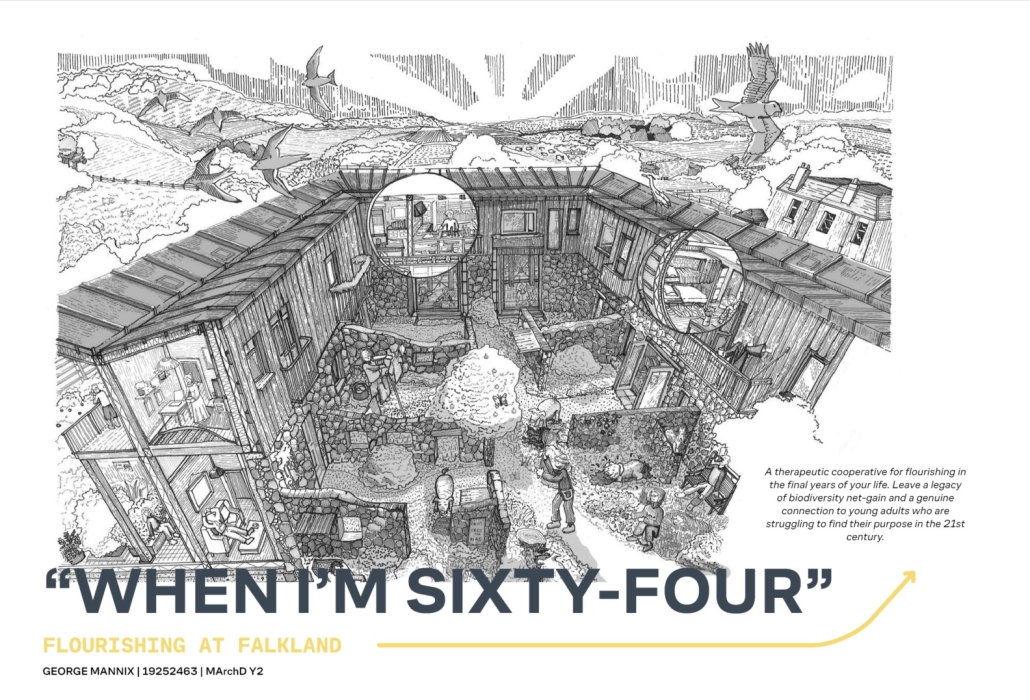
When I’m Sixty-Four: Flourishing at Falkland by George Mannix, M.ArchD ’25
Oxford Brookes School of Architecture | Advisors: Melissa Kinnear & Alex Towler

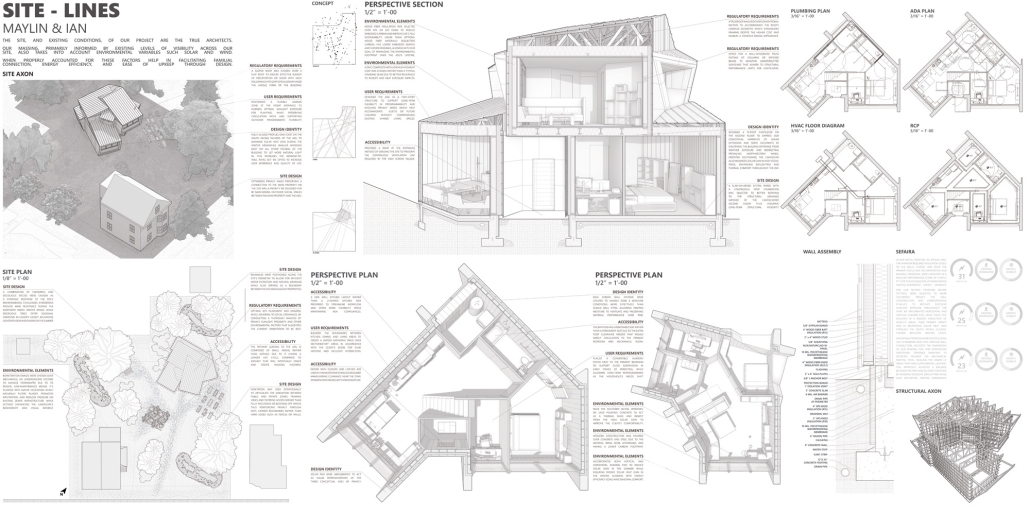
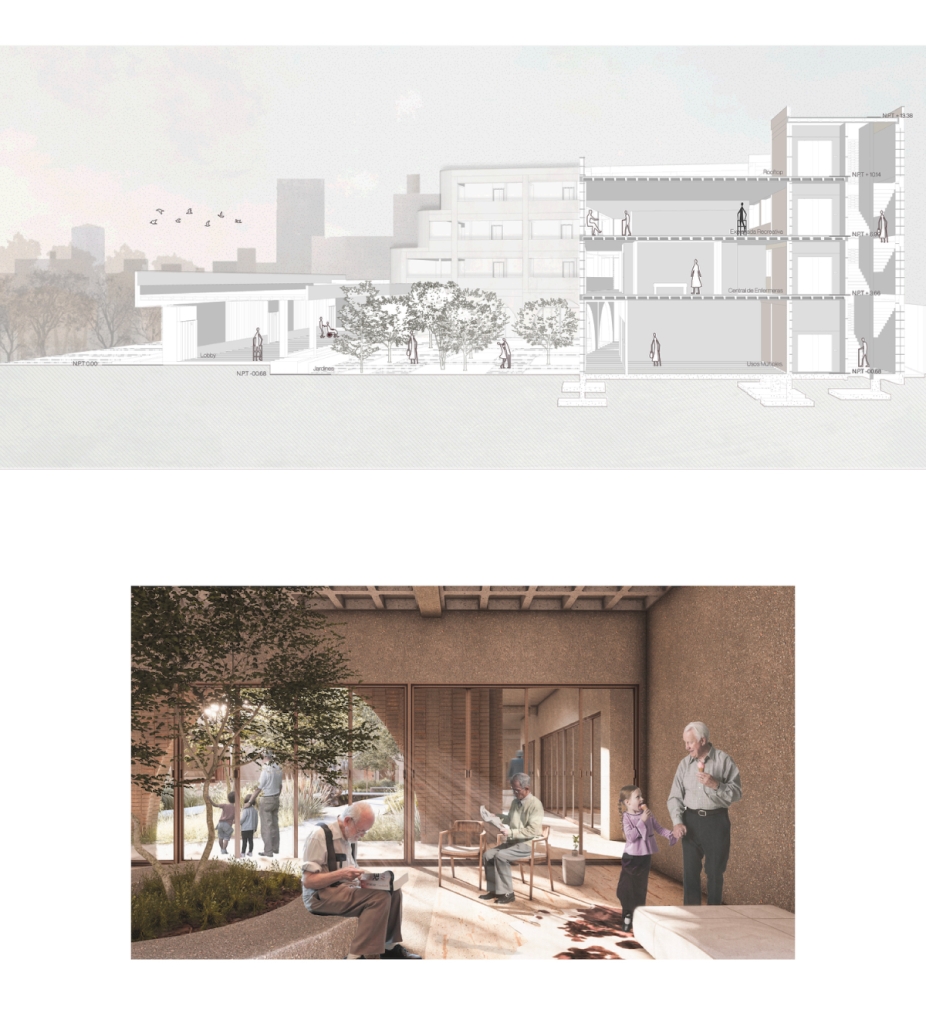
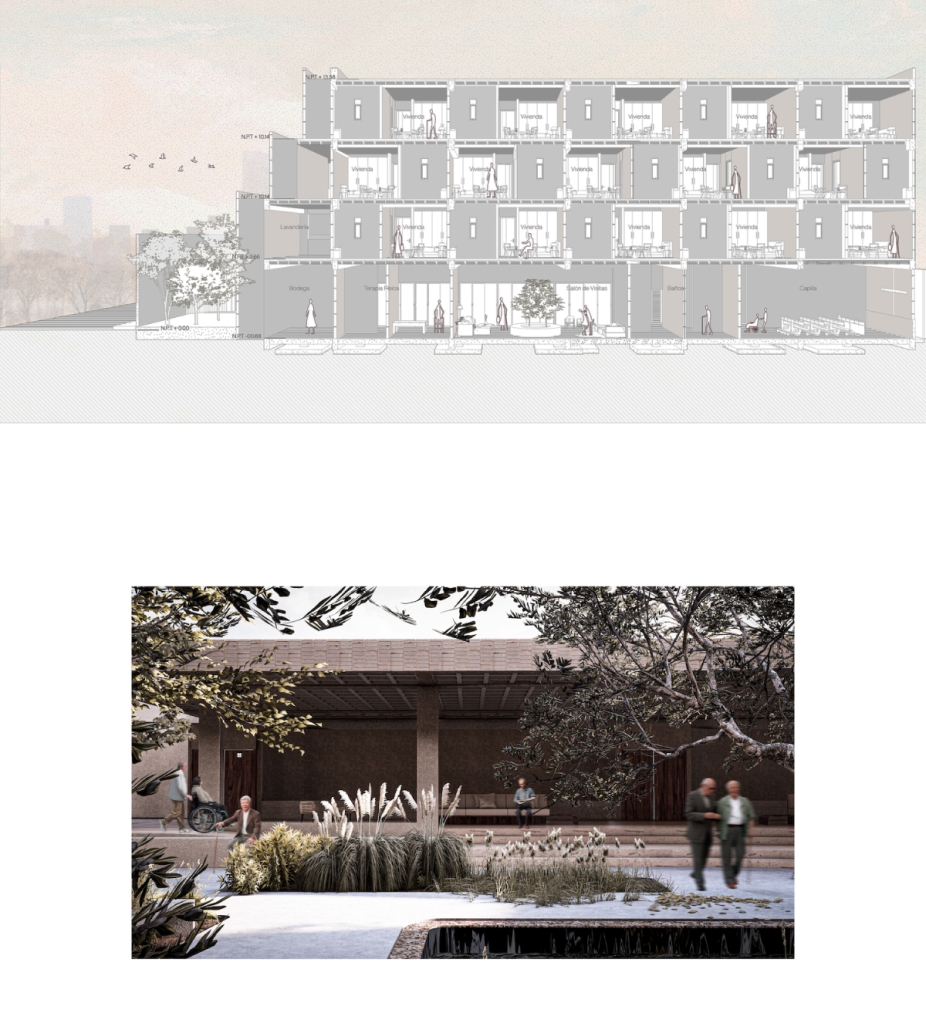
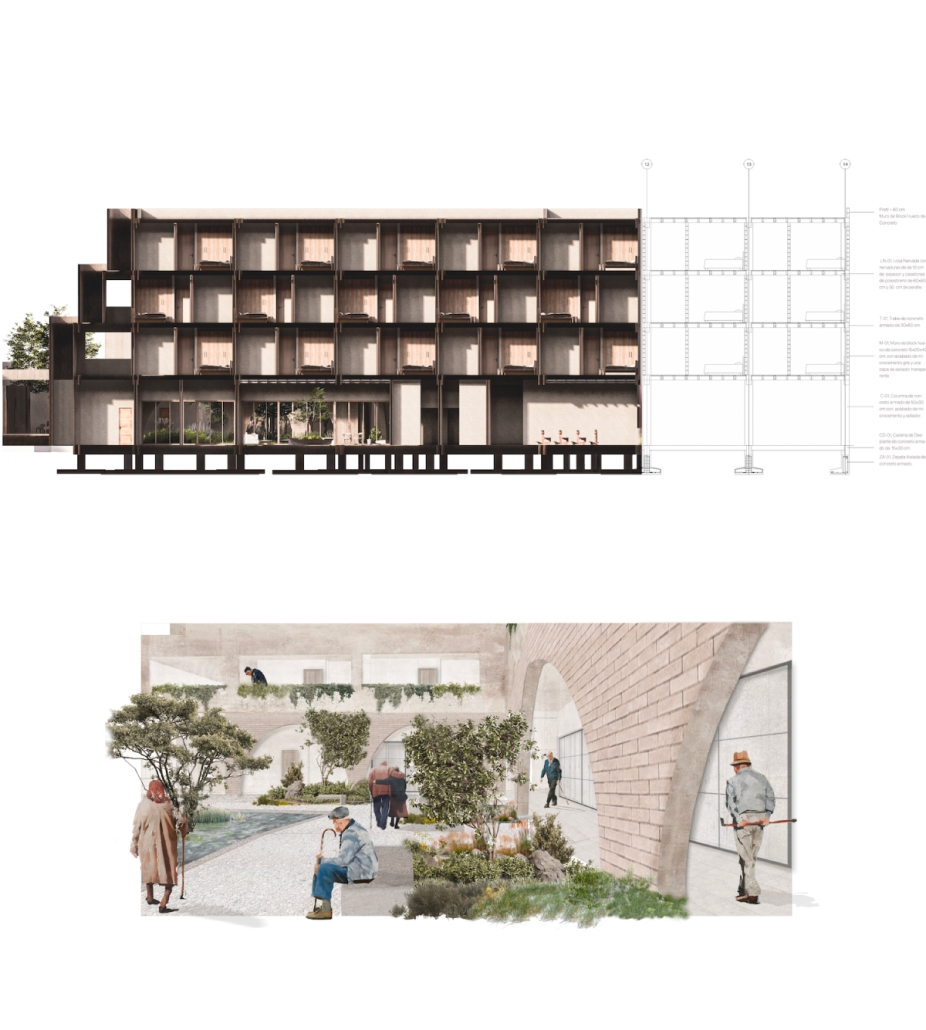
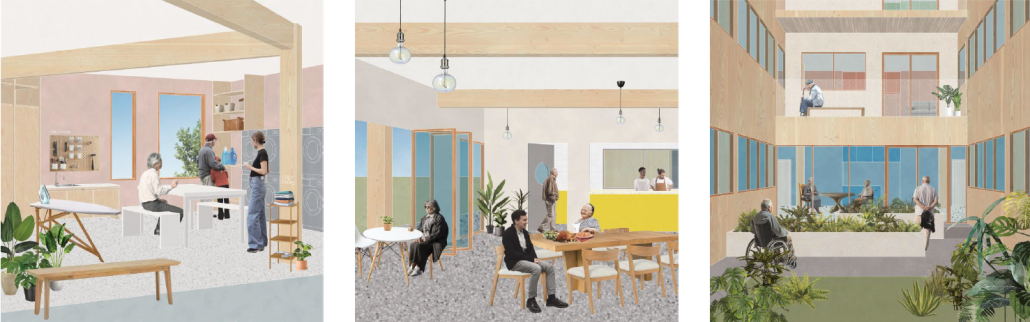
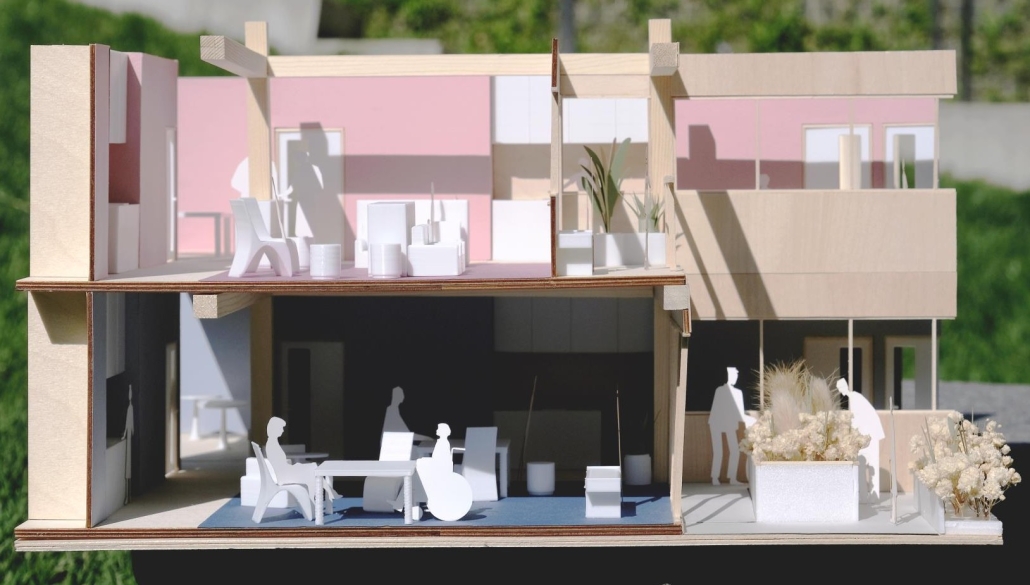
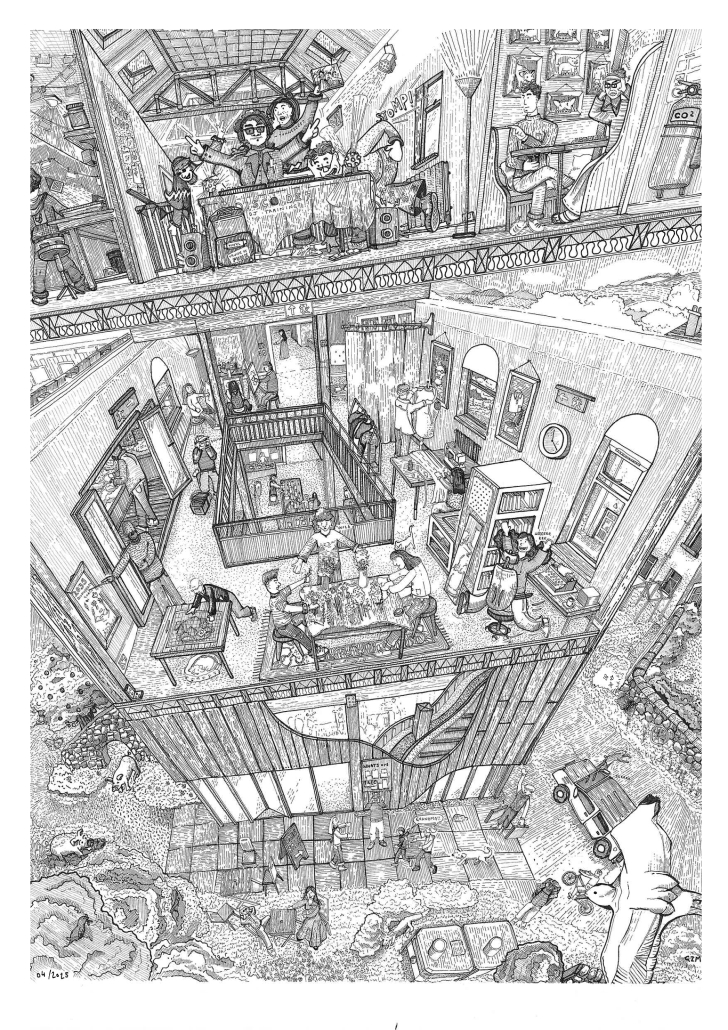
This project proposes a “therapeutic cooperative” that reimagines later life as a time for purpose, legacy, and connection. Designed for people aged 64 and over, the initiative creates a living environment where older adults can flourish by sharing life experiences with younger visitors while contributing to environmental and social regeneration. 

Central to the concept is the cohabitation of residents with Tamworth pigs, which serve both symbolic and ecological roles—facilitating intergenerational dialogue and promoting biodiversity through trophic rewilding.

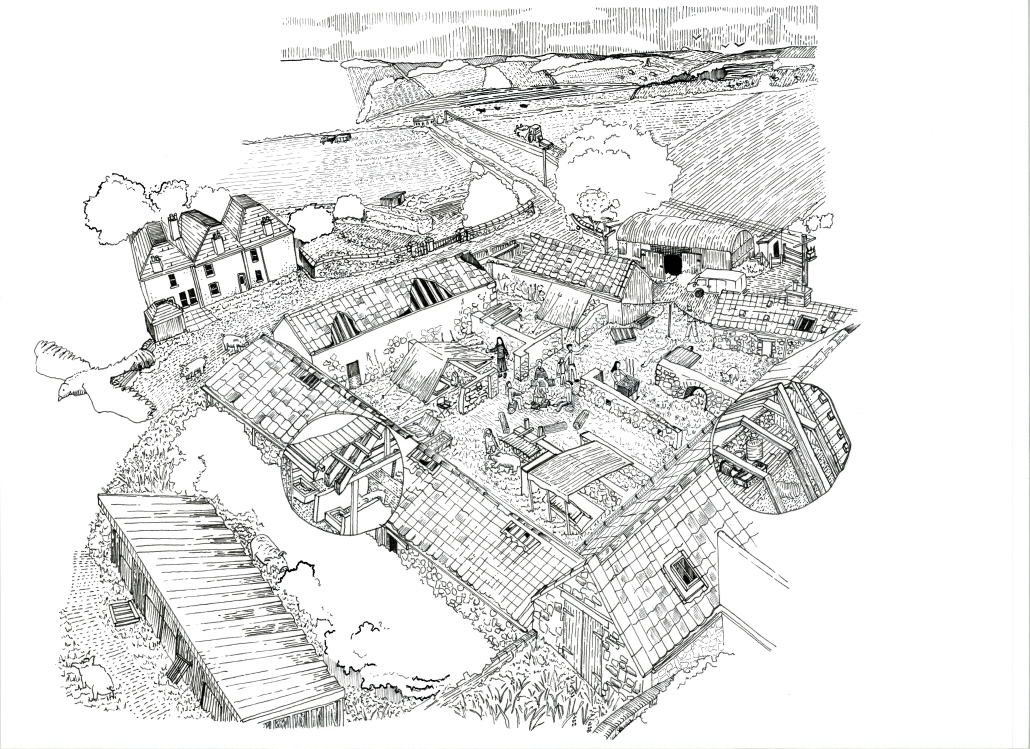
Located at Kilgour, a Victorian farm steading on Scotland’s Falkland estate, the site carries historical significance and a past tied to pig-rearing and the celebration of endings. 

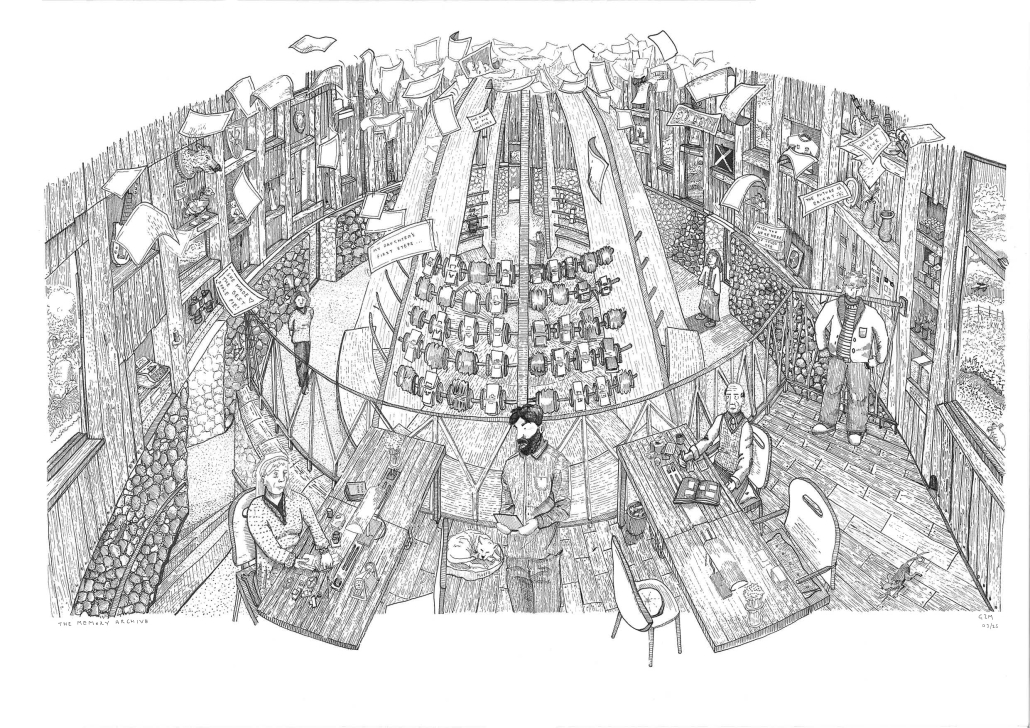
Accommodation includes accessible apartments, communal gardens, and a biodiversity-rich courtyard. Pigs will live in creatively built “Ad-Hog” styes using reclaimed materials. A chapel-like “Memory Archive” will hold personal stories of residents’ lives, offering a space for reflection and remembrance.

The project unfolds in three phases: first, clearing and revitalising the site with community involvement; second, welcoming the first residents and establishing the Memory Archive; and third, expanding the model across Scotland to transform abandoned steadings and boost natural regeneration.

Younger visitors, whom we have dubbed “biodiversity-backpackers,” can stay in on-site hostel lodgings, with the hope of fostering meaningful interaction between generations. Funding comes from elderly participants downsizing their homes, combined with national grants, giving them control over their later years.

Ultimately, this initiative responds to the growing issue of isolation among the elderly in Scotland. By embedding legacy, memory, and biocentric living into the design, it aims to help people see out their days with dignity whilst living with renewed purpose.

This project received the Ackroyd Lowrie Prize.

Instagram: @georgemannix, @ds3_obu

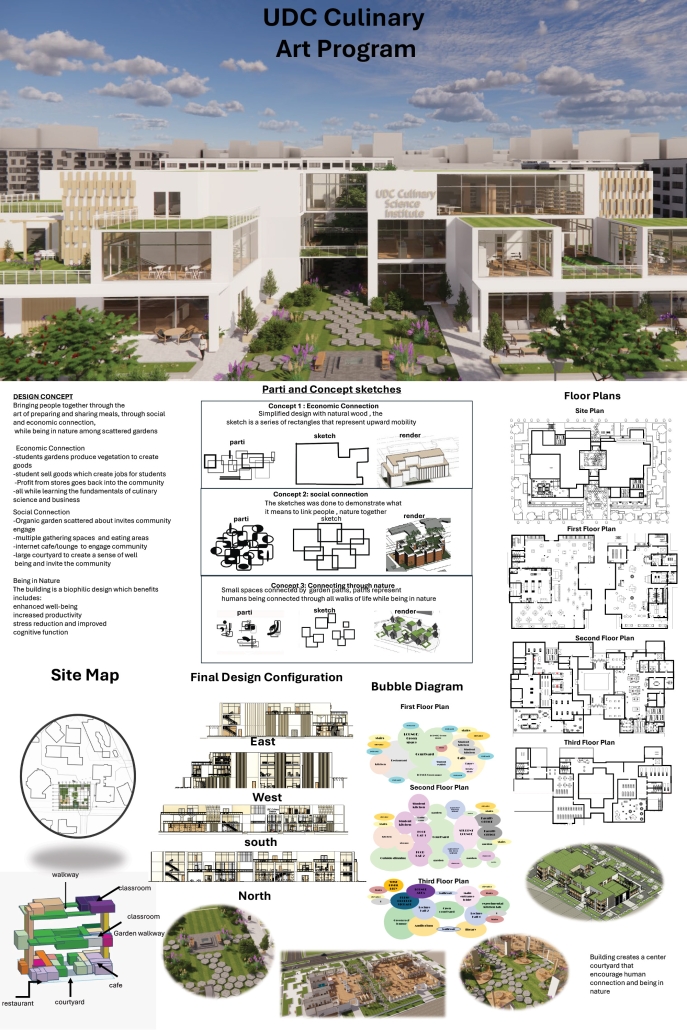
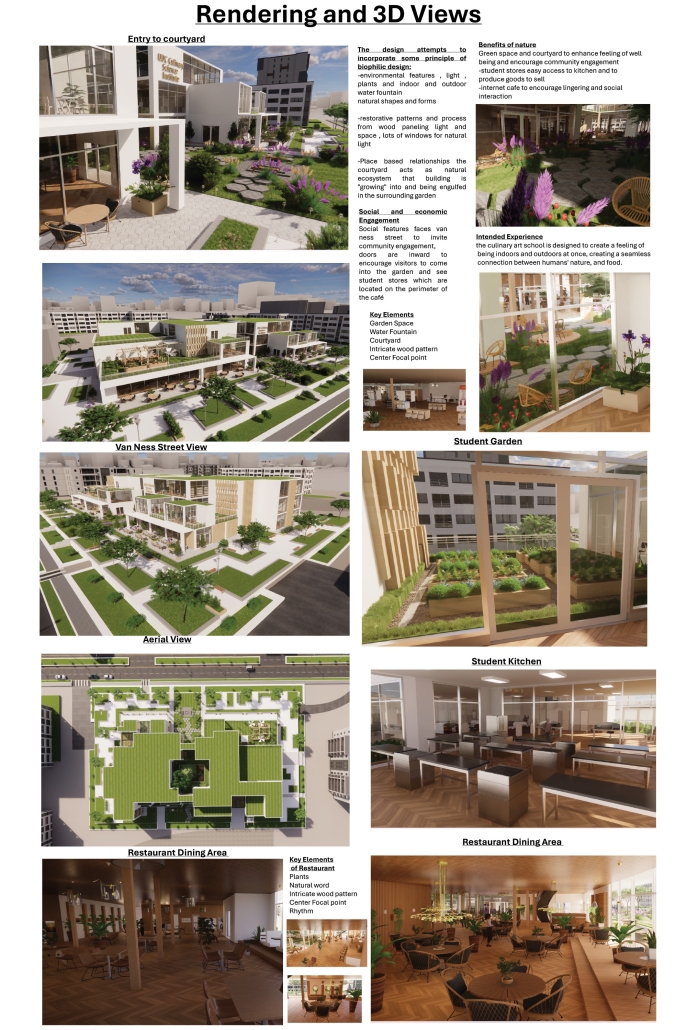
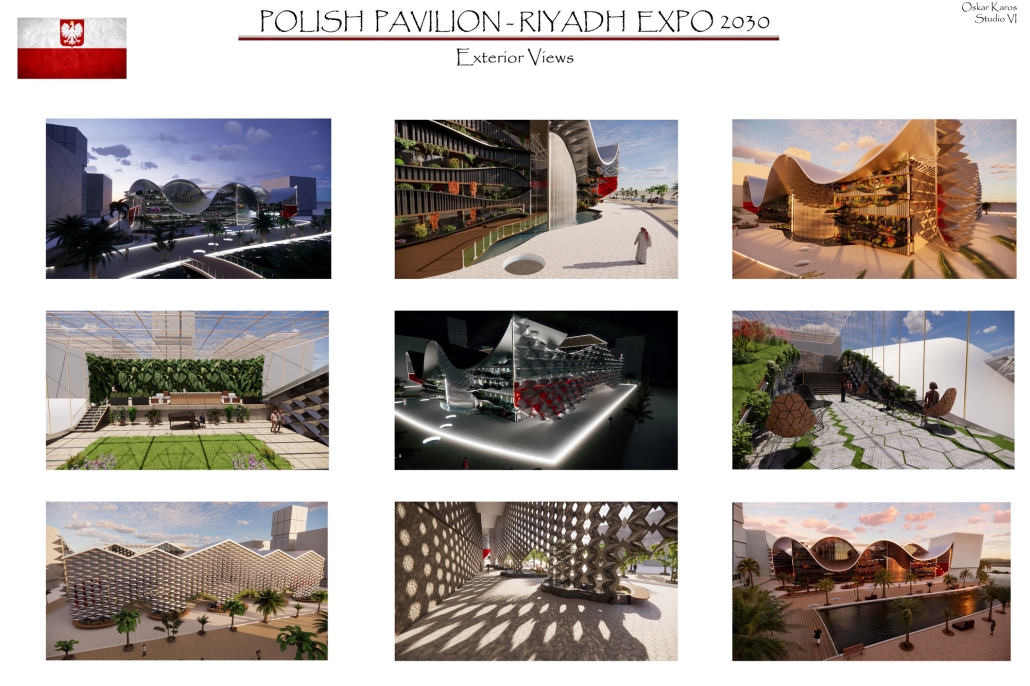
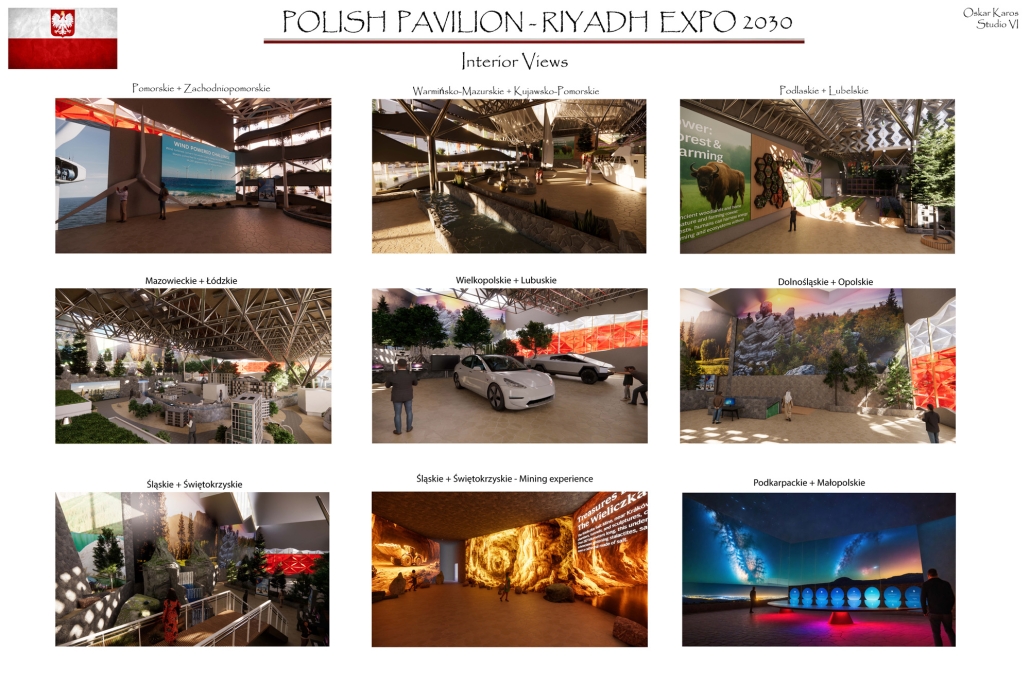
POLISH PAVILION – RIYADH EXPO 2030 by Oskar Karos, B.Sc. in Architecture ’25
University of the District of Columbia | Advisor: Golnar Ahmadi

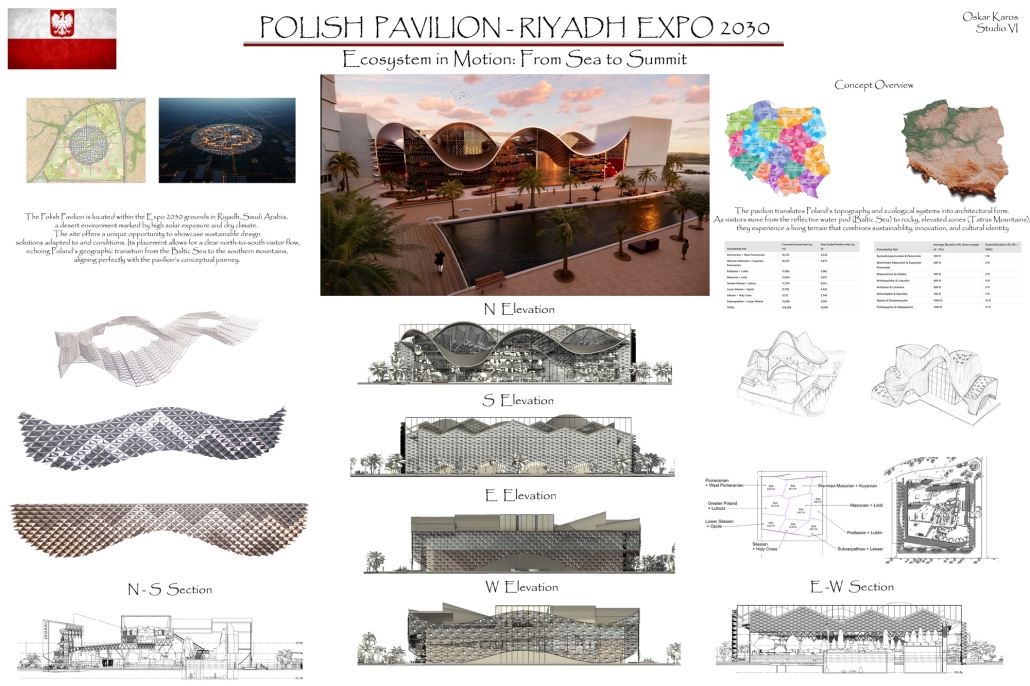
Set in Riyadh for Expo 2030, the Polish Pavilion reinterprets the nation’s geography and ecological identity through architecture. Designed as a living map of Poland, the pavilion invites visitors to journey from the southern Tatra Mountains to the northern Baltic Sea, experiencing the country’s topography, climate, and innovation within one continuous landscape. The project explores how architecture can embody an entire nation’s ecosystem, transforming exhibition space into a self-sustaining organism.

Poland’s diverse terrain—from its rugged mountains to fertile plains and coastal winds—inspired a spatial narrative divided into eight regions. Each represents two neighboring voivodeships, blending their natural and technological identities: wind power in Pomorskie, hydropower in Warmińsko-Mazurskie, sustainable farming in Podlaskie, and smart urbanism in Mazowieckie, among others. 

Visitors move northward along a symbolic Vistula River, linking interactive installations that demonstrate Poland’s leadership in renewable energy, circular economy, and ecological stewardship. Constructed with steel, wood, stone, and glass, the pavilion merges material authenticity with sustainability. A closed water cycle system replicates natural evaporation and rainfall, powering greenery and regulating humidity. The accessible green roof offers shaded paths and aerial views of Poland’s “living topography,” blending innovation with environmental harmony.

Beyond a national exhibition, the pavilion is a statement of coexistence—between people and nature, culture and technology. It celebrates Poland not through static displays, but as a breathing ecosystem where every element, from water to wind, participates in a cycle of renewal.

Instagram: @Golnarahmadi

Stay tuned for Part XI!

2023 Study Architecture Student Showcase - Part XV

Welcome to Part XV of the Study Architecture Student Showcase! Healthcare and Well-Being are the central themes of today’s highlighted student work. The projects below demonstrate how intentionality around design and architecture can support the well-being of society, playing an essential role in everyday life. Today, we dive into pieces that reinforce dwelling through spatial culture and reimagine architecture through the lens of a matriarchal community in rural Uganda. Viewers can explore project plans for a site in Puerto Rice that serves as a creative and cultural therapy center. And a classroom designed with adaptive design elements and sensory-friendly features to support neurodiverse and disabled students. Read on for more details!

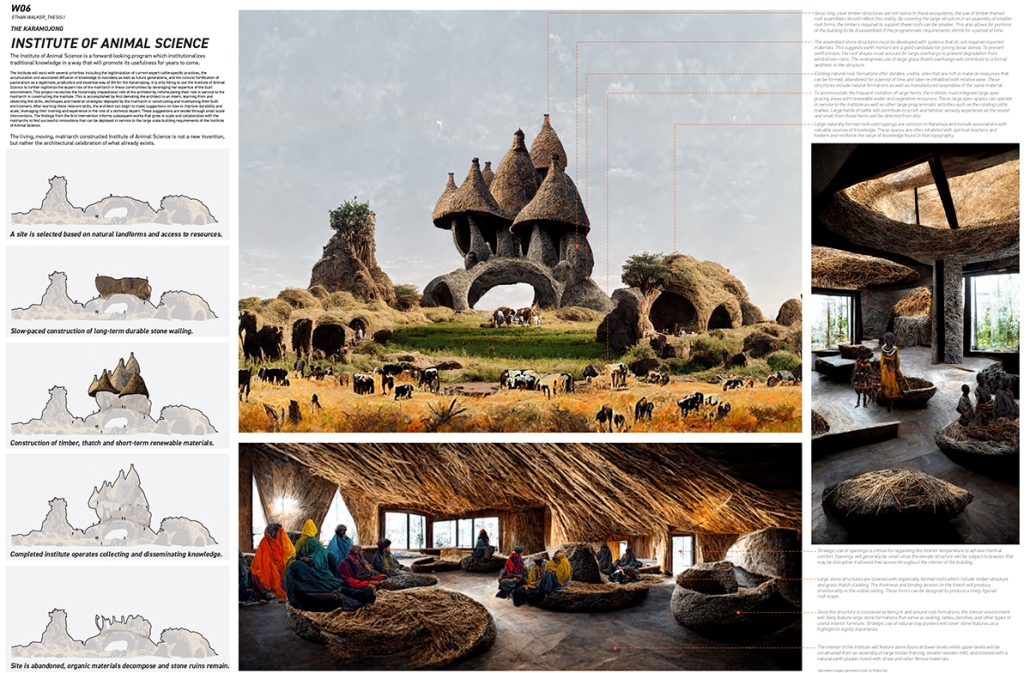
Made with Matriarchs: Crafting Heritage-Oriented Futures with the Karamojong by Ethan Walker, M.Arch ‘23
Lawrence Technological University | Advisors: Scott Shall (Committee Chair), Joonsub Kim (Member), and Edward Orlowski (Member)

In the rural northeast of Uganda, the ethnic Karamojong are experiencing unprecedented pressures to change their ways of life (Knighton, 2017). As semi-nomadic pastoralists, these peoples are dependent on the health of their herds which is contingent on the health of their ancestral lands. Studies show that land health has deteriorated due to climate change, overgrazing and lack of mobility producing a vulnerability context that has attracted international attention. Interventions by foreign actors and the national government have attempted to improve public health while making recurring calls to transform Karamojong culture away from pastoralism towards sedentism and farming (Dbins, 2013). While appropriate in particular cases, the overwhelming call to cultural transformation could be at odds with the capabilities of the land, potentially undermining the pastoral ways of life. These globalizing influences extend beyond policy-making and have fundamentally altered the process of architectural production and construction in the region.

In response, this thesis proposes an iterative, heritage-based approach to design and construction, crafted to mitigate the increasingly harmful effects of globalization upon the traditionally semi-nomadic societies of northern Uganda. In this approach, alternative futures are imagined by reconsidering the role of the architect in relation to the pre-colonial keepers of the built environment; the Matriarchs. When working within this alternative arrangement, architects would work responsively with Matriarchs, lengthening the process of interaction in favor of a responsive design methodology that strengthens the Matriarchs’ power of architectural self-determination. Strategies to equip pastoralist architecture with greater autonomy are imagined, proposed and filtered through a Matriarch-led process to determine what is appropriated, effective and ultimately in the best interest of their desired way of life.

Instagram: @ewalke_ , @scott_shall

This project was selected for the ARCC King Medal and won the LTU Deans Award – Best Project.

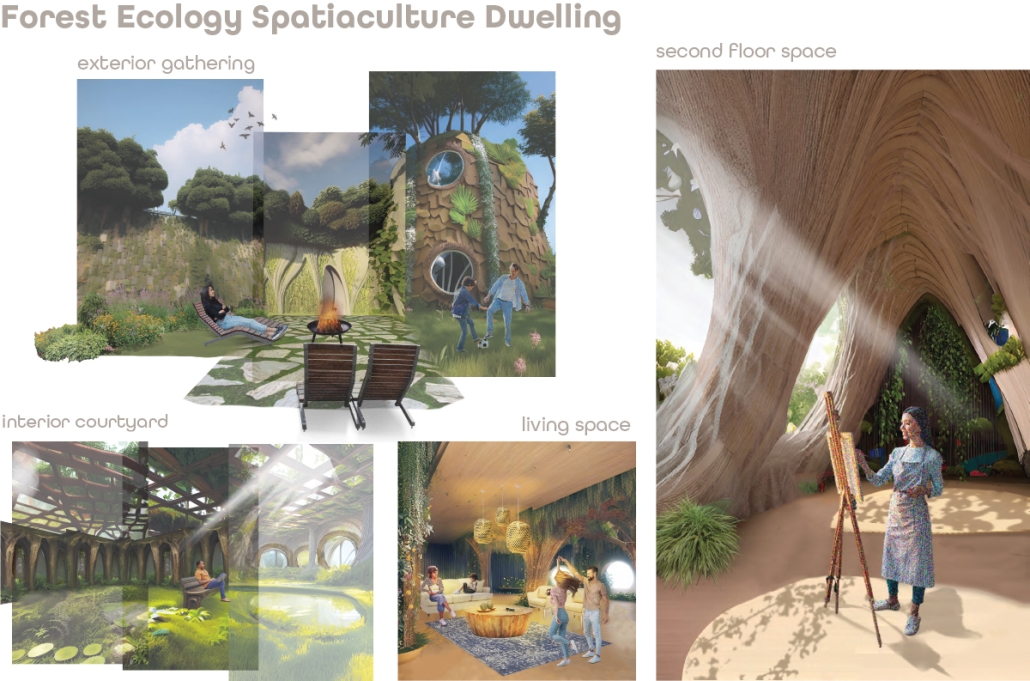
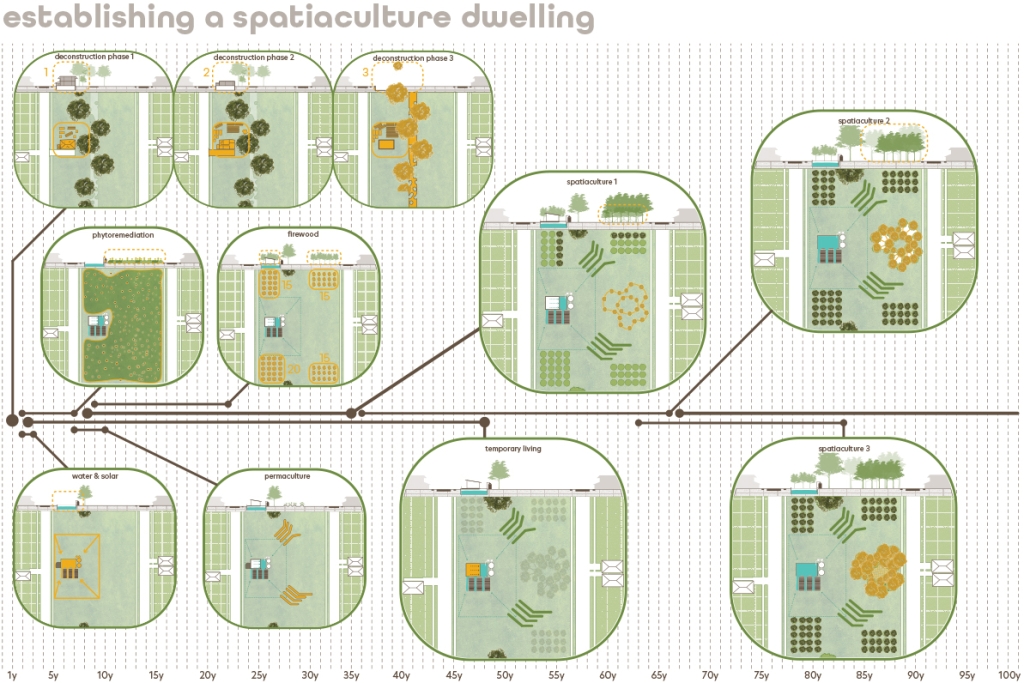
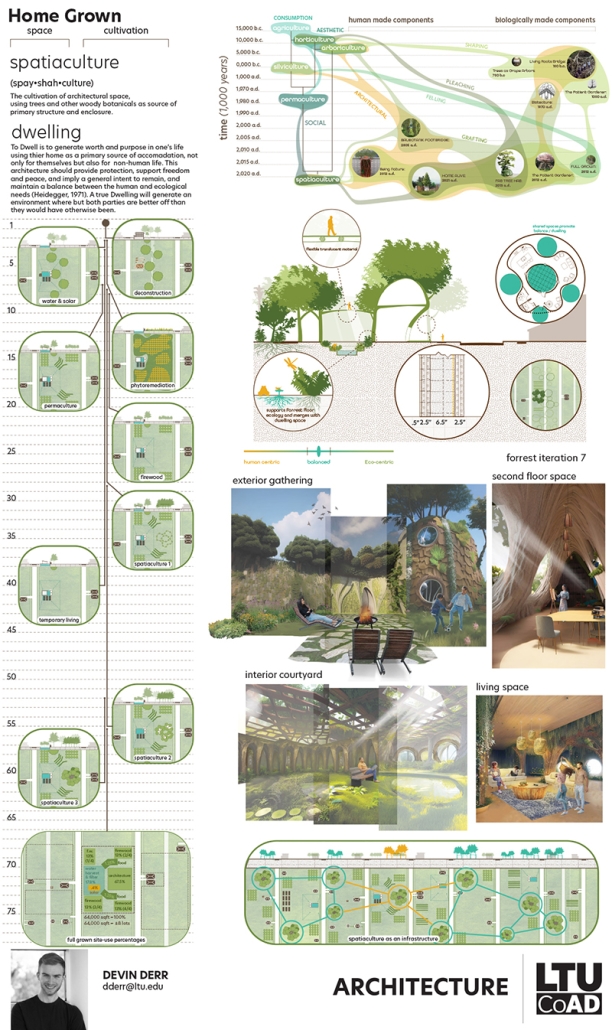
Home Grown: Reimagining Dwelling Through Spatiaculture by Devin Derr, M.Arch ‘23
Lawrence Technological University | Advisors: Scott Shall (Chair), Dan Faoro (Member), and Sara Codarin (Member)

To dwell is to feel at home in a space that: maintains nature (both human and non-human), provides protection, freedom, and peace, and implies a general intent to remain (Heidegger, 1971). To inhabit is to view both house and land as mere assets of monetary value. Without dwelling, people can feel uprooted or disconnected from their homes, and the home itself can disrupt or compromise the ecosystem that hosts it. Unfortunately, home design in the U.S. rarely makes dwelling a priority and often glorifies investment-centric metrics to increase profits and value of the land-stances that encourage inhabitation.

Dwelling not only demands a balance between human-created and naturally occurring environments, but also the simultaneous improvement of both. To achieve dwelling many ancient cultivation practices like permaculture, horticulture, silviculture, and arboriculture are necessary. These practices have a central focus on maintaining and improving natural environments because the benefits they reap directly rely on the natural environment’s well-being. If architecture leverages the 17,000 years of ecological knowledge that these fields have generated, then true protection, freedom, support, peace, and balance may begin to take root (Rasmussen, Wayne D., et al., 2022). Using trees and other living botanicals as a source of structure and enclosure, this thesis aims to trade inhabitation and its associated ailments for an architecture that is quite literally cultivated and alive. There is currently an imbalance of the built and natural environments caused by the commodification of land and architecture, which is best addressed with dwelling reinforced through spatial culture. To investigate this proposition, an extrapolative study of Spatiaculture Dwellings will be applied to several environment and ecosystem types and then analyzed on their performance using the qualifiers that define dwelling.

Instagram: @scott_shall

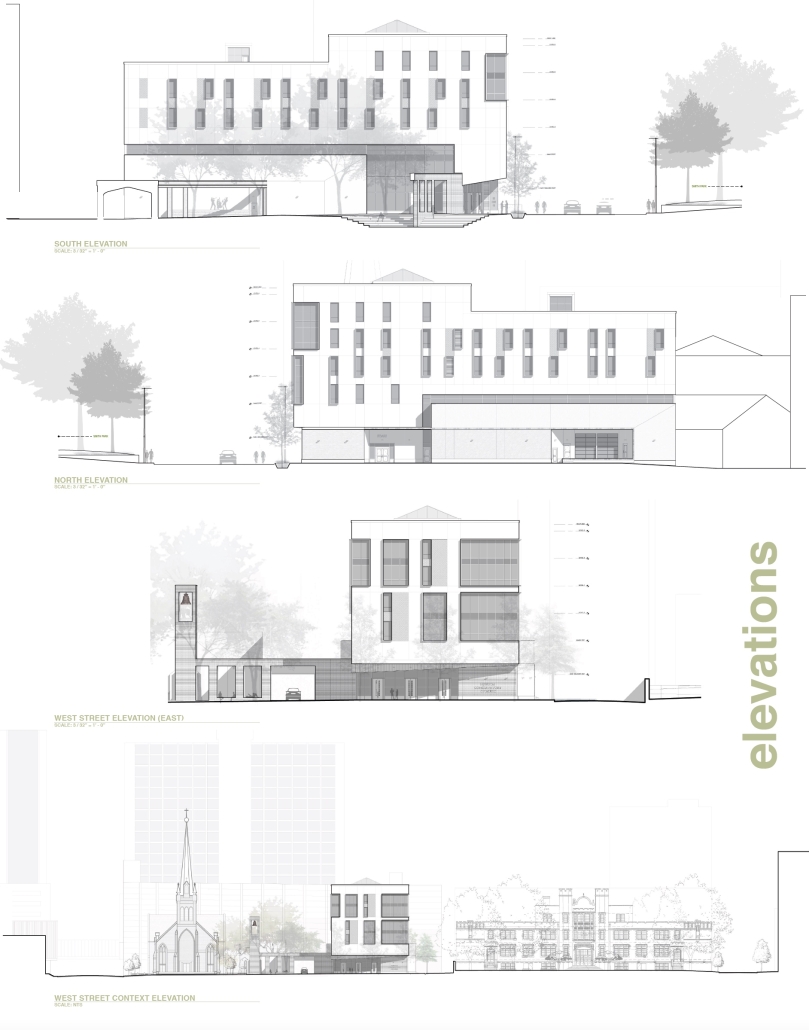
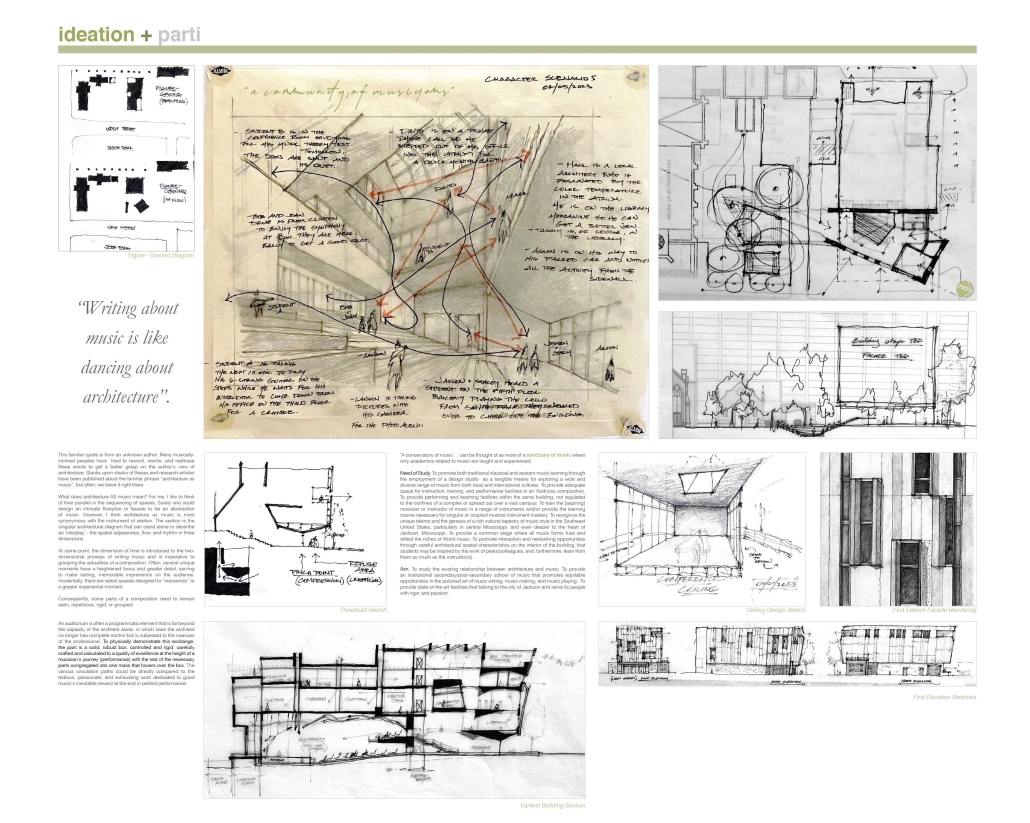
Newson Conservatory of Music by Jacob Lindley, B.Arch ‘23
Mississippi State University | Advisors: Jassen Callender and Mark Vaughan

I am fascinated with the analytical, poetic, and metaphorical connections between music and architecture. This can only resonate with someone if they understand how to read music. There are so many other connections besides simple scripting, though. Making one of those connections evident to people is important to me: so that more of the world can physically connect something that is so familiar in some genre or another [music] to the way we experience “city,” certainly a city that has a rich history in the blues music. I believe that our world needs more positive influence, particularly in the physical realm. I have and continue to believe that architecture can allow us to aid in the effort to foster positive environments. Architecture should enhance our planet and meet the needs of a society that will make a lasting impression for generations. This is my legacy. In humility, we walk and observe that around us to understand the psyche – that true reflection can be obtained through the simplest of measures.

Architecture should remind you who you are. Architecture is dependent upon the individual and the landscape as its sources of life. It should be a mechanism for empowering, and supportive in its greatest capacity of manifesting life – not only life physically, but life that is generated in the psychological realm too. The rituals of daily life inform the architecture of its role in that support, and, in return, the architecture celebrates the best in life, the individual.

This project was awarded the first place CDFL Capstone Travel Award

Instagram: @jakewlindley, @jassencallender

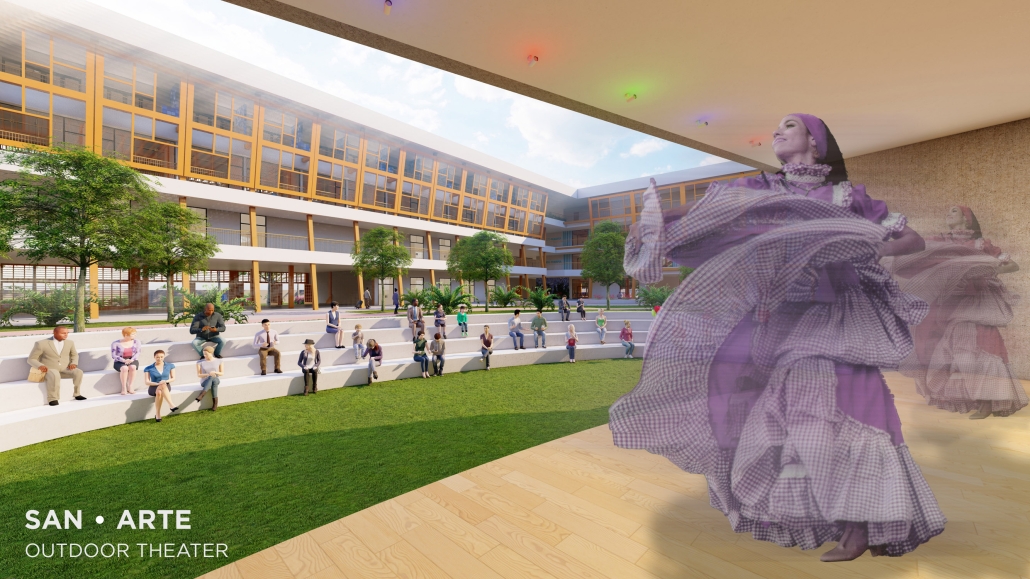
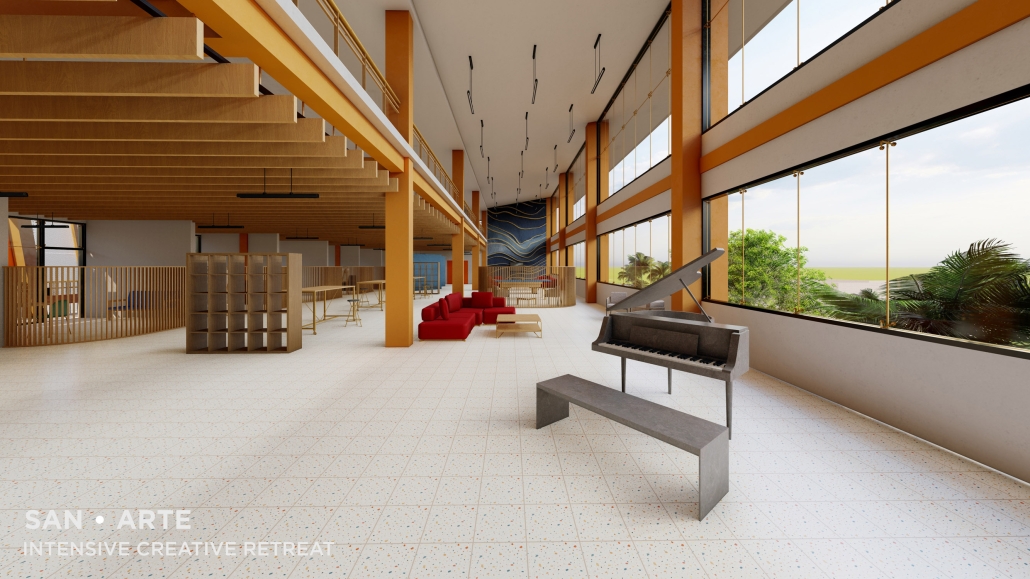
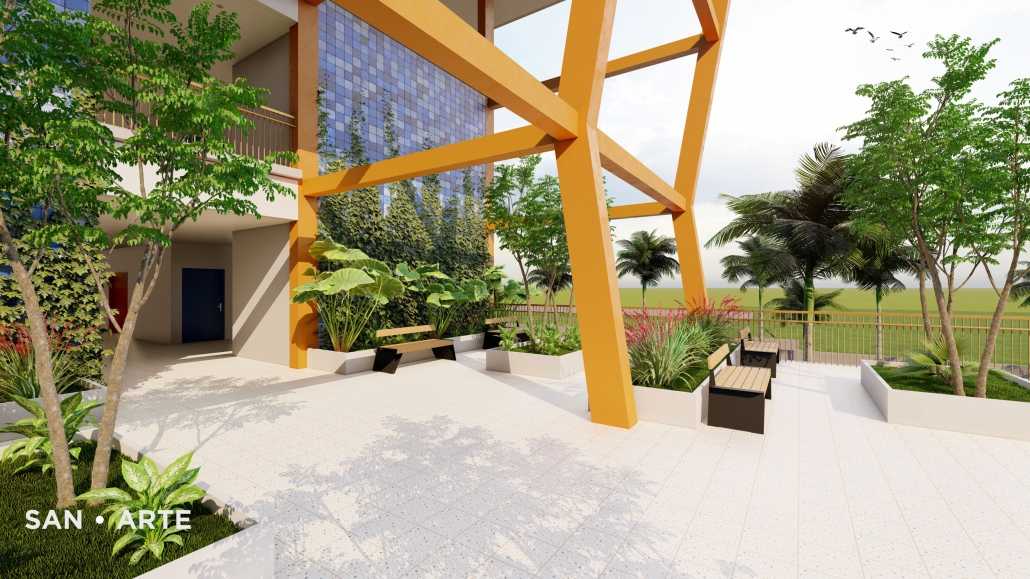
San・Arte: Art as a Healing Tool by Glorivette Correa, B.Arch ‘23
Pontifical Catholic University of Puerto Rico | Advisors: J. Omar García Beauchamp & Pedro A. Rosario-Torres

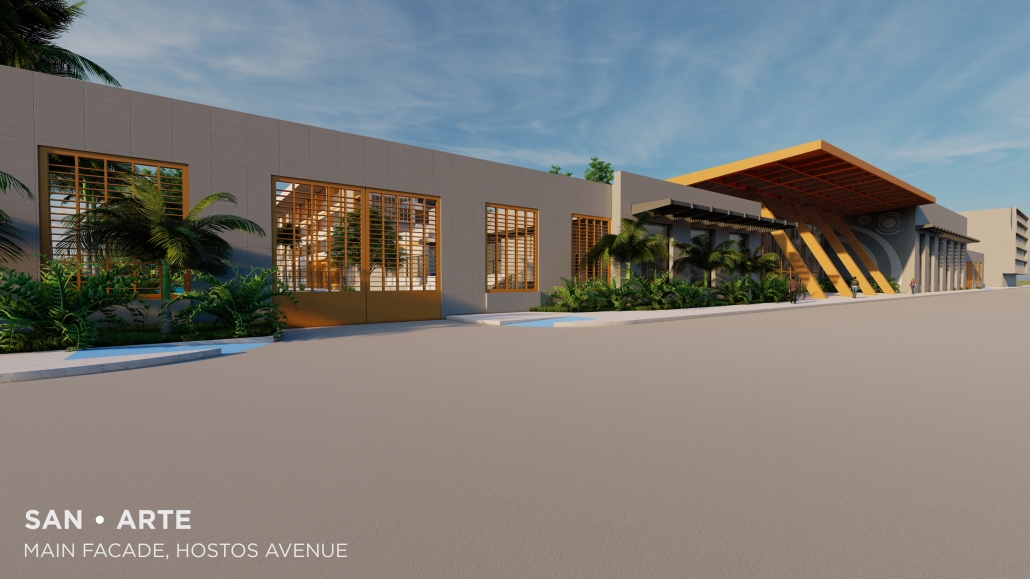
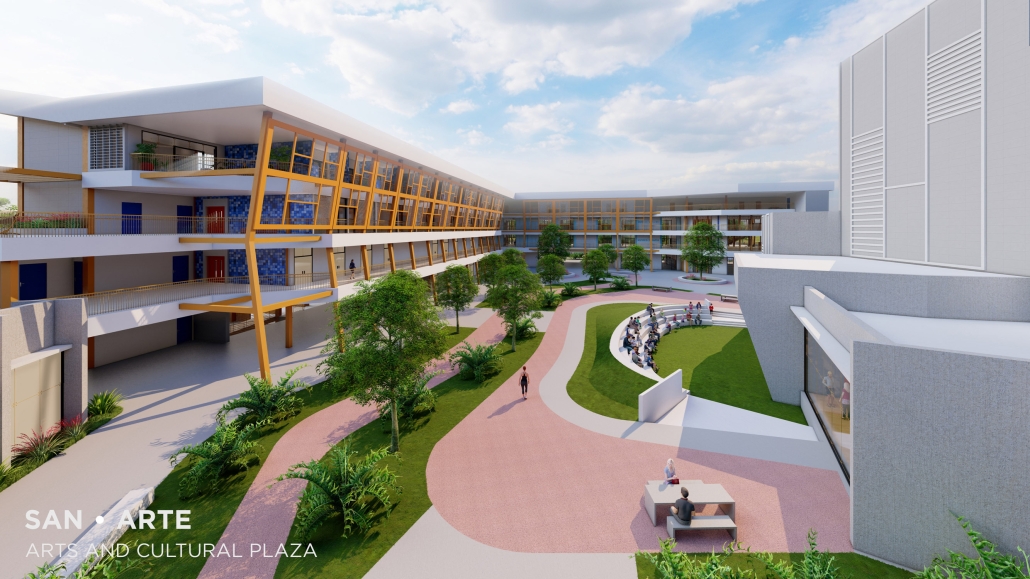
The global mental health system is deteriorating, so much so that a large part of the population suffering from a mental disorder does not receive the necessary treatment or any type of help, due to lack of information, insecurity, fear of discrimination or lack of services. While the population served is limited to a general traditional treatment, which in many cases is not the help they need. For this reason, the objectives of this project are to expand the traditional medicine market, by developing new spaces that focus on providing other treatment alternatives (such as artistic-creative therapies), and explore the architectural capabilities that can be achieved together with art and nature, to meet the appropriate conditions in a space to provide these therapies.

This project focuses on the island of Puerto Rico, specifically in the town of Ponce. San・Arte’s proposal aims to develop a center focused on arts, culture and healing. A Cultural and Artistic Creative Therapy Center is then created to positively serve the community and the people. A place that helps raise awareness and educate people about mental health. The center offers four different therapies: art therapy, dance-movement therapy, music therapy and drama therapy. The center also has spaces for artists, theater (indoor and outdoor), and an intensive creative retreat which serves as a safe space away from everyday life and where professionals or those who attend (not necessarily artists) can once again feel inspired, motivated and creative. The center also has different green areas such as terraces and an aromatherapy garden, thus providing different semi-public and semi-private spaces. The number of people who need psychological assistance continues to grow. The arts are an excellent communication tool that also helps us to connect with other people and that is what this proposal seeks.

Instagram: @glorivette_correa

Designing Outside the Lines for Neurodiverse Children by Monica Higbee, M.Arch ‘23
University of Idaho | Advisor: Hala Barakatu

The number of children with developmental disabilities or that are neurodiverse that live within the United States is a rising number. Children aged 3 through 17 are stripped of equitable opportunities within early learning environments and are often filtered through the education system with little to no accommodations for learning or independence in the built environment.

My aim for this project is to systematically identify adaptive design elements and sensory-friendly features that can improve the average classroom and promote independence for individuals with disabilities or who are neurodiverse in the built environment. In doing this, I also aim to find and develop a learning environment that changes the negative attitudes towards disabilities and teaches others how to better adapt the built environment to everyone regardless of ability or disability.

Instagram: @monicahigbee, @halahb2

Architectural Neural AgilityVisions of Architecture through SensationPerceptionand Self by Skyler Howell, M. Arch ‘23
University of Idaho | Advisor: Hala Barakat

How do we know that our fundamental beliefs of this world are our own? The problem is that the lack of “freedom of will” influences our neurological synaptic pathways; these pathways are strengthened or eliminated passively based of our individual experiences. Frascari was hinting at this notion when he stated, “Just as we think architecture with our bodies, we think our bodies through architecture.” Our vision of reality exists through our nervous systems ability to sense and perceive our environment. Paying attention to perceptions makes way for our nervous system to produce conscious or unconscious thoughts; thoughts can provoke emotions, and exists not only within the present, but memories of the past, and visions of the future. 

This project explores the way our nervous system builds reality through sensations like sight, touch, hearing, and smell while filtering stored object-oriented information known as “schema.” According to Edelman, “Our neural networks are a deeply embodied phenomenon that leads to architectural genesis.”


In order to break free from traditional architectural design-thinking, this project proposes a new vision of architecture by actively stimulating neuroplasticity. We need to evoke our nervous systems’ ability to adapt through deliberate actions allowing architects to break free from our existing paths. Translating the architectural design-thinking process by creating new models of an action-oriented “architectural neural-agility” within architectural-genesis.

Instagram:  @ponyboysky, @halahb2

Communal Healing by Tanner Mote, B.Arch ‘23
Ball State University | Advisors: Robert Koester and Sarah Keogh

Younger generations want to live in cities and yet most neighborhoods are afflicted by limited housing choices, disconnection from food sources and public transportation, and often are also dangerous environments for pedestrians. These problems have made existing neighborhoods undesirable. So, how can neighborhoods be systemically redeveloped to address current concerns so that they don’t become exacerbated in the future?

This project proposes the strategic implementation of infill housing and urban food production in the redevelopment of existing neighborhoods. The McKinley neighborhood in Muncie, Indiana was chosen as the location to test this thesis. Initial designs create additional housing that offers different living opportunities, from single-family dwellings to accessory dwelling units. Each design enables
residents to grow their own food via raised beds or vertical towers in an incorporated greenhouse. The ability to be self-sufficient and the visibility of food production will educate and inspire the community and promote continued progression toward sustainable living. Later phases could provide the neighborhood with varying scales of community spaces such as shared gardens, food markets, and education centers to attract and support community members. These latter phases will also have to address existing patterns of public transportation and correlated pedestrian paths for better connectivity.

See you next week for the next installment of the Student Showcase!

2023 Study Architecture Student Showcase - Part XIV

Welcome to Part XIV of the Study Architecture Student Showcase! Today, we take a look at projects that use architecture as an avenue to convey philosophy and storytelling. Inspiration for these pieces ranges from renowned filmmakers and unfinished architectural projects to the study of fluids and memory as a sense of home.

We hope you enjoy this collection of student work and come back next week for a new installment.

A Machine for Living: Re-Provoking the Slow House in Contemporaneity by Russell Harman, B.Arch ‘23
Syracuse University| Advisors: Iman Fayyad, Kyle Miller, and Edgar Rodriguez

A Machine for Living is a thesis that aims to re-provoke Diller + Scofidio’s “Slow House within Contemporaneity.” 

The project began in 1989, but construction stopped shortly after breaking ground due to the client’s own financial limitations. The project took on a new life through its representation when it later debuted for a lecture at Columbia in 1991, which ultimately led to its success and acclimation. 

The site still remains undeveloped, and for the argument of this thesis, the palimpsest of the original construction still exists on the site, making it readily available for a new provocation of what the home could be. 

Similar to the ways that OMA’s exhibition of “La Casa Palestra” offered new readings of the Barcelona Pavilion, this thesis aims to be a contemporary counterpart to the original Slow House.

The plan of the Slow House follows two curves and moves the occupant from the automobile to the view as seen in the picture window juxtaposed to the television screen. It is simply “a means to an end.” 

Deforming the original plan changes the relationship between the occupant and the home. 

A number of possible homes and narratives emerge through iterating the parameters of the home, making the design of Diller + Scofidio one of many that could be derived.

The ultimate one (the provocation of this thesis) becomes enveloped in itself so that the occupants are confronted with being trapped in the cycle of their inhabitance, longing for an escape. It becomes “a means with no end,” or “a means to an end that never ends.” 

The home becomes a composite of its history. And the home itself offers the potential for multiplicity in experiences or a non-singular narrative. 

The two homes thus engage in conversation with one another. This provocation of the Slow House in 2023 is in many ways both a commentary and critique of that from 1991. Their engagement with one another becomes amplified in understanding contemporary domesticity. Through their comparison, the two designs re-invigorate the potential for what the home could be on this vacant site, both in the past and in the present. 

This thesis project won the Syracuse University School of Architecture 2023 James A. Britton Memorial Awards Citation for Excellence in Thesis Design.

Instagram: @rjharman_, @i.fayyad, @projectif.space, @kylejamesmiller, @edgararl

Atlas of Memory: The Representation of the Invisible in Architectural Drawings through Generative Coding by Julia A. Lopez, M. Arch ‘23
Arizona State University | Advisor: Elena Rocchi

Architecture serves as a medium through which our worldview and memories find expression, capable of evoking emotions, silence, and discovery. Within architectural spaces, memory acts as a guiding reference, enriching our understanding of spatial awareness. Inspired by Giuliana Bruno’s “Atlas of Emotion,” Julia Lopez embarked on a transformative journey for her capstone project, seeking to discover her own personal narrative and construct an atlas of memories through the exploration of composition and connections. This endeavor aimed to transcend the limitations of language and discover a visual language of emotions and images that could bridge the gap between people and their invisible memories and dreams, ultimately breaking down barriers.

The research question focused on understanding how to represent the invisible realm and manifest hidden memories and dreams using storytelling, sketches, AutoCAD drawings, and generative coding.

The project began with a comprehensive study of Andrei Tarkovsky, a renowned filmmaker fascinated by the representation of the unseen and the intangible, imparting a distinct presence that shaped the poetic and spiritual essence of memories. Through an analysis of Tarkovsky’s work, the student observed his skill in using light and shadow to evoke stillness and hint at dimensions beyond the visible world of memories. She also discovered his ability to bring attention to imperceptible elements, such as the movement of objects, effectively conveying the distortions of dreams. Building upon her architectural perspective, the project unfolded in two phases, with drawing serving as the core methodology.

In Phase 1, the student explored how to incorporate architecture and the invisibility of memories through storytelling, aiming to forge a new language within the field. Phase 2 delved into advancing architectural representation through generative coding. Leveraging the p5.js script library and TouchDesigner, she created interactive visuals based on narratives, expanding spatial representation through data points. This innovative approach made the invisible visible, enhancing the representation of memories.

Throughout the process, the capstone project took a personal turn as the student documented her grandmother’s life transition and the various states of consciousness she experienced. Considering this as an authentic experiment, she observed her grandmother’s moments of hallucination and integrated her own drawings into the coding program. This generated data points representing her grandmother’s memories, including those recorded during her unconscious moments. By incorporating these sketches, the student aimed to transform them into tangible forms, capturing invisible memories and bringing them to life through drawings and a 5-minute movie.

This project won the TDS Design Excellence Award.

Novel Natures Within Itself  by Cherie Wan and Changzhe Xu, M. Arch ‘23
University of Pennsylvania | Advisor: Simon Kim

There is an architecture that travels within Los Angeles. The building has two states: it collects and it curates. The homunculus’ emergence in the landscape of Los Angeles’ urban fabric began its role as a collector. As it traverses across disparate environments, it collects human waste materials that make up its own body and functioning system. The body is an incubator for a new world. As it accumulates material, new hybrid environments are created until it no longer has the capacity for it. When it reaches this state of death, it deposits new hybrid environments where novel natures are ultimately curated. This cycle repeats itself for as long as civilization persists. Through the lens of homunculi, we are reminded that we must find new, critical ways to reflect on the architecture and monuments we have inherited and to imagine those we have yet to build.

This project was featured in the Fall 2022 Pressing Matters Publication.

Instagram: @cherie.arch, @changzhexu

Fluid Motives: Experimental Connections by Sterling Jones, M.Arch ‘23
University of Idaho | Advisor: Hala Baraka

The study of fluids in motion reveals the open-ended process of becoming, ranging in size from astronomical to atomic. The understanding and depiction of fluids has intrigued many artists and scientists, but its pivotal beginnings belong to Leonardo da Vinci, who documented the foundations of many now-accepted theories and principles centuries before their societal realization. Da Vinci’s methods of thinking, experimenting, and drawing embody a dynamic process of work integral to architecture and visual communication, and it may be his study of fluids that aided in his inventions and was responsible for his underlying genius. Fluid’s natural lack of a boundary creates connections between surfaces, disciplines, and thinking, as well as a framework that relies on other components and interfaces for it to be understood. The study of fluids’ influence on architecture is pinnacle and unrealized as architecture deals often with conceiving a whole made up of many constituent parts. 

Architecture is the convergent reality of divergent design explorations and relies on innovation and the radical repurposing of technology, taking the idea, concept, tool, or method from one intended purpose and using it to address another. “The essential nature of matter lies not in objects but in connections,” and fluid not only generates through transformation and reaction, but also destroys through breakdown and decay. Applying a system of understanding to fluids underlines conceptual frameworks for problem-solving and solution-adapting in both design and operation. A number of fluid experiments and graphic mediums are explored to better understand, visualize, and realize fluid studies’ architectural applications.

This project won the King Medal’s Award.

Instagram: @Sterlingstratfordjones, @Halahb

Composing Persona by Francesca Picard, M.Arch ‘23
University of Southern California | Advisor: Ryan Tyler Martinez

In this thesis, architecture is explored through the lens of persona. What if buildings are just as much of characters in the built environment as the people who occupy them?

This study will explore two main determinants of a building’s persona; form and materiality. The form is seen as the body of a building; its frame, posture, and overall presence. Just as we define characters by their physique, buildings are characterized by their form. Materiality offers another layer of characterization to buildings, through properties of patterns, colors, and textures. Analogous to a character’s wardrobe, materiality defines persona in architecture through ensemble. Together, form and materiality are the elements that propose the tone and character of buildings, not only to people but to their surrounding environment. What happens when these characters interact? How do their personalities communicate with one another?

Intertextuality refers to the idea that every text is in dialogue with other texts, which provides a dynamic, shifting context of meaning. This study aims to investigate the intertextuality of architecture, with a focus on persona. With collage as a way of working and a nod to the exploration of intertextuality, compositions of both form and materiality will be created. These resulting personas will be asked to interact with each other, just as the buildings architects design are asked to speak to their surrounding contexts. Through this exploration, a dialogue on persona in architecture will develop.

This thesis project won the USC Master of Architecture Disciplinary Advancement in Directed Design Research Award – In recognition of the most outstanding graduate final degree project illustrating a critical position that advances the discourse of the architectural discipline.

Instagram: @francescapicard, @ryantylermartinez

Magic of the Real by Nickolas Witt, B.Arch ‘23
University of Arizona | Advisors: Christopher Domin (studio coordinator), Laura Hollengreen, and Jesus Robles

STUDIO PEDAGOGY

This research cluster seeks to enhance our understanding of light scientifically, technically, and culturally so that we conceive of it as more than that which reveals the “masterly, correct and magnificent play of masses.” It is also something that has physiological, psychological, and affective impacts on us while operating within a dynamic environmental economy of atmospheric and energy conditions. At the same time, the light that accompanies heat can be searing, increasing water evaporation, desertification, urban heat island effects, and other deleterious environmental effects.  The ethical and humanistic dilemmas this causes and the inequitable distribution of impacts across countries and populations are pressing issues to be addressed by designers and policymakers.

THE EXPERIENCE OF ARCHITECTURAL ATMOSPHERE (project narrative)

In architectural design, “atmosphere” refers to the overall sensory and emotional experience created by a building or space. It encompasses a range of factors such as lighting, materiality, color, texture, scale, and sound, which all work together to create a particular mood or ambiance.

Atmosphere is a critical consideration in architectural design, as it can significantly influence how people experience and interact with a space. For example, a space with warm lighting, soft textures, and natural materials may create an inviting atmosphere, while a space with bright lighting, hard surfaces, and artificial materials may feel more sterile and clinical. Architects often employ atmospheric design strategies to create specific emotional responses in people who use or visit a space. This can include using materials and colors that evoke a certain feeling or controlling the amount and quality of light to create a particular mood. Overall, atmosphere is an important element of architectural design, as it can greatly impact how people perceive and interact with a space. By carefully considering the atmospheric qualities of a building or space, architects can create environments that are both functional and emotionally engaging.  As we design for the present, and the future, we must consider the atmospheres of space and architecture’s lasting impact.

This project received the University of Arizona: School of Architecture Capstone Award and the Rick Joy Award: The Generous Mind.

House(s) of Tethered Fragments, a Consideration of Embodied Images for Memories and Daydreams by Ashley Skidmore, M.Arch. ‘23
The University of Texas at Austin | Advisors: Professor Elizabeth Danze and Professor Kevin Alter

This thesis is a phenomenological and poetic exploration of the relationship between memory and place as it relates to a sense of home. My interpretation of this relationship assumes that memory is held by both the human inhabitant and architecture itself. The former is more straightforward and has been well-trodden by phenomenological writers such as Juhani Pallasmaa and Peter Zumthor, and captured in the paintings of Andrew Wyeth. 

This project is derived not only from an interest in exploring the different impetuses for memory but is also a study of the archetypal images of space carried in the collective unconscious, and how those images drive humans to embody and inhabit a place. These archetypal notions – primordial, fundamental, and deep-seeded – imbue spaces with preconceived, self-evident meaning. By incorporating these interpretations into the design of a house, I am emphasizing the role that home has as a character in the story of a life, and a generator of memory. 

From Jung’s “Man and His Symbols and Bachelard’s Poetics of Space,” I have derived nine archetypal spaces or elements embedded in the home: thresholds, doors, passageways, stairs, cellars/attics, hearths, water basins, nests, and niches. These spaces are consequently frameworks through which to consider how people inhabit their homes through the body – musing on what moments, artifacts, and spaces they attach themselves to. This approach is formed through a deep reading and sympathy for the imagined resident. By deriving spatial images from archetypal notions in the stage-set of a home, it will reveal how impulses for inhabitation are simultaneously individual and more collective. Through this lens, my question is: How can a home be designed to augment these interactions, and cultivate memory, daydreams, and meaning? 

My project is an approach to designing a house by creating a series of vignettes that explore and encourage the embodiment of the identified archetypal spaces. These vignettes are tethered together, or ordered, by the application of specific site constraints. The intention is to suggest that the desires of each room, and the relationships therein, precede any contrived diagram or ordering principle.

St. Vitus Reimagined by Izzy Brehm, M.Arch. ‘23
University of Nebraska–Lincoln | Advisor: Zeb Lund

This project reimagines a small, architectural detail as an occupied landscape for small creatures. It is an exploration of process and an attempt to reimagine how we design space. Depicted in this drawing is a species of small creatures, who have evolved to occupy a man-made column and manipulate it to fit their needs. Taking advantage of the column’s verticality, they have evolved to climb rather precarious surfaces, carve space into stone, anchor into flat facades, employ vertical farming, and cohabitate with bugs and insects. The form of the drawing was inspired by a gothic column at St. Vitus’s Cathedral.

Bigness by Fangshuo Zhao, M.Arch. ‘23
University of Southern California | Advisor: Ryan Tyler Martinez

The one ending of Modernism is Heroism. This should be a dead end with no further believers.

Only if the prosperity and miracle of growth are shut by the miserable reality. Based on the background that social democracy/democratic socialism is losing the battle to Populism and Neoliberalism.

And then, the plague, the unrest, the witch hunt, the populism, the Strongman, the totalism, the authoritarianism, the anarchism, ……

This is the history, but also the actuality.

Heroism as a manifesto and a paradigm evolving from modernism, is being consumed and evolved into a new mutation/variation: Post-Heroism. 

My thesis starting point is not the Heroism Architecture in the past, but the relationship between the old and new heroism, and how this changing relationship could lead to a new form. It is a form that accommodates the mix of force and the cluster of programs.

The two points that define post-heroism are “bigness” and “public Thermae model”. I think “bigness” is becoming more important, especially in this virtual and AI period. Inside the bigness, there will be a magnet to make people get closer, and will be possible to contain more programs, activities, and problems physically. More civic, living, leisure, and culture programs will serve as a modern Thermae, a modern public bath. And Post-Heroism will be the formalism index or paradigm of it.

This project received the USC Master of Architecture Excellence in Directed Design Research Award – In recognition of the most overall outstanding graduate final degree project 

Instagram:  @adamzfs, @ryantylermartinez

Monster Generator by Rose Vito, M.Arch. ‘23
Lawrence Technological University | Advisor: Masataka Yoshikawa

This project started off with a few questions to ponder – do you dream about waves? And do you know what meanings embed your nightmares?

This project began with the cabinet of curiosities. Because of the qualitative nature of this interest, rather than put together a cabinet, I collected objects that had the specific geometries that I could use to tell a story, and the “cabinet” almost immediately took the form of a sculptural representation of human emotions impacted by dreams, which then morphed into what I am calling the Monster Generator.

The background research that went into this work came from the fields of psychology, literature, mythology, and seismology. Literary characters such as Dracula, Frankenstein, and Jekyll and Hyde were developed based on the author’s nightmares. 

As you will see soon, The central images generated were inspired both by these literary works as well as some of my own nightmares. How do they make you feel?

The components of the monster generator are the good which represents the adrenaline of the dreamer which powers the generator. The goo powers the machine and turns the propellers that process the ingredients.

The ingredients include structures that represent proteins, vitamins and minerals, cages for animals, and nets that have captured bugs. I thought it was fun to show the bugs escaping and to pose the question – what happens when the bugs escape?

As the person dreams their adrenaline (goo) displaces the parts of the machine. The seismograph-like structure measures the level of adrenaline and translates the memories, experiences, hopes, and desires into the dream catcher.

Dream catchers catch the bad dreams as they are translated through the fins. The machine struggles to keep up with the constant influx of memories and is in a constant state of regeneration as the dream catchers are used and broken down. As the machine regenerates it evolves and the antiquated seismograph system begins to be replaced with the more modern accelerometer system. This evolution is causing inconsistencies in generator functionality. The system malfunctions and the monsters constructed in the Central Images are more than only alive in dreams.

The Central Images are released from the dream catcher. These elements create the emotional center of the dream or, what is called in psychology, the Central Image – is the “best-remembered” and “most powerful” part of the dream. If we are frightened by our memory of the qualities of the Central Image we label it a nightmare. The Central Images are meant to spark your imagination. The scariest monsters are the ones in our own minds.

Instagram:  @ltu_coad

See you next week for the next installment of the Student Showcase!

Architectural Filmmaking and Storytelling with Ian Harris

Frame by frame, moment by moment, we record the world around us through our senses. We experience the warmth of light through a window, the sound of our footsteps in a hallway, the texture of a handrail, the aroma of something cooking in the kitchen. These senses create the full experience of the spaces we inhabit. They each play a role in the story of the space that we occupy. With the technological advancements in creating and distributing video we now have a way to tell the story of a design, the imagined or realized space can come alive at 24 frames per second. In the profession of architecture, video provides a new way of communicating the experience of the spaces and places designers create for those that may not be able to experience them first hand.

StudyArchitecture met with Ian Harris, director of Archiculture and co-founder of video production agency, Arbuckle Industries, to chat about teaching video to architecture students as a way to expand the way they think and talk about design.

Preparing to interview David Rockwell of Rockwell Group

Read more